
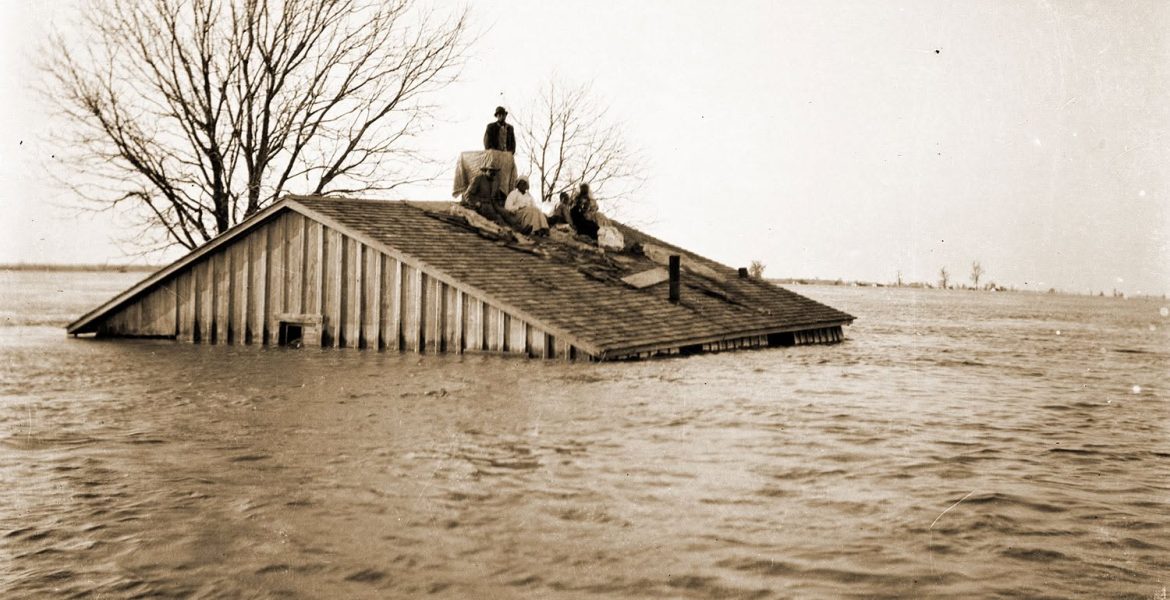
Editor’s note: What were the deadliest floods in Texas history? This guide examines 10 of the worst flooding disasters ever recorded in Texas, including the 1900 Galveston hurricane, the Corpus Christi hurricane of 1919, the 1921 Central Texas flood, Hurricane Harvey and the 2025 Texas Hill Country flood. Together, these historic coastal storms, river floods and flash floods claimed thousands of lives and destroyed communities across the state.
Texas’ deadliest floods are usually remembered in inches of rain, infrastructure damage and death tolls. The stories that follow center on the people caught in them and the decisions they made as the water rose and time ran out.
At St. Mary’s Orphan Asylum in Galveston, the sisters cut a clothesline into pieces and used them to tie the children to their waists. Near San Angelo, Zemula Metcalfe had an opportunity to escape the flooding at Ben Ficklin, but she would not leave her mother behind. More than a century later, four children climbed into a borrowed van with their great-grandparents as Hurricane Harvey flooded Houston. The family reached Greens Bayou but never made it across.
Katy Christian Magazine arranged these 10 disasters broadly by reported deaths. The precise order remains uncertain for several of the earliest floods because records are incomplete and historical accounts sometimes give different totals.

1. The 1900 Galveston Hurricane: The Sisters Refused to Abandon the Orphanage Children
Death toll: An estimated 6,000 to 12,000 people, with approximately 8,000 commonly cited

St. Mary’s Orphan Asylum on the Galveston beachfront shortly before it was completely leveled by the catastrophic 1900 Galveston Hurricane. Photo courtesy of the Sisters of Charity of the Incarnate Word, Houston / Rosenberg Library, Galveston, Texas.
The sisters at St. Mary’s Orphan Asylum had long used the Catholic Marian hymn “Queen of the Waves” as an evening hymn. On Sept. 8, 1900, as Gulf water crossed Galveston Island and climbed around the orphanage, they gathered the children and sang it again.
The asylum stood west of the main city, close to the Gulf and exposed to the storm. As conditions deteriorated, the sisters moved the children into the girls’ dormitory, which they believed was the stronger of the two buildings. Water soon covered the first floor, forcing everyone upstairs.
The sisters then sent orphanage worker Henry Esquior to collect clothesline rope. They cut it into lengths and tied the children to themselves in groups, hoping the arrangement would keep the smaller children from being swept away if the building failed.
The building did fail.
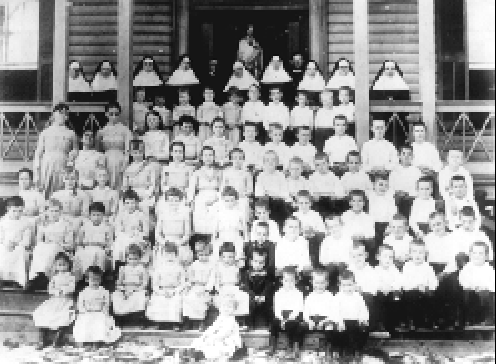
The Sisters of Charity and children of St. Mary’s Orphan Asylum on the steps of the dormitory shortly before the catastrophic 1900 Galveston Hurricane, which claimed the lives of all 10 sisters and 90 of the children pictured. Photo courtesy of the Sisters of Charity of the Incarnate Word, Houston / Rosenberg Library, Galveston, Texas.
The dormitory was lifted from its foundation and collapsed in the storm. Ten sisters and at least 90 children died. Three boys; William Murney, Frank Madera and Albert Campbell; escaped and found refuge in a tree. Their survival is why we have a description of the final, heroic actions of the women and children inside.
The orphanage was one small part of an islandwide catastrophe. A storm surge estimated at approximately 15 feet swept across land whose highest natural elevation was less than 9 feet. Houses broke apart, and their lumber became moving debris that struck other buildings. Bridges and telegraph lines failed, leaving Galveston isolated.
A complete list of victims was never possible to compile. Entire families disappeared, leaving nobody to report some individuals missing. Modern estimates generally place the death toll within the wide range of 6,000 and 12,000, and regardless of the exact number, the storm was the deadliest natural disaster in United States history.
The destruction continued after the hurricane left the island. As explored in Katy Christian Magazine’s history of the 1900 hurricane that nearly wiped Katy off the map, the storm damaged or destroyed nearly every improvement in the young prairie town.
Galveston rebuilt behind a new seawall and raised large portions of the city. The orphanage was rebuilt farther inland. The sisters’ clothesline became one of the storm’s most enduring memories because it recorded their final moments of heroism and dedication to the small children in the face of nearly certain death.
2. The 1919 Corpus Christi Hurricane: The Boy Who Survived and Studied Storms for a Lifetime
Death toll: 284 officially recorded; the National Weather Service estimates that 600 to 1,000 may have died
Six-year-old Robert Simpson lived with his family in Corpus Christi’s North Beach neighborhood when the Gulf began pushing into the city on Sept. 14, 1919.
The family left North Beach and reached the Nueces County Courthouse, a substantial building on higher ground overlooking the flooded district. From its windows, Simpson watched people struggling in the water below.
The storm had reached the Texas coast with sustained winds estimated at 115 mph. A surge of approximately 16 feet entered Corpus Christi Bay, while water reached a depth of about 11½ feet in parts of downtown. North Beach was devastated. Homes broke loose or collapsed, and people were swept into Nueces Bay.
When the water receded, wreckage stood in piles reportedly reaching 16 feet. Lumber, furniture and approximately 1,400 bales of cotton were scattered through the city. Oil tanks ruptured, releasing petroleum that coated the water and many of the victims.
Authorities officially recorded 284 deaths, counting bodies that could be positively identified. The National Weather Service’s history of the hurricane places the probable toll between 600 and 1,000 because many victims were never recovered or could no longer be identified.
Simpson never forgot what he saw from the courthouse.
He studied meteorology, joined the U.S. Weather Bureau in 1940 and later led the National Hurricane Research Project. In 1968, he became director of the National Hurricane Center.
During the early 1970s, Simpson worked with engineer Herbert Saffir on the five-category system that became the Saffir-Simpson Hurricane Wind Scale. The scale gave forecasters a concise way to communicate the destructive potential of an approaching hurricane.
The little boy who watched Corpus Christi disappear beneath muddy, oil-covered water eventually helped build the language Americans use to understand hurricane danger.
3. The 1915 Galveston Hurricane: When the Lifesavers Needed Saving
Death toll: 275 people in Texas
Galveston’s new seawall faced its first great test on Aug. 16, 1915. The structure protected much of the rebuilt city, but it could offer no shelter to the lifesaving crews stationed along less-protected stretches of the Texas coast.
The U.S. Coast Guard itself was only months old. Congress had created it in January by combining the Revenue Cutter Service and the U.S. Life-Saving Service. The surfmen assigned to coastal stations were trained to launch boats into storms and rescue sailors whose vessels had foundered.
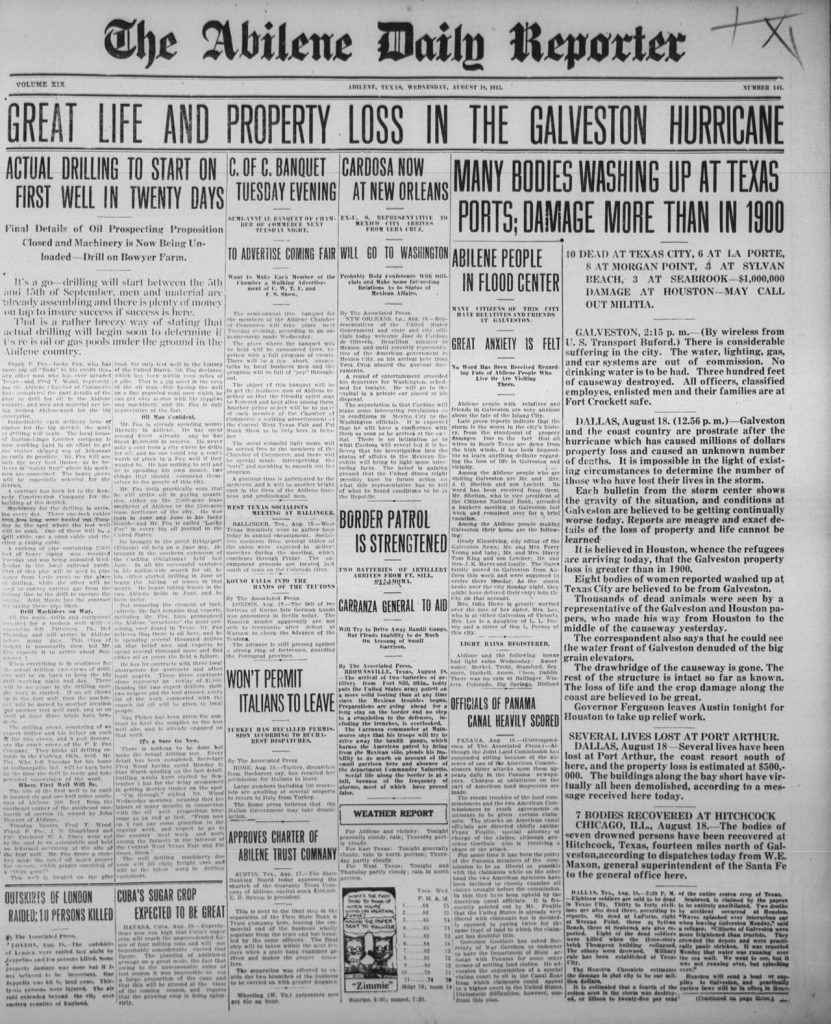 The Abilene Daily Reporter coverage of the hurricane on August 18, Public Domain, Via Wikipedia Commons
At the Velasco station near the mouth of the Brazos River, the rescuers became trapped with their own families and other refugees.
Twenty-one people took shelter in two boats tied to the station. The group included Coast Guard personnel, women and children. As the hurricane tore apart the building, both boats overturned.
Sixteen people drowned. Among them were surfmen Christian P. Oddershede and Theodore Gust, along with the station keeper’s wife and daughter.
Two crewmen and a young woman survived by wearing life preservers and holding onto debris. For approximately 20 hours, the Gulf carried them through darkness, wind and waves. They finally reached Galveston Island about 25 miles from the station.
Farther down the coast, the San Luis station also failed. Four surfmen died, along with relatives and a visitor. Other survivors remained in the water for as long as 46 hours before reaching land or being rescued.
The Galveston station fared better. Its crew rescued 18 people without losing a member, even as hurricane-force winds drove waves against the seawall.
The storm killed 275 people in Texas, according to the Weather Bureau’s contemporary account. Galveston’s seawall was credited with preventing another catastrophe on the scale of 1900, but the losses at Velasco and San Luis exposed how dangerous the coast remained beyond it.
 Extensive damage to an Apartment House after the 1915 Galveston Hurricane, SMU Central University Libraries, No restrictions, via Wikimedia Commons.
The Coast Guard Enlisted Memorial’s record of the disaster preserves the names of men who spent their working lives entering dangerous water for strangers. In 1915, they faced the same water with their wives, children and neighbors beside them.
4. The 1921 Central Texas Flood: A Family’s Long Night in a Pecan Tree
Death toll: 215 people statewide
Billie Ruth Russell was about 3 when floodwater trapped her family on a farm east of Georgetown, the Williamson County seat about 30 miles north of Austin. Berry Creek, a Pecan Creek branch and the San Gabriel River surrounded the property. As those waterways overflowed, the family’s escape routes disappeared.
Her father hitched a horse to a surrey, but a flooded crossing forced them home. They climbed a pecan tree. He held Billie Ruth; her mother held her baby sister. Two older sisters found places in the branches. Two farmworkers crossed from a smaller tree along overlapping limbs, bringing the number sheltering in the larger tree to eight.
Below them, their house floated off its blocks and turned, crushing her father’s horse, tethered to the well. He wanted to free it, but her mother feared the fast current and whirlpools.
Would-be rescuers followed railroad tracks, but they had no boat and faced roughly 2 miles of water. Her mother waved a rag from a branch, hoping someone would see. All eight remained in the tree through the day and night, climbing higher as the water rose.
In her March 2014 oral history, Russell recalled climbing down around 3 p.m. the following afternoon. Inside the muddy house, the puppies she had cried for were alive. Her mother believed they had survived on her floating mattress.
The disaster began with a hurricane that struck near Veracruz, Mexico, on Sept. 7, 1921. Its weakened remnants crossed the Rio Grande and moved north. As moisture-laden air rose over the Balcones Escarpment, the terrain helped intensify the rainfall. By Sept. 9 and 10, flooding stretched from San Antonio to Temple. At Thrall, in eastern Williamson County, a Weather Bureau station measured 36.4 inches of rain in 18 hours and 38.2 inches in 24 hours.
Williamson County recorded 93 confirmed deaths. Along the San Gabriel River, the flood destroyed the community of Laneport, where at least 23 migrant workers died when their dwellings washed away. Across the eastern part of the county, bridges over the San Gabriel River and Brushy Creek were destroyed or badly damaged.
In northern San Antonio, approximately 18 inches of rain sent a 12-foot flood wave through downtown. People scrambled upstairs as water invaded buildings; it reached 4 to 5 feet deep inside St. Mary’s Church and the Gunter Hotel. Fifty-one people drowned as the flood peaked around 1:30 a.m. The National Weather Service records 215 drowning deaths statewide from the disaster.
5. The 1913 Brazos River Flood: Three Nights on a Drifting Rooftop
Death toll: At least 177 people statewide
On Dec. 7, 1913, Albert May, a 27-year-old motorman from Bryan, volunteered to search for people calling for help along the flooded Brazos River. The rescue took place near Pittsbridge, a small farming settlement on the river’s west bank in Burleson County, about 13 miles northeast of Caldwell, along the road to Bryan.
May and another volunteer paddled a flat-bottomed boat across the river and through a break in a levee. The Carnegie Hero Fund’s account reports water rushing through the opening at 20 mph. Nearby, it describes a whirlpool that had scoured a depression approximately half a mile across and 100 feet deep.
Beyond the breach, they heard cries. A house roof had become lodged with other debris against a tree, stranding a man, woman and child. They had spent three nights on the roof and drifted approximately 14 miles from where their ordeal began.
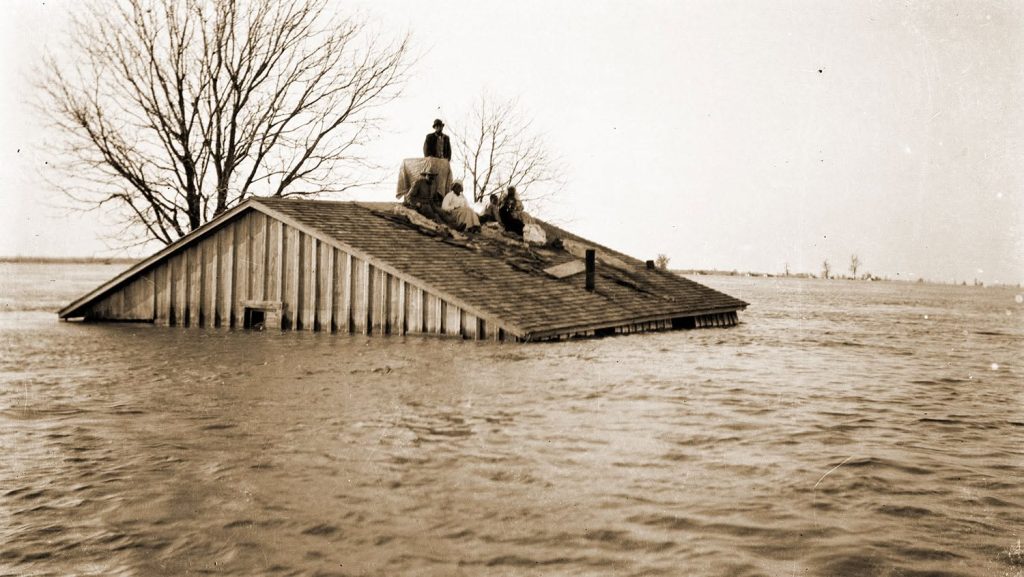 Photo of one family on a rooftop, among many others, during the 1913 Brazos River Flood. Courtesy the City of Bryan’s website and the Carnegie History Center.
May brought them aboard. The two volunteers paddled another mile toward a building on a knoll, but as they approached, the boat’s stern was sucked downward. May slid from his seat into the flood.
He grabbed the boat and held on. In water about 4 feet deep, he found his footing and waded toward the building, keeping hold of the craft carrying the survivors. The Carnegie Hero Fund later recognized him for the rescue.
The December disaster had been building for weeks. Rain during the last 10 days of November had already soaked several Texas river basins. Another prolonged downpour followed in early December, with the heaviest rain falling Dec. 2-4. Across the Brazos basin, rainfall averaged approximately 5.4 inches during the first six days of December, on top of roughly 3.5 inches in late November.
The Brazos, Colorado, Guadalupe and Trinity rivers overflowed during the wider disaster, inundating more than 3,000 square miles. The commonly cited toll of at least 177 deaths covers those widespread Texas floods. A U.S. Geological Survey report placed the combined property losses above $8.5 million.
Downstream in Fort Bend County, floodwater reportedly formed an unbroken stretch for 12 miles between Richmond and Sugar Land, flooding Sugar Land’s depot. In the low-lying neighborhoods north of Richmond’s railroad tracks, water reached the second story of houses. Rescue boats searched for stranded residents while disrupted rail service complicated relief efforts. Regular trains resumed Dec. 17.
Back near Pittsbridge, another rescue party demonstrated how dangerous the levee opening remained. About six hours after May set out, carpenter Henry Berger and two other men launched a boat after dark. The current swung it into a tree and broke it apart. Berger and one companion drifted approximately 2½ miles before catching a sapling. They spent 20 hours standing on a fence in the floodwater before reaching a house.
6. The July 2025 Texas Hill Country Flood: Counselors Passed 15 Children Through a Window
Death toll: 137 people statewide
A Camp Mystic counselor awoke during the early morning of July 4, 2025, and looked from her bunk toward the road outside Chatterbox cabin.
She saw vehicles moving through the storm and girls running toward the recreation hall. When a trash can floated down the road, she stepped onto the porch and screamed for help.

Back inside, she turned on the lights and woke the 9-year-old campers. She initially believed someone would come for them. Instead, banging sounded against a window. A counselor from the nearby Nut Hut cabin was outside, begging to be pulled in and saying she would die if they left her there.
The Chatterbox counselors realized the water had cut off their route to the recreation hall. No adult had reached them, and the current continued climbing between the cabin and the hill behind it.
They told the frightened campers to remember the previous evening’s devotional about courage.
One counselor went through the window and entered the torrent. An equipment shed swept toward her, but another counselor pulled her out of its path. She eventually crossed cold water that reached from her waist to her chest and braced herself on the hillside.
A second counselor positioned herself in the water. The two remaining inside began passing children through the window, one at a time. Each girl moved from the cabin to the counselor in the current and then to the woman waiting on higher ground.
They repeated the process until all 15 campers were out.
Rain poured down the hillside. The girls lost their shoes and climbed barefoot in their pajamas. Three children became separated from the group during the confusion, prompting two counselors to return and search for them. All three were found before daybreak with another cabin group.
The account appears in the Texas House investigation of the Camp Mystic disaster, which reconstructed the camp’s preparation, warnings, evacuations and losses.
The Guadalupe River rose with extraordinary speed after more than a foot of rain fell over portions of the Hill Country while residents and campers slept. By the time the flooding ended, 137 people had died across Texas.
Camp Mystic lost 25 campers and two counselors. Camp director Richard “Dick” Eastland also died while attempting to help.
The disaster led to investigations, lawsuits and new arguments over flood warnings and youth-camp safety. It also produced accounts of young counselors confronting a situation few experienced adults could have managed. At Chatterbox, four of them found a route through a window and kept passing children until the cabin was empty.
Katy Christian Magazine previously covered the public reaction that followed the Camp Mystic deaths.
7. Hurricane Harvey: Four Children and Their Great-Grandparents Lost in One Van
Death toll: At least 68 direct deaths and approximately 35 indirect deaths
Manuel “Sammy” Saldivar borrowed a van on Aug. 27, 2017, to move his family away from the water rising around their northeast Houston home.
Inside were his parents, Manuel Saldivar, 84, and Belia Saldivar, 81. Four of the couple’s great-grandchildren rode with them: Devy Saldivar, 16; Dominic Saldivar, 14; Xavier Saldivar, 8; and Daisy Saldivar, 6.
As Sammy attempted to cross a bridge near Greens Bayou, the current took the van.
The vehicle entered the bayou and began sinking. Sammy escaped through the driver’s window and grabbed a tree branch. He could hear the children calling from inside, but the van disappeared beneath the water before anyone could reach them.
Harris County deputies later rescued Sammy from the tree. Search crews recovered the van and all six bodies several days later.
We are sad to report we have found a van inundated by Greens Bayou flooding while purportedly carrying 6 family members Sunday. #harvey https://t.co/zFhS3J7fRC
— HCSOTexas (@HCSOTexas) August 30, 2017
Their deaths occurred during a storm that overwhelmed one of the country’s largest metropolitan areas. Harvey made landfall near Rockport as a Category 4 hurricane before stalling over Southeast Texas. The storm repeatedly drew moisture from the Gulf, producing more than 60 inches of rain near Nederland and catastrophic flooding across the Houston region.
The National Hurricane Center’s final report attributed at least 68 direct deaths to Harvey, all in Texas. Freshwater flooding caused all but three of those deaths. Approximately 35 additional people died from indirect causes, including electrocution, crashes and interrupted medical care.
Across Katy and West Houston, flooding from Harvey and the emergency releases from Barker and Addicks reservoirs forced thousands of families from their homes. Churches became shelters, supply centers and rebuilding hubs.
Pastor Jorge Cardenas and his wife, Olivia, were rescued by canoe after water entered their neighborhood. Their Church on the Rock campus sustained extensive damage, but volunteers from local congregations and ministries across the country helped the church resume services within 54 days. Katy Christian Magazine documented that recovery in its original profile of Cardenas after Harvey and a 2026 account of his ministry in Katy.
The Saldivars were one family among thousands trying to choose a safe route through unfamiliar water. Their van traveled only a short distance from home. Six people representing three generations died together before they could reach the other side of the bayou.
8. The 1882 Ben Ficklin Flood: “My Place Is With Mother”
Death toll: At least 65 people
Ben Ficklin stood near the South Concho River several miles south of present-day San Angelo. In 1882, the settlement was the seat of Tom Green County, with a courthouse, jail, homes, businesses and a stage station.
Heavy rain had already saturated the surrounding country when another storm struck on the night of Aug. 23. Water began moving through the low-lying town before many residents understood how high it would climb.
Mary Jane Metcalfe initially believed the flood had reached its crest. When an opportunity came to leave, her daughter Zemula chose to remain with her.
“My place is with mother,” the Tom Green Times later quoted her as saying.
When the water continued rising, the women attempted to leave in a hack, a horse-drawn carriage used for transporting passengers. The horses refused to move into the current.
Mary Jane and Zemula returned to the building and climbed a ladder to its roof with several other people. Two men approached in a rescue boat but capsized within a few feet of reaching them. The rescuers escaped into pecan trees.
The building’s roof eventually broke apart. One section carried several men. The portion supporting Mary Jane and Zemula entered a mass of floating wreckage, and both women were swept away.
One man survived by moving between trees as the debris passed beneath him.
The flood killed at least 65 people and destroyed nearly all of Ben Ficklin. The courthouse, jail and one residence were among the few substantial structures left standing on the flat. Survivors buried victims on higher ground, creating the cemetery that still preserves the community’s name.
Ben Ficklin never recovered. San Angelo became the county seat, and the ruined settlement gradually disappeared, joining the many Texas communities whose histories survive through cemeteries, markers and family records. Katy Christian Magazine has explored similar places in its guide to ghost towns and lost communities around Katy.
The Ben Ficklin Cemetery Foundation’s transcription of the 1882 newspaper account preserves more than a casualty figure. It preserves a daughter’s answer when asked to leave her mother.
9. The 1978 Central Texas Floods: A Ham Radio Kept Camp Bandina Connected
Death toll: 33 people
The remnants of Tropical Storm Amelia moved into South Texas at the end of July 1978 and released exceptional rainfall over the Hill Country.
 Amelia as a newly-formed tropical depression on July 30, 1978, SSEC/CIMSS, University of Wisconsin–Madison, Public domain, via Wikimedia Commons
More than 48 inches reportedly fell near Medina during a 72-hour period, establishing a national rainfall record at the time. The Medina and Guadalupe rivers rose to levels that destroyed homes, uprooted massive cypress trees and isolated communities.
At Camp Bandina, a Church of Christ youth camp on the Medina River, children were moved to a church in Bandera as the danger increased. Floodwater later filled camp buildings to depths of several feet. Eight people died in the Camp Bandina area, although the evacuated children escaped the flood.
Travis Claude Thompson was the camp’s resident manager. He had spent years learning electronics and amateur radio, interests that became urgently practical after flooding damaged roads and disrupted ordinary communication.
According to Thompson’s family, he operated his ham radio for several days during the search-and-rescue operation, helping messages move into and out of the devastated area.
A working radio could tell authorities where help was needed, relay information about survivors and reconnect people who had no other way to reach one another. Thompson also participated in the difficult search that followed after the water receded.
The disaster extended far beyond the camp. In northern Central Texas, another burst of extreme rain struck Albany and the Clear Fork of the Brazos River. Flooding across the affected region killed 33 people and caused more than $110 million in damage.
The U.S. Geological Survey’s account found that several rivers reached record-setting discharges and flood levels associated with recurrence intervals exceeding 100 years. Archival television footage preserved by the Texas Archive of the Moving Image shows National Guard members entering the Hill Country, checking a children’s camp and helping a victim’s family.
Camp Bandina’s story includes people who escaped, people who died nearby and a caretaker who remained at his radio as rescuers searched the riverbanks.
- The 1998 South Central Texas Flood: A Little Girl Carried From the Water
Death toll: 31 people
A photograph taken on Oct. 17, 1998, shows a firefighter carrying 10-year-old Nadia Sanchez away from a flooded creek.
Nadia had been riding in a truck with her mother and uncle when rushing water swept the vehicle downstream near Dreamland Drive in San Antonio. All three were rescued without serious injury.
The photograph captured a moment that could easily have ended differently. Most of the 31 people who died during the October flood drowned in vehicles.
A slow-moving weather system drew deep tropical moisture across South Central Texas, producing intense rain over San Antonio, New Braunfels, San Marcos and surrounding communities. Some locations received more than 30 inches during the multiday event.
Creeks rose across streets and neighborhoods. The San Marcos and Guadalupe rivers carried the flood southeast toward Seguin, Gonzales, Cuero and Victoria. In Cuero, diverted water reached downtown even though the district stood more than 2½ miles from the Guadalupe River’s principal channel.
Thirty-one counties received disaster declarations. Property losses reached approximately $750 million, according to the National Weather Service.
The flood occurred during an era when television helicopters and newspaper photographers could preserve individual rescues almost as they happened. Nadia’s image, revisited by the San Antonio Express-News, became one of the event’s defining photographs.
She appears small in the firefighter’s arms, her wet clothing pressed against her and floodwater still covering the ground behind them. Her mother and uncle also survived. In a disaster remembered for dozens of motorists who could not escape their vehicles, one entire family was reached in time.
Enjoyed this article? Continue exploring the overlooked people, disasters and conflicts that shaped Texas in Katy Christian Magazine’s history archive:
- Is Patterson Road Really Haunted? The Truth Behind Houston’s Most Haunted Road, Blue Light Cemetery and Devil Worship Legends
- The Webster Massacre: A Texas Wagon Train Made Its Last Stand. Every Single Man Was Killed.
- The Battle of Sabine Pass: 47 Confederate Soldiers Stopped a 5,000-Man Union Invasion of Texas
- The Phantom Killer of Texarkana: A Masked Murderer Terrorized a Texas Town, Then Vanished Without a Trace
- The Battle of Medina: The Bloodiest Battle in Texas History, Yet Most Texans Have Never Heard of It
Feature photo courtesy the City of Bryan’s website and the Carnegie History Center.