
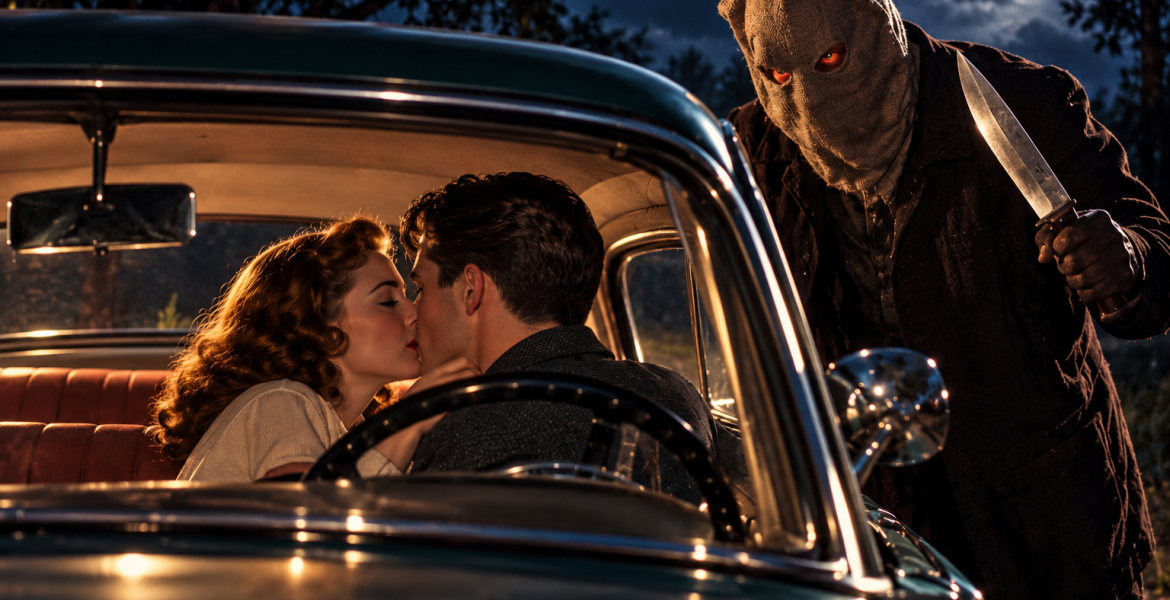
By 11 p.m. on May 5, 1946, the streets of Texarkana, Texas, were nearly deserted. For 10 terrifying weeks, a masked murderer newspapers called the Phantom Killer had stalked the Texas-Arkansas border city in a series of attacks now remembered as the Texarkana Moonlight Murders. Five people were dead and three others seriously wounded. The killer would inspire The Town That Dreaded Sundown, become the center of one of Texas’ most infamous unsolved murder mysteries, and then seemingly vanish without a trace.
The only witness who saw the assailant clearly enough to describe him remembered a slender man wearing a white sack over his head, with openings cut for his eyes. Later victims could offer no description. Two young couples were found shot along secluded roads, and a farmer was killed by bullets fired through his living-room window.
Then the attacks stopped.
Texas Ranger Capt. Manuel T. “Lone Wolf” Gonzaullas and officers from two states pursued hundreds of leads, collected confessions and investigated the man many of them came to consider the strongest suspect. No one was ever convicted.

Eighty years later, the Texarkana Moonlight Murders remain among the most unsettling unsolved crimes in Texas history. The 1976 film The Town That Dreaded Sundown turned the Phantom into a horror icon, but the real investigation never supplied the ending Hollywood gave him.
The Texarkana Moonlight Murders Begin
Texarkana was—and remains—two cities sharing one name. State Line Avenue separated Texarkana, Texas, in Bowie County, from Texarkana, Arkansas, in Miller County. Its unusual geography would eventually bring city police departments, county sheriffs, Arkansas officers, Texas Rangers and federal investigators into the same sprawling murder investigation.
In early 1946, the combined community had roughly 40,000 residents. World War II had ended less than six months earlier, and the enormous Red River Army Depot and nearby Lone Star ammunition plant had helped transform the region’s economy. Soldiers were coming home, wartime restrictions were lifting and young people were again filling theaters and dance halls. The Handbook of Texas’ history of Texarkana describes a city entering an era of postwar prosperity.
The violence began on Friday, Feb. 22.
Jimmy Hollis, 24, and Mary Jeanne Larey, 19, had attended a movie before parking on a secluded lane outside Texarkana. They had been there only a short time when a flashlight appeared at the driver’s window.
A man holding a pistol ordered them out of the car. Larey later described him as approximately 6 feet tall and thin, with a white hood or sack concealing his head. Two openings had been cut for his eyes.
The gunman attacked Hollis with such force that his skull was fractured in two places. He then pursued and sexually assaulted Larey before she escaped and found help. Both survived, but Hollis spent days in critical condition and carried the effects of his injuries long afterward.
Their account provides the case’s only firsthand description of the hood. No witness survived the later shootings with a view of the assailant, so investigators could never prove that the mask made famous by photographs, illustrations and film appeared during any other attack.
At first, authorities had little reason to foresee what would follow.
Shortly after dawn on March 24, a motorist noticed a parked Oldsmobile on a secluded Bowie County road. Inside were 29-year-old Richard Griffin and 17-year-old Polly Ann Moore.
Both had been shot with a .32-caliber weapon. Investigators found blood outside the automobile and concluded that they had been killed nearby before their bodies were placed inside. Heavy overnight rain washed across the scene, damaging tracks and other evidence that might have helped identify their killer.
Griffin was a recently discharged Navy veteran. Moore worked at the Red River Arsenal. Nothing about their backgrounds supplied police with an obvious motive for their deaths.
Less than a month later, the killer struck again.
On Saturday, April 13, 15-year-old Betty Jo Booker played alto saxophone with the Rhythmaires at a Veterans of Foreign Wars dance. Her friend Paul Martin, 16, arrived after the dance to drive her home.
Neither teenager made it.
Martin’s body was discovered beside a road early the next morning. Booker remained missing until nearly noon, when searchers found her body in another location. Martin’s car had been abandoned elsewhere, and Booker’s saxophone had disappeared.
Both teenagers had been shot. Evidence again pointed to a .32-caliber weapon.
Contemporary newspaper coverage shows how rapidly the investigation grew. The April 15 Abilene Reporter-News reported that officers, Texas Rangers and FBI agents had joined the search. Photographs of Booker and Martin appeared in newspapers across the state as law enforcement tried to determine where they had gone after leaving the dance.
Two couples had now been shot to death on isolated roads in less than a month. The February attack on Hollis and Larey no longer looked like an isolated act.
The Phantom Killer Sends a Texas Town Into a Panic
The Texarkana Gazette supplied the unknown attacker with the name that endured: the Phantom Killer.
Another label, the Texarkana Moonlight Murders, eventually entered the popular history of the case. It was memorable, although misleading. The attacks did not consistently occur during a full moon, and the final shooting took place inside a home rather than at a secluded nighttime meeting place.
After the deaths of Booker and Martin, fear spread faster than confirmed information. Theories moved through barber shops, restaurants, workplaces and street-corner conversations. Every unfamiliar automobile became suspicious. Every sound outside a window invited another look.
A contemporary newspaper report from April 19 said local organizations and residents had assembled a $1,450 reward—a substantial sum in 1946—for information leading to the killer.
Residents bought guns, ammunition and locks. Families who had lived comfortably with open windows began securing them at night. According to a later reconstruction of the investigation by the Dallas Observer, some wives and children of men working night shifts at the ammunition plant temporarily moved into the Grim Hotel rather than remain home alone. Western Union suspended nighttime deliveries after someone fired at a messenger.
Police increased patrols along country roads and warned couples away from isolated parking places. Officers investigated prowlers, peeping-tom complaints, suspicious cars and reports of men carrying flashlights. The flood of calls strained departments that still had no reliable description of the killer’s face.
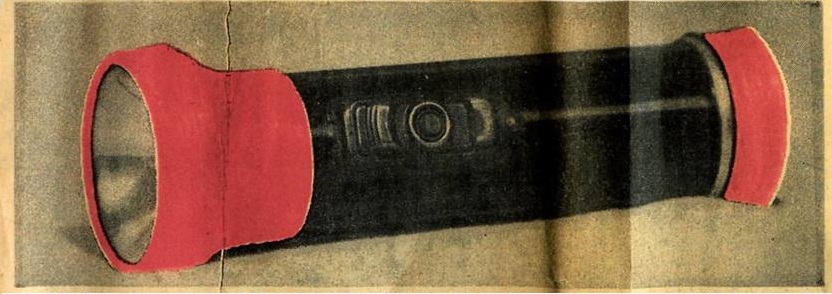
Police called for the public to report anyone who owned a flashlight like the one above, found at the Starks murder scene. This was the first spot-colored photograph published by the Texarkana Gazette. Public domain, via Wikimedia Commons
The mask intensified the fear because it gave residents something to imagine. Yet it also concealed how little police knew. Larey had seen a hooded attacker during the February assault; no witness could establish that the person who killed Griffin, Moore, Martin and Booker had worn the same disguise—or even that he was definitely the same man.
Still, the shared circumstances were difficult to ignore. Three attacks had occurred after dark in rural sections of Bowie County. All involved young couples, and the two double murders involved .32-caliber gunfire.
By then, Texarkana had experienced something Austin residents had endured during the Servant Girl Annihilator killings six decades earlier: an unseen attacker had turned familiar streets and roads into sources of dread.
Texas Ranger “Lone Wolf” Gonzaullas Joins the Hunt
The murders brought one of the most recognizable lawmen in Texas to Texarkana.
Manuel Trazazas Gonzaullas had joined the Texas Rangers in 1920 after service in the Mexican military and the U.S. Treasury Department. During the following decades, he pursued bootleggers, bank robbers, narcotics traffickers, cattle thieves and organized criminals across the state.
His “Lone Wolf” nickname matched his public image, but Gonzaullas also embraced forensic investigation. He worked with firearms evidence, fingerprints and laboratory analysis at a time when the romantic image of the lone mounted Ranger still dominated public memory. Before returning to the Rangers as a captain in 1940, he had helped develop the Texas Department of Public Safety’s Bureau of Intelligence and crime laboratory.
The Texas Ranger Hall of Fame and Museum records that Gonzaullas took command of Company B and became involved in some of the era’s most prominent cases. After the murders of Booker and Martin, he was sent to Texarkana to help direct the Phantom investigation.
Gonzaullas entered a difficult case.
The crimes covered widely separated locations, and rain had damaged the Griffin-Moore scene. Officers had no murder weapon, useful facial description or known relationship connecting all the victims. The Texas-Arkansas boundary also required coordination among separate police departments, sheriffs and state agencies.
The FBI assisted with parts of the investigation. Its surviving Texarkana Phantom case records document the scale of the search and the volume of information moving among agencies.
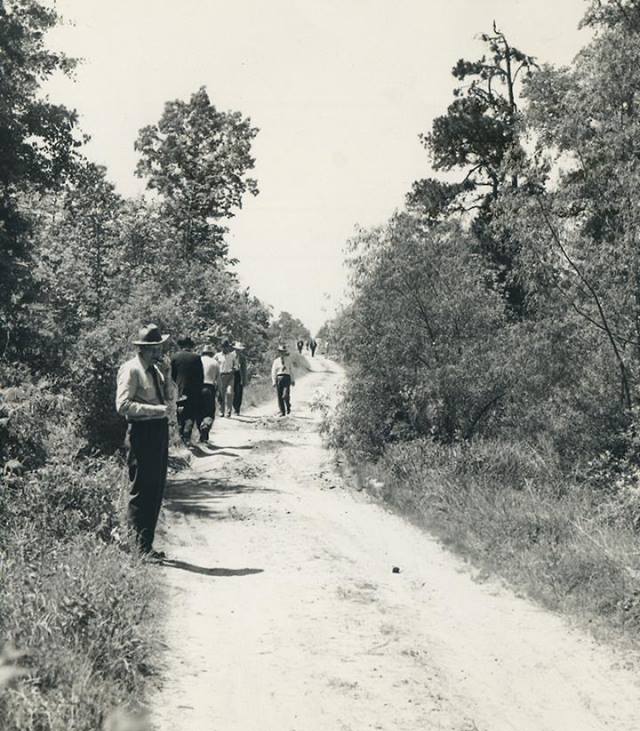
Officers searching for clues down Morris Lane in 1946, Texarkana Daily News, Public domain, via Wikimedia Commons
Investigators questioned people with violent records, gun owners, former servicemen and men accused of sexual crimes. They checked alibis, examined cars and followed reports from people who claimed to recognize the Phantom. Others confessed merely to attract attention or satisfy some private compulsion.
The missing saxophone became one of the investigation’s most recognizable pieces of evidence. Officers hoped it might lead them to Booker’s killer, especially if someone attempted to sell, hide or discard it.

Police also wondered whether the gunman was deliberately following press coverage. He had allowed Hollis and Larey to survive, then left no living witnesses during the next two attacks. The victims and locations appeared increasingly difficult to connect by accident.
On May 3, the pattern changed completely.
Then, Just as Suddenly, the Killings Stop
Virgil and Katie Starks lived in a farmhouse northeast of Texarkana on the Arkansas side of the state line.
On the night of May 3, Virgil Starks was sitting in his living room, reading a newspaper. Katie was elsewhere in the house when gunshots tore through a closed window and struck her husband.
She entered the room and found him mortally wounded. As she attempted to call for help, more shots came through the window, striking her in the face. Badly injured and bleeding, she fled the house and reached a neighbor who summoned assistance.
Virgil Starks died at the scene. Katie survived.
Officers found .22-caliber evidence outside the farmhouse, along with a red-handled flashlight and a footprint. Bloodhounds followed a trail from the property before losing the scent near a road. Despite a large search, the shooter escaped.
Texarkana immediately treated the shooting as another Phantom attack. For the public, the killer had crossed a terrifying boundary. Staying away from secluded roads no longer seemed sufficient protection; Virgil Starks had been attacked while sitting inside his own home.
The Starks case was also markedly different from the preceding crimes. The victims were a married couple at their farmhouse, the shooter remained outside and the gun was a .22 rather than the .32-caliber weapon associated with the two double murders.
Miller County Sheriff W.E. Davis investigated the possibility that the Phantom had changed his method. In later years, however, some officers who worked the case came to suspect that Starks had been killed over a personal grievance by someone unrelated to the lovers’ lane attacks.
The evidence never settled the question. The traditional account therefore attributes five deaths and three wounded survivors to the Phantom, while leaving open the possibility that the farmhouse shooting had a different perpetrator.
What is certain is what happened to Texarkana afterward.
A May 6 edition of the Denton Record-Chronicle reported that lights burned throughout the night in rural homes. A 7 p.m. movie had drawn an audience, but the 9 p.m. showing was almost empty. “By 11 p.m. the streets were almost deserted.”
The atmosphere was so tense that officers once surrounded the darkened Starks farmhouse after seeing mysterious flashes inside. The supposed intruders turned out to be Gonzaullas and a Life magazine photographer using flashbulbs at the crime scene.
The May 3 shooting became the last killing attributed to the Phantom.
Weeks passed without another attack. Police continued questioning suspects and following tips, but the nightly panic gradually receded. Texarkana resumed its routines without learning why the violence had begun or why it had stopped.
Who Was the Texarkana Phantom Killer?
Law enforcement investigated many suspects, but one name became central to the case: Youell Swinney.
Swinney was a repeat offender with a long record of automobile theft. Arkansas State Police officer Max Tackett noticed that cars had been stolen and abandoned around the periods when the Phantom attacks occurred. His investigation eventually led officers to Swinney and a woman identified in accounts as his wife, Peggy.
During questioning, Peggy Swinney implicated her husband. Investigators said she knew details that had not appeared in newspapers, including information about Martin’s missing pocket date book and the area where Booker’s saxophone had been discarded.
The information appeared promising, but her account repeatedly changed. She recanted, altered important details and became an unreliable witness. Spousal-testimony rules presented an additional obstacle to using her statements in court.
Police never recovered a murder weapon from Swinney. They found no fingerprint, eyewitness identification or physical evidence that conclusively placed him at a murder scene. Swinney never confessed.
Prosecutors instead pursued him for automobile theft. In 1947, he received a life sentence as a habitual offender. He was paroled in 1973 after legal challenges to the conviction and later returned to prison for counterfeiting. He died in 1994.
Several investigators remained convinced that Swinney committed the lovers’ lane murders. Conviction was another matter. Their case depended heavily on a changing account from a witness prosecutors could not confidently place before a jury. The Encyclopedia of Arkansas’ case history consequently identifies him as the principal suspect, not the proven killer.
Other confessions produced more headlines than evidence. In 1948, 17-year-old H.B. Tennison died by suicide after leaving a note claiming responsibility for several Phantom murders. Officers quickly found problems in his story, and investigators who knew him did not believe he had committed the crimes. A contemporary report on Tennison’s confession recorded the skepticism of the sheriffs responsible for the investigation.
The question of the Phantom’s identity may actually contain two mysteries. One concerns the person who attacked Hollis and Larey and killed Griffin, Moore, Martin and Booker. The second is whether that same person fired through the Starks’ farmhouse window.
Popular accounts frequently place the Phantom among unidentified Texas serial killers. That description assumes the attacks belonged to one offender—precisely the point investigators never proved.
Swinney may have been responsible. The actual killer may have died, gone to prison for another crime, left the region or simply decided to stop. Publicly available evidence cannot separate those possibilities.
The True Story Behind The Town That Dreaded Sundown
Thirty years after the murders, filmmaker Charles B. Pierce brought the Phantom back to Texarkana.
Released in 1976, The Town That Dreaded Sundown presented itself as a dramatization of the 1946 case. Ben Johnson played Texas Ranger J.D. Morales, a fictionalized version of Gonzaullas. Andrew Prine portrayed Deputy Norman Ramsey, and Gilligan’s Island actress Dawn Wells played Helen Reed, a character modeled partly on Katie Starks.

Pierce filmed much of the picture in and around Texarkana. Its pseudo-documentary narration, locations and period setting gave audiences the impression that they were watching a close reconstruction of the Moonlight Murders.
The broad outline was true. A hooded man attacked couples outside Texarkana, five deaths were traditionally attributed to him, the Texas Rangers joined the investigation and the killer escaped identification.
Many of the film’s most memorable details were invented.
The famous scene in which the Phantom attaches a knife to a trombone and kills a musician did not happen. Betty Jo Booker played the saxophone, and she was killed by gunfire. The Turner Classic Movies history of the production identifies the trombone sequence as one of the movie’s major fictional departures.
The climactic chase of the Phantom was also created for the film. Police never saw the real killer fleeing a crime scene and never shot at him as he escaped. Character names, relationships, chronology and circumstances were changed throughout the picture.
The hood itself grew more definite on screen. The historical description came solely from Mary Jeanne Larey after the first attack. The film placed its burlap-masked Phantom at every murder, turning a witness’s brief view into the killer’s permanent identity.
Even Texarkana officials objected to the marketing. According to the Encyclopedia of Arkansas’ history of the film, the city threatened legal action over promotional language suggesting that the killer still lived in the community. The film nevertheless became a financial success and helped establish several conventions later associated with slasher movies.
Beginning in 2003, outdoor October screenings at Spring Lake Park turned the film into a Texarkana tradition. The location carries an uncomfortable historical connection: Paul Martin’s car was found near the park during the search for him and Betty Jo Booker.
A 2014 film, also titled The Town That Dreaded Sundown, returned to the case through a fictional story set in a community haunted by the original murders and the 1976 movie.
The films ensured that the Phantom would not disappear from popular culture. They also risked allowing the mask to overshadow the people whose lives gave the story its power.
Jimmy Hollis and Mary Jeanne Larey survived the first attack. Richard Griffin and Polly Ann Moore were killed a month later. Paul Martin and Betty Jo Booker disappeared after a dance and were found dead the following morning. Virgil Starks was murdered in his home, while Katie Starks escaped despite gunshot wounds to her face.
Their assailant was never brought to trial.
On screen, officers eventually chase a visible villain. In the historical record, the final attack attributed to the Phantom ended at the Starks farmhouse on May 3, 1946. After that came investigations, suspicions and 80 years of unanswered questions.
Enjoyed this article? Continue exploring the crimes, disasters, battles and forgotten events that shaped Texas in Katy Christian Magazine’s history archive:
- Before Jack the Ripper: The Servant Girl Annihilator Who Terrorized Austin, Texas
- Is Patterson Road Really Haunted? The Truth Behind Houston’s Most Haunted Road
- The Webster Massacre: A Texas Wagon Train Made Its Last Stand—Every Single Man Was Killed
- The New London School Explosion: The Deadliest School Disaster in American History Happened in Texas
- The Great Hangings at Gainesville: Texas’ Darkest Chapter and the Largest Mass Hanging in American History
- The Battle of Medina: The Bloodiest Battle in Texas History, Yet Most Texans Have Never Heard of It
- The 10 Greatest Lost Treasures in Texas: Spanish Gold, Pirate Treasure, Buried Silver and Hidden Fortunes