

Where are the greatest lost treasures in Texas? From Spanish gold and pirate treasure to hidden outlaw fortunes, buried silver, shipwrecks and forgotten treasure legends, Texas is filled with mysteries that have fascinated historians and treasure hunters for centuries. Long before Katy existed, Spanish treasure fleets wrecked along the Gulf Coast, pirates smuggled valuable cargo through Galveston, famous outlaws vanished with stolen gold, and fortunes disappeared into the deserts, rivers and forests of Texas—some of them never recovered.
Some of these lost treasures are supported by Spanish records, government audits, archaeological discoveries and historical documents. Others survive through generations of Texas folklore. Together they tell the story of real shipwrecks, hidden caches, pirate legends, outlaw robberies and unexplained disappearances that continue to inspire treasure hunters across the Lone Star State.
This is the third installment in a new Katy Christian Magazine series on the forgotten histories of Katy and West Houston: the places, people and stories that shaped the area long before today’s neighborhoods appeared. We recently covered the greater Houston area’s ghost towns and lost communities you never knew existed and the bloodiest battle in Texas history that you weren’t taught in school.
Some Texas fortunes can be traced through ship manifests, government audits and archaeological discoveries. Others survive only in stories passed from one treasure hunter to another.

Long before Katy, Texas began developing rice farms, railroads or even a name, small fortunes were disappearing across a drastically different Texas.
Spanish ships carrying loads of silver broke apart in the Gulf of Mexico. French colonists witnessed essential supplies sink beneath Matagorda Bay. Outlaws fled with newly minted gold coins, and an armed gang of outlaws emptied the Texas State Treasury while Austin waited for order to return in the wake of the Civil War.
Many of those mysteries remained unsolved due to the shifting geography of the Lone Star State. Barrier islands moved, rivers changed course, storms swept away landmarks, and the caves, canyons and dense bottomlands of Texas gave treasure hunters plenty of places to search.
Inevitably, folklore filled in the gaps in historical record. A documented robbery eventually became associated with a cave full of buried gold. A Spanish mission acquired a secret tunnel. Once notorious, early-19th-century French pirate and smuggler Jean Lafitte’s name entered a story, nearly any chest of coins discovered near the Gulf transformed into pirate treasure.
That does not mean every legend should be dismissed. Some grew from losses recorded in government documents or shipping records. Others inspired searches that became part of Texas history themselves. The challenge is identifying the point where the surviving evidence ends and the treasure hunt story takes over.
These 10 mysteries, compiled by Katy Christian Magazine, are ranked according to the strength of their historical foundations, the significance of what was lost and the questions that remain. Some involve fortunes that have never been recovered. Others were found after centuries beneath the ground or water, proving that the Texas landscape occasionally returns what it has concealed.
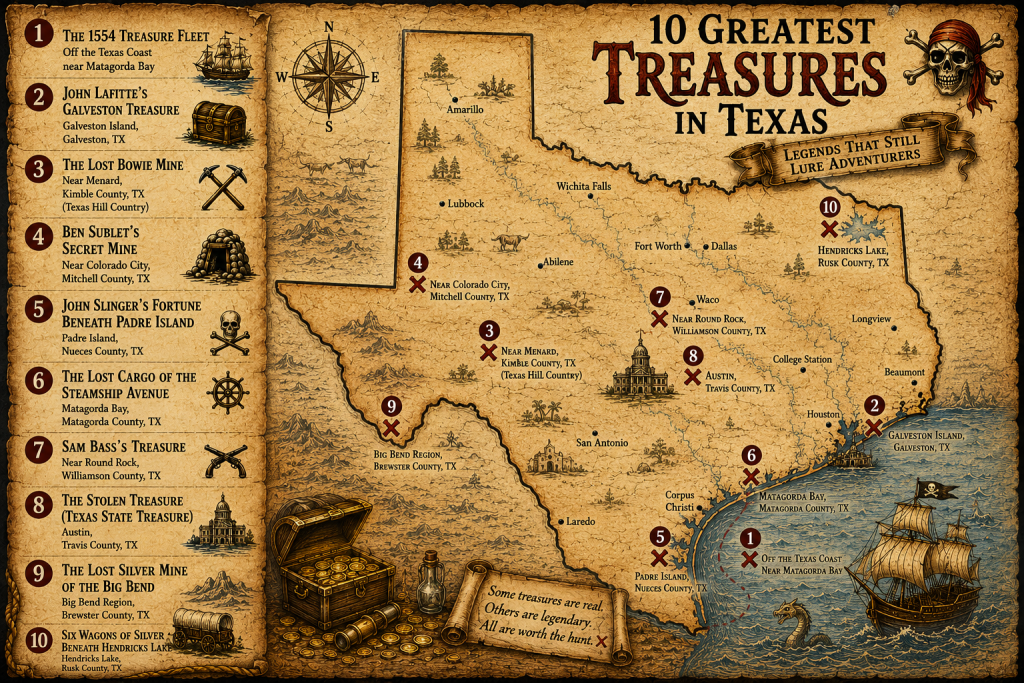
- Six Wagons of Silver Beneath Hendricks Lake
Hendricks Lake is an oxbow lake near Tatum in East Texas, not far from the Sabine River and the historic route known as Trammel’s Trace. For more than 150 years, treasure hunters have arrived there convinced that six wagonloads of silver are buried beneath its dark water and deep mud.
The best-known version of the story dates the loss to 1816. Silver supposedly taken from the Spanish brig Santa Rosa by men connected to Jean Lafitte was being carried north from Matagorda Bay. When Spanish soldiers approached the caravan, the men allegedly pushed six wagons filled with silver into Hendricks Lake rather than allow the fortune to be recaptured.
The details shifted as the story spread by mouth. Some versions connected the treasure to Santa Anna and the Texas Revolution. Others substituted gold, jewelry or precious stones for the Spanish silver. The six wagons remained permanent fixtures in the tale.
The first documented recovery attempt came in 1884, when Paul “Uncle Fox” Tatum reportedly constructed a steam-powered system of buckets and conveyors to drain or excavate the lake. Later searchers brought draglines, diving equipment, underwater metal detectors, aerial photographs and magnetometers. One plan involved a divining rod activated with radioactive isotopes.
None of those methods produced a fortune. Despite decades of dredging, diving and even dynamiting, searchers reportedly recovered only the rim of an old wagon wheel.
The origin of the treasure legend remains uncertain, but the long history of the search is well established. Oilmen, engineers, contractors, amateur divers and professional treasure hunters have spent years trying to defeat the lake’s boggy bottom. The discovery of that lone piece of wagon wheel may have been more effective than finding nothing at all. It offered just enough encouragement to keep the story alive.
- Jean Lafitte’s Galveston Treasure
Jean Lafitte’s documented years in Texas already contain enough smuggling, privateering and international intrigue to explain why treasure legends followed him.
After operating a smuggling network from Barataria near New Orleans, the infamous pirate became involved in privateering ventures along the Gulf Coast. In 1817, he established himself on Galveston Island and developed the settlement known as Campeche into a center of privateering and illegal trade.
Captured cargo passed through Galveston aboard ships sailing under commissions from revolutionary governments fighting Spain. Goods that could not legally enter the United States reached buyers through Lafitte’s network.
The Rosenberg Library’s collections on Lafitte’s Galveston years include an 1819 letter he sent from the island to Gen. James Long, along with manuscripts, photographs and other records. His presence on Galveston and the movement of valuable goods through his settlement are matters of history rather than folklore.
Stories of buried treasure appeared afterward. Supposed caches have been placed on Galveston Island, Bolivar Peninsula, High Island, Matagorda Island and in the coastal marshes farther east. One version claims Lafitte buried chests before leaving Galveston under pressure from the United States. Others say members of his organization concealed captured cargo during storms, military threats or hurried departures.
No authenticated Lafitte cache has been recovered in Texas. The stories generally lack a contemporary map, inventory or dependable witness describing a specific burial. Their durability comes from Lafitte himself. A smuggler who controlled valuable cargo from an exposed island could reasonably have hidden some of it, even though no surviving record proves that he did.

Photo: Anonymous portrait of Jean Lafitte, early 19th century, Rosenberg Library, Galveston, Texas via Wiki Commons
- The Lost Bowie Mine
The Lost Bowie Mine developed from an actual Spanish search for mineral wealth in the Texas Hill Country.
In 1753, a Spanish expedition learned of a hill containing red ocher and mineral-bearing rock in what is now Llano County. Three years later, Bernardo de Miranda y Flores led an official party to investigate. His men opened a shaft, encountered what Miranda described as an extensive body of ore and named the site San José del Alcázar.
Miranda’s report was enthusiastic enough that he reportedly envisioned a mine for every resident of Spanish Texas.
The discovery did not lead to a profitable silver operation. A sample sent for testing was considered too small for an accurate assay. Capt. Diego Ortiz Parrilla later smelted ore at the San Sabá presidio and estimated that 75 pounds produced about 1½ ounces of silver.
Confusion over the site’s location soon became part of the story. Because ore had been tested at San Sabá, later searchers assumed the mine itself must have been near the presidio. Maps and published accounts repeated that conclusion until the supposed San Sabá silver mine became better known than the original Los Almagres deposit.
James Bowie was among the men drawn into the search. In 1831, Bowie, his brother Rezin and nine companions traveled into the region looking for the mine. Their expedition became famous for a violent battle fought during the journey, but Bowie did not locate the silver source.
The Spanish records establish that mineral deposits were found, sampled and tested. They do not demonstrate that an exceptionally rich silver mine vanished. The enduring mystery may be less about the loss of a mine than the transformation of a modest colonial prospect into an increasingly valuable legend.
- Ben Sublett’s Secret Gold Mine
Most lost-mine stories begin with a prospector returning from the wilderness with a nugget and refusing to disclose where he found it. William Caldwell “Ben” Sublett appears to have done so repeatedly.
While working near the temporary Texas and Pacific Railway terminal at Colorado, now Colorado City, Sublett reportedly discovered gold dust and nuggets somewhere in the Pecos River region in early 1881.
He described the source as a mine but kept its location secret. Throughout the 1880s and early 1890s, Sublett made periodic journeys into West Texas and returned with additional gold. Men attempted to follow him, but he managed to lose them in the mountains and desert. Others tried to persuade him to reveal the location without success.
Sublett did not live like a man drawing wealth from an inexhaustible deposit. In 1891, he reported only $265 in personal property for tax purposes. His modest circumstances could indicate that the gold source was small, difficult to reach or considerably less valuable than later versions of the story suggested.
He died in 1892 without identifying it. His son believed the gold came from the Guadalupe Mountains or the Rustler Hills of Culberson County and joined the many people who later searched the region. No expedition succeeded in conclusively locating Sublett’s mine.
The geography leaves room for several possibilities. Sublett may have found a rich vein, a limited placer deposit or a small pocket of gold that he gradually exhausted. Whatever the source, he seems to have returned from West Texas carrying real gold from a place no one else could identify.
- John Singer’s Fortune Beneath Padre Island
Padre Island’s shifting dunes have always made landmarks temporary, which is why a buried cache could disappear even from the people who concealed it.
John V. Singer, a brother of sewing-machine entrepreneur Isaac Singer, settled with his family along the Texas coast during the 1840s. He worked as a wreckmaster and salvaged material from vessels lost along a shoreline already known for maritime disasters.
When the Civil War began, the family was ordered to leave Padre Island because of its Union sympathies. Before departing, the Singers reportedly buried a collection later valued at more than $80,000 and said to include Spanish coins, silver bars, jewelry and paper currency.
The amount deserves caution because Singer’s biography became heavily mixed with legend. The circumstances behind the burial are nevertheless plausible. A wreckmaster could have accumulated coins, salvaged metal and valuables, while a family forced to leave during wartime might have considered burial safer than carrying the collection through dangerous territory.
When the Singers returned after the war, the island had changed. Wind, water and storms had erased the landmarks they remembered. Dunes on barrier islands migrate, ridges flatten and inlets shift, sometimes within a matter of months.
The family searched without success. Singer and his oldest son later returned at least twice, but the collection was never found.
A cache assembled from decades of shipwreck salvage may remain somewhere beneath the island. It may also have been scattered, carried away by a storm or buried far deeper than its owners expected.
- The Lost Cargo of L’Aimable
Treasure does not always mean coins or precious metal. For La Salle’s stranded French colonists, tools, food and building supplies were worth more than silver.
When René-Robert Cavelier, Sieur de La Salle, reached the Texas coast in 1685, he believed his expedition was near the mouth of the Mississippi River. Navigational errors had brought the ships hundreds of miles west to Matagorda Bay.
One of those vessels, L’Aimable, carried a large share of the equipment and provisions intended for the French colony.
The ship grounded while attempting to enter Matagorda Bay through Cavallo Pass. Although some materials were salvaged, most of the supplies intended for the settlement were lost.
The accident weakened an expedition that was already isolated and badly misplaced. Materials recovered from L’Aimable were used to construct buildings at the settlement now known as Fort St. Louis, but much of the cargo remained beyond reach.
The wreck has never been conclusively identified. The Texas Historical Commission continues to investigate shipwrecks in and around Matagorda Bay and has included the search for L’Aimable in its marine archaeological work.
Locating the vessel could reveal what France intended to bring into its proposed Texas colony and how much the settlers lost before they had fully established themselves. Its importance would lie not in a dramatic chest of gold, but in an intact collection of objects from a colonial venture that began to fail almost as soon as it reached the coast.
- La Belle: The Treasure Texas Recovered
Another vessel from La Salle’s expedition remained beneath the mud of Matagorda Bay for more than 300 years.
By 1686, La Belle was the explorer’s last remaining ship. Its loss during a storm severed the struggling French colony’s final dependable connection to the outside world.
Texas Historical Commission archaeologists located the wreck in the 1990s. The water was too murky for an ordinary underwater excavation, so workers built a cofferdam around the site, pumped out the water and excavated the vessel as though it were on dry land.
The project recovered the surviving hull, three bronze cannons, trade beads, bells, pottery and the skeleton of a crew member. Nearly two million artifacts and fragments were documented during the excavation and conservation process.
The significance of La Belle did not depend on one spectacularly valuable object. Its cargo remained together as a collection, allowing archaeologists to study the tools, weapons, dishes, trade goods and personal possessions of a 17th-century colonial expedition.
The discovery offered a detailed view of how La Salle expected the settlement to survive and what his colonists brought with them into Texas. It also strengthened the case for continuing to search for L’Aimable. Matagorda Bay preserved one of the expedition’s ships well enough to reconstruct much of its story, and another may still be concealed nearby.
- Sam Bass and the Gold He Brought to Texas
Sam Bass became a Texas outlaw, but the robbery that produced his largest fortune took place in Nebraska.
On Sept. 18, 1877, Bass and five other men stopped a Union Pacific passenger train at Big Springs. Inside the express car, they discovered approximately $60,000 in newly minted $20 gold pieces, in addition to cash and watches taken from passengers.
After dividing the proceeds, the gang separated. Several members were killed or captured, while Bass disguised himself as a farmer and returned to Texas with an estimated $10,000 share.
He resumed robbing trains within months, raising questions about what had happened to his gold. He may have gambled or spent it carelessly, but later stories claimed that he hid most of the money before assembling a new gang.
According to the City of Round Rock’s account of the outlaw, supposed hiding places include caves near Mineral Wells and Prairie Dell. One tradition places the gold near Big Blue Spring, where Bass allegedly concealed it before heading to Round Rock to rob a bank.
Bass never completed that robbery. He was mortally wounded in a shootout in July 1878 and died on his 27th birthday.
No authenticated cache has been found. Bass had a history of gambling, poor judgment and reckless spending, so there is no reason to assume he handled the gold carefully. Even so, $10,000 in 1877 was a substantial sum to spend in a few months without leaving a clearer trail. That gap between the documented robbery and Bass’ death has allowed the hidden-gold stories to survive.
- The Stolen Gold of the Texas State Treasury
Austin was caught between governments on the night of June 11, 1865.
The Confederacy had collapsed, Gov. Pendleton Murrah and other officials had fled toward Mexico, civil authority was breaking down and Union occupation forces had not yet arrived. An estimated 50 armed men used the confusion to attack the Texas State Treasury.
The robbers forced open the safes in the treasury building near the Capitol. After a church bell sounded the alarm, a group of Austin volunteers led by Confederate veteran George R. Freeman confronted them.
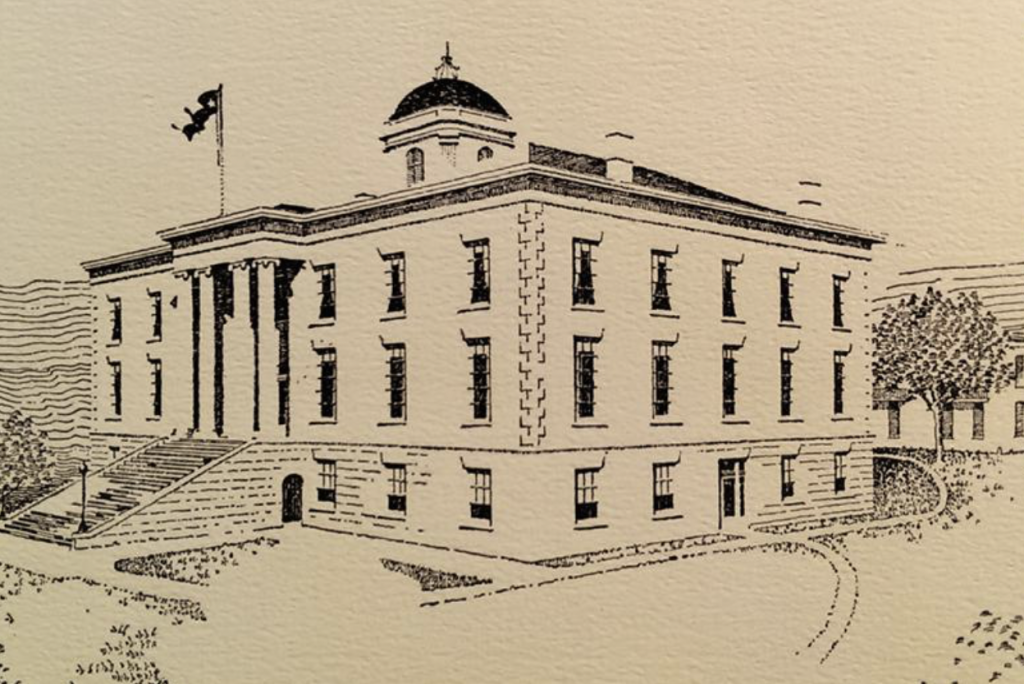
Gunfire followed. Freeman was wounded, one robber was mortally shot and the remaining men fled toward Mount Bonnell carrying about $17,000 in gold and silver specie.
An official audit later determined that the treasury had contained $27,525 in specie, $800 in Louisiana bank bills and millions of dollars in bonds, coupons and securities. The robbers ignored the papers and took money that could be carried and spent.

Some coins were recovered along the route between the treasury and Mount Bonnell, but the surviving robbers were never captured and most of the money remained missing.
The case has more documentation than most Texas treasure stories. The robbery occurred on a known date, the government recorded the amount taken, witnesses described the attack and the escape route was identified.
What happened after the robbers reached the hills west of Austin is less clear. They may have divided the specie immediately and introduced it gradually into circulation. A participant could also have buried a portion during the flight, intending to retrieve it later.
Austin recovered from the disorder of 1865 and eventually expanded into the surrounding hills. The missing gold was never conclusively accounted for.
- The 1554 Spanish Treasure Fleet
On April 29, 1554, a violent storm drove three Spanish ships onto the Texas coast.
The Espíritu Santo, San Esteban and Santa María de Yciar had left San Juan de Ulúa near Veracruz as part of a fleet bound for Spain. Their cargo included raw silver and minted reales from Spain’s American colonies.
Nearly 250 people died in the wrecks and during the survivors’ disastrous attempt to travel overland toward Mexico. Only about 30 survived.

Painting: Padre Island Spanish Shipwrecks of 1554. Image available on the Internet and included in accordance with Title 17 U.S.C. Section 107.
Spanish authorities learned of the loss quickly and sent salvage expeditions north from Veracruz. Divers worked along Padre Island from July through September, recovering silver and other valuable cargo.
A large portion remained behind. Historical estimates indicate that the Spanish salvagers recovered only about 41% of the combined cargo, leaving the rest beneath the surf and shifting sand.
The wrecks remained hidden for more than four centuries before their rediscovery in the 20th century. Commercial salvage operations and archaeological investigations recovered silver coins and discs, a gold bar, a gold crucifix, cannons, anchors, weapons and rare navigational instruments.
Archaeologists eventually documented about 9,500 artifacts from the wreck sites and the Spanish salvage camp. The Santa María de Yciar has remained especially elusive and may have been disturbed or destroyed when Mansfield Cut was created.
The 1554 fleet ranks first because its central claims are supported by Spanish records and physical evidence. The ships, their cargo and the official salvage expeditions are documented, and modern excavations have recovered both precious metal and thousands of historical objects.

Photo: Astrolabes, coins, and other objects recovered from the Padre Island shipwrecks of April, 1554. U.S. National Park Service, Public domain, via Wikimedia Commons
The uncertainty concerns what Spanish salvagers and later searchers did not recover. The Gulf has had centuries to scatter the remaining silver. Coins could rest far from the original wreck sites, while heavier objects may be buried beneath layers of sand. Some material may also have been privately collected before Texas established modern protections for historic shipwrecks.
The scale of the documented loss leaves little need for embellishment. Three ships carrying colonial treasure wrecked on the Texas coast, and much of their cargo never returned to Spain.
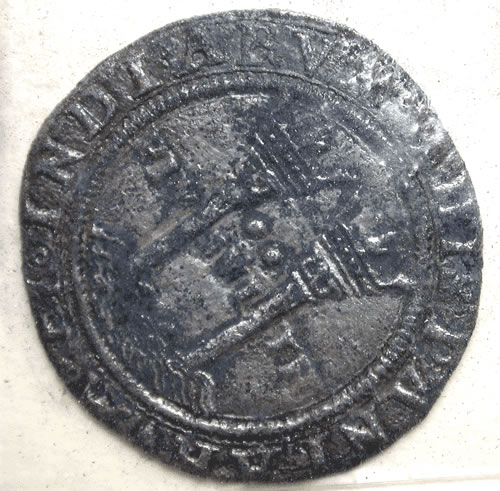
Photo: Spanish coin found at Padre Island National Seashore. National Park Service, Public domain, via Wikimedia Commons
Texas Treasure Legends: Great Stories That Could Be True
Texas has enough documented shipwrecks, robberies and missing fortunes to sustain generations of treasure hunters. Folklore added many more. Most of these stories are attached to genuine people, conflicts or places. The evidence usually weakens when the tale introduces a large fortune without identifying who owned it, where it came from or how knowledge of the burial survived. The legends remain part of Texas culture, but their historical foundations vary considerably.
The San Sabá Mission Treasure
Mission Santa Cruz de San Sabá was established near present-day Menard in 1757. On March 16, 1758, a large force of Comanches and their allies attacked, looted and burned the mission, killing two priests and six other people.
The speed and violence of the San Sabá attack leave little room for the later tale of missionaries calmly burying church silver before abandoning the site.
The mission owned religious furnishings, but no strong documentary evidence establishes an unrecovered cache. The story may have absorbed elements of the Lost Bowie Mine tradition, which brought silver into the folklore of the same general region.
The Lost Silver of El Camino Real
The El Camino Real de los Tejas linked Mexico with Spanish settlements in Texas and Louisiana. Soldiers, missionaries, settlers, traders and livestock traveled its network of routes for generations.
Robbery, abandoned cargo and accidental loss were all possible along a road that crossed rivers, wilderness and contested territory. The familiar treasure legend, however, rarely identifies a specific mule train, shipment, attack or Spanish report.
Until a documented convoy can be tied to a particular loss, the silver of El Camino Real remains a broad regional tradition rather than a clearly defined historical mystery.
The Missing Confederate Treasury
Confederate money, government records and property moved across the South during the final months of the Civil War. The confusion surrounding the collapse produced stories about wagon trains of gold disappearing before Union forces arrived.
Texas versions generally lack the name of a convoy, a verified amount or a documented official responsible for transporting the funds. They are also frequently confused with the well-recorded robbery of the Texas State Treasury in Austin.
The Austin species unquestionably existed and disappeared in 1865. Evidence for a separate Confederate treasury buried elsewhere in Texas is far less convincing.
The Lost Payroll of the Cattle Trails
Cattle drives generated substantial amounts of money, and drovers faced robberies, accidents, violence and hazardous river crossings. A payroll could certainly have been stolen or lost.
Most versions of the legend provide no ranch, trail boss, bank, payroll officer, date or contemporary report. Without those details, the story describes a danger associated with the cattle-drive era rather than a specific missing fortune.
Spanish Gold Near Presidio and Big Bend
The Big Bend region contains many of the elements that encourage treasure stories: military routes, abandoned settlements, mining ventures, border conflicts and vast areas of difficult terrain.
Depending on the version, Spanish soldiers, Mexican officials or revolutionaries buried the treasure while fleeing through West Texas. Names, dates and amounts tend to change with the storyteller.
No single account has produced a persuasive chain of evidence connecting a known shipment of gold to a documented disappearance in Texas. Lost valuables may remain in the region, but the existing stories depend more heavily on the landscape than on surviving records.
The Sutton-Taylor Feud Gold
The Sutton-Taylor feud was a prolonged and deadly conflict in South Texas. Cattle theft, political rivalries, revenge killings and disputes over law enforcement all contributed to the violence.
The buried fortune is not nearly as well documented. No widely accepted record identifies a particular cache accumulated and concealed by the feud’s participants.
The legend reflects a recurring assumption in treasure folklore: men involved in dangerous and illegal activity must have possessed hidden wealth, and any money they accumulated must still be buried near the places where they lived.
The Espíritu Santo Mission Treasure
Nuestra Señora del Espíritu Santo de Zúñiga Mission was founded in 1722 and relocated several times before becoming permanently established near present-day Goliad.
Those moves encouraged stories that priests buried silver or religious objects rather than transport them to a new site. No major authenticated cache has confirmed the claim.
The mission is also sometimes confused with the Espíritu Santo, one of the ships wrecked off Padre Island in 1554. The ship carried documented treasure. The mission story does not have the same evidentiary support.
Captain Kidd’s Texas Treasure
Captain William Kidd’s name became attached to treasure legends far beyond the places where his movements can be documented. “Captain Kidd’s gold” eventually became a generic label for pirate treasure.
No credible historical evidence connects Kidd with a buried cache in Texas. Jean Lafitte actually operated from Galveston and is therefore a more plausible figure in Texas pirate lore. Even the stories of Lafitte’s buried treasure, however, remain unverified.

Photo: Illustration of William “Captain” Kidd overseeing a treasure burial. Howard Pyle, Public domain, via Wikimedia Commons
The Lost Treasure of New Washington
One version of this legend claims that valuable cargo sank when the Republic of Texas port of New Washington was destroyed during the 1900 hurricane.
The historical record describes a different place and event. New Washington was a planned settlement near present-day Morgan’s Point, and only a few buildings had been completed by 1836. During the Texas Revolution, Mexican troops removed supplies and burned its warehouses.
New Washington was not a major Republic-era port destroyed in the 1900 Galveston hurricane, and no credible account establishes a fortune in ship cargo lost there during that storm. The legend appears to combine unrelated parts of Texas history.
Where History Ends and the Treasure Hunt Begins
The least reliable Texas treasure stories often promise the largest fortunes. Millions of dollars in Spanish gold appear without a manifest, an eyewitness or the name of the expedition that supposedly carried it.
The strongest mysteries begin with firmer details: a government audit recording $17,000 missing from the treasury, a Spanish report describing an ore sample or a family returning after the Civil War to discover that Padre Island had erased its landmarks.
Those records do not make the stories less exciting. They give readers a reason to take the mysteries seriously.
The 1554 fleet proves that ships carrying large quantities of silver wrecked along the Texas coast. The excavation of La Belle shows that a vessel can remain beneath a shallow bay for three centuries while preserving nearly two million pieces of its story. Ben Sublett seems to have returned from West Texas with genuine gold, and Sam Bass left enough of his fortune unaccounted for to keep treasure hunters searching caves.
However, folklore also deserves a place in the history of Texas, provided it is identified clearly. Stories of mission silver, pirate maps and outlaw caches have influenced how Texans see the landscape. An isolated hill can become a marker, an abandoned road can become the route of a lost shipment, and every major storm raises the possibility that something buried may have been exposed.
Searching for historical material also carries legal responsibilities. The Texas Historical Commission warns that historic shipwrecks in state waters cannot be disturbed without an antiquities permit, while artifacts found on state-owned land belong to the state. Treasure hunting on private property requires the landowner’s permission.
Before Katy became a city of homes, highways, rice fields and rail lines, Texas was already accumulating unfinished stories. Some fortunes were stolen, some sank and a few emerged centuries later. The rest remain divided between the historical record, the landscape and the people who continue to search.