
What are the different Christian denominations, and what do Catholics, Protestants, Orthodox Christians, Baptists, Methodists, Lutherans, Presbyterians, Pentecostals and Anglicans actually believe? This comprehensive guide explains the history, beliefs and key differences among the major Christian denominations, including how they understand baptism, Communion, salvation, church authority and worship. Whether you’re comparing Catholic vs. Protestant, Orthodox vs. Catholic, looking for a Christian denomination chart, or simply trying to understand the different types of Christian churches, this guide provides an easy-to-follow overview rooted in historic Christianity.
Christian Denominations at a Glance
Why do Catholics baptize infants while Baptists wait for a profession of faith? What separates Orthodox and Catholic Christians? Where do Methodists, Pentecostals, Anglicans and nondenominational churches fit? The answers begin with history.

A drive from Katy through Greater Houston can take a person past churches that appear to have little in common beyond the word Christian. One congregation meets in a former retail space with a worship band and a casually dressed pastor. Another follows a liturgy filled with incense, icons or prayers that have been used for centuries. A Catholic parish may baptize an infant on the same Sunday that a Baptist church immerses an adult who has recently professed faith. A Church of Christ may sing without instruments, while a Pentecostal congregation encourages spontaneous prayer and the public exercise of spiritual gifts.
This Katy Christian Magazine guide covers the major churches and church families within historic, mainstream Christianity, with particular attention to the denominations Americans are most likely to encounter. It does not include Jehovah’s Witnesses, the Church of Jesus Christ of Latter-day Saints, Unitarian Universalism, Christian Science or Scientology. Those movements differ from historic Christianity on foundational teachings about God, Jesus Christ, Scripture or salvation and require separate treatment rather than placement on a mainstream Christian family tree.
The variety within Christianity is substantial. According to the Pew Research Center’s 2023–24 Religious Landscape Study, 62% of U.S. adults identify as Christian: 40% as Protestant, 19% as Catholic and 3% as members of other Christian traditions. Each of those broad categories contains churches with different histories, forms of worship and answers to important theological questions.
What Is a Christian Denomination?
A denomination is an organized body of congregations joined by a name, governing structure and set of beliefs. The Southern Baptist Convention, United Methodist Church, Presbyterian Church in America and Lutheran Church—Missouri Synod fit that definition, although they distribute authority differently between local congregations and denominational leaders.
The term becomes less precise outside Protestantism. Catholics understand themselves as one worldwide church rather than a denomination. Eastern Orthodoxy is a communion of self-governing churches, including the Greek, Antiochian, Serbian and Russian Orthodox churches, that share the same faith and sacramental life. Many Churches of Christ avoid denominational language because they intend to identify simply with the church described in the New Testament. Nondenominational congregations have no formal denominational affiliation, though their theology is often recognizably Baptist, Reformed, charismatic or Pentecostal.
Several labels in this guide describe a structure rather than a distinct theology. A communion joins churches through shared faith, sacraments and recognized ministry. A convention or association allows congregations to cooperate while retaining considerable local independence; the Southern Baptist Convention explains that its local churches are autonomous in their internal affairs. A synod may be a council, a regional church body or part of a denomination’s name. A presbytery is a regional council of Presbyterian elders and ministers. Evangelical and charismatic describe movements that cross denominational lines.
The Questions That Separate Christian Traditions
Church divisions have involved politics, language, geography and race as well as theology. Four questions, however, account for many of the differences a visitor will notice.
Who has authority to define Christian teaching?
Catholic teaching places Scripture and apostolic Tradition within one deposit of faith interpreted authoritatively by the church’s bishops in communion with the pope. Orthodox churches also read Scripture within Holy Tradition, but they govern through councils of bishops and reject universal papal jurisdiction. Protestants generally treat Scripture as the church’s final doctrinal authority, though they differ over the role of creeds, confessions and historic interpretation.
How does God save and transform a person?
All of the traditions in this guide place salvation in Jesus Christ and God’s grace. Their explanations differ. Lutheran and Reformed churches give particular attention to justification by grace through faith. Wesleyan churches stress grace that precedes conversion and continues in sanctification. Catholic and Orthodox teaching places salvation within a lifelong sacramental life of faith, grace and participation in Christ. Baptists and many evangelicals emphasize personal conversion, while Anabaptists give unusual weight to visible discipleship and life in Christian community.
What happens in baptism and Communion?
Catholic, Orthodox, Lutheran, Anglican, Methodist and Reformed churches baptize infants as well as converts. Baptists, Anabaptists, Adventists, Pentecostals, Churches of Christ and most nondenominational evangelical churches reserve baptism for people who personally profess faith.
Views of Communion range from the Catholic doctrine of transubstantiation to a memorial meal in which the bread and cup symbolize Christ’s death. Orthodox, Lutheran, Reformed, Anglican and Methodist churches affirm Christ’s presence in different ways and resist being reduced to either the Catholic explanation or a purely symbolic one.
Who governs the church?
Episcopal churches are led by bishops; Catholic, Orthodox, Anglican and many Methodist bodies use some form of this structure. Presbyterian churches are governed by representative councils of elders. Congregational churches give final governing authority to the local congregation. Some denominations combine these patterns, and independent churches may be governed by elders, a senior pastor, a local board or a ministry network.
A Brief History of the Christian Family Tree

The first Christians belonged to no modern denomination. Congregations spread from Jerusalem throughout the Roman Empire and beyond, joined by apostolic teaching, baptism, the Lord’s Supper, prayer and the ministry of bishops, presbyters and deacons.
The councils of Nicaea in 325 and Constantinople in 381 gave the church enduring language for its belief in the Trinity and the full divinity of Jesus Christ. The Nicene Creed remains a shared confession across Catholic, Orthodox, Anglican and much of Protestant Christianity, even in churches that seldom recite it during worship.
The ancient church’s first lasting divisions centered on how Christians should describe Jesus Christ as both divine and human. The councils of Nicaea in 325 and Constantinople in 381 affirmed that the Son is fully divine and shares the same divine being as the Father. The Council of Ephesus in 431 then addressed whether Christ’s humanity and divinity should be spoken of as though they belonged to two separate persons. The council insisted that Jesus Christ is one person and defended the title Theotokos, or “God-bearer,” for Mary because the person born from her was truly God incarnate.
Churches within the Persian Empire had already developed with considerable independence from bishops inside the Roman Empire. Disagreement over the Council of Ephesus in 431, which affirmed that Jesus Christ is one person who is both fully divine and fully human, contributed to the separation of the Church of the East from churches within the Roman Empire. This divide was compounded by differences in language, theology and imperial politics. Their tradition became known as the Church of the East, which later carried Christianity through Persia and Central Asia and as far as India and China. Today, it continues principally through the Assyrian Church of the East and Ancient Church of the East. It is distinct from both Eastern and Oriental Orthodoxy. The World Council of Churches’ history of the Assyrian Church of the East provides a useful account of that development.
Another division followed the Council of Chalcedon in 451. Chalcedon taught that Jesus Christ is one person “in two natures,” divine and human, united without confusion, change, division or separation. Many Christians in Egypt, Syria, Armenia and neighboring regions believed that this wording could divide Christ too sharply. They preferred to speak of Christ’s one united incarnate nature, which is fully divine and fully human. Political conflict and differences among Greek, Coptic, Syriac and Armenian theological language made the disagreement harder to resolve.
The churches that rejected Chalcedon became the communion now called Oriental Orthodox. It includes the Coptic Orthodox, Armenian Apostolic, Syriac Orthodox, Ethiopian Orthodox Tewahedo, Eritrean Orthodox Tewahedo and Malankara Orthodox Syrian churches. The churches that accepted Chalcedon remained within the Roman imperial church and later developed into the Catholic and Eastern Orthodox communions. Eastern Orthodoxy and Oriental Orthodoxy are therefore two separate ancient Christian families, despite the similarity of their names. The World Council of Churches confirms that the Oriental Orthodox churches accept the first three ecumenical councils but not Chalcedon.
The split between Eastern and Western Christianity took shape over several centuries. The year 1054 is a popular marker, but disputes over papal authority, the wording of the creed, jurisdiction and political rivalry had developed long before it. The Latin West became identified with Catholicism, while the Byzantine churches became known collectively as Eastern Orthodox.
The Protestant Reformation began in the 16th-century Western church. Lutheran, Reformed and Anglican churches emerged during its first generations. Anabaptists rejected infant baptism and the close partnership between church and state. Baptists appeared among English Separatists in the early 1600s, and Methodism grew from John Wesley’s 18th-century renewal movement within the Church of England.
Several distinctly American families followed. The Stone-Campbell Restoration Movement sought a return to New Testament church life. Adventism developed from a 19th-century expectation of Christ’s return. The Wesleyan Holiness movement emphasized sanctification and helped shape early Pentecostalism. The Azusa Street revival in Los Angeles, led by William J. Seymour beginning in 1906, became an important center of a Pentecostal movement that quickly crossed racial, national and denominational boundaries.
Racial exclusion also changed the American church map. Black Christians created independent Methodist and Baptist institutions when white-led churches denied them equal participation and leadership. Those denominations retained their Methodist, Baptist or Pentecostal theology while developing a shared historical role in Black community life and the struggle for civil rights.
Catholic Christianity
The Catholic Church is a worldwide communion of local churches led by bishops and united with the bishop of Rome, the pope. Catholics understand the pope as the successor of Peter with universal pastoral authority, while bishops are successors of the apostles within their dioceses.
Catholic doctrine receives Sacred Scripture and apostolic Tradition together and entrusts authoritative interpretation to the church’s teaching office. Worship centers on the Mass and especially the Eucharist. Catholic teaching holds that, at consecration, the bread and wine become Christ’s body and blood while their outward appearances remain. The Catechism of the Catholic Church recognizes seven sacraments: baptism, confirmation, Eucharist, penance or reconciliation, anointing of the sick, holy orders and matrimony.
Most Catholics belong to the Latin Church, which includes the Roman rite familiar in American parishes. The 23 Eastern Catholic Churches are fully Catholic and in communion with the pope while retaining their own liturgies, theological traditions and disciplines. They include the Maronite, Melkite Greek Catholic, Ukrainian Greek Catholic, Chaldean Catholic and Syro-Malabar churches. Under the rules of many Eastern Catholic churches, married men may be ordained to the priesthood, although their bishops are ordinarily chosen from celibate clergy.
Catholic infants are baptized, and first Communion and confirmation usually follow later. The church practices a ministerial priesthood, ordains men to the priesthood and episcopate, and expects Latin-rite priests to remain celibate apart from limited exceptions.
Eastern Orthodox Christianity
Eastern Orthodoxy is a communion of self-governing churches that share doctrine, sacraments and episcopal ministry. Greek Orthodox, Antiochian Orthodox, Russian Orthodox, Serbian Orthodox, Romanian Orthodox and the Orthodox Church in America are jurisdictions within the same Christian family, not denominations with separate systems of belief. National names usually reflect history, language or jurisdiction.
Orthodox theology reads Scripture as part of Holy Tradition, which also includes the ecumenical councils, the church fathers, the liturgy and the church’s continuing life. Authority is conciliar: bishops govern their churches together, and Orthodoxy has no office equivalent to the Catholic papacy.
The Divine Liturgy uses icons, chanting and incense and centers on the Eucharist, which Orthodox Christians receive as the true body and blood of Christ. The church does not rely on the Catholic scholastic definition of transubstantiation to explain the mystery. Baptism, chrismation and Communion are administered together, including to infants; the Orthodox Church in America’s explanation of the Eucharist confirms that baptized and chrismated infants receive Communion.
Orthodox priests may marry before ordination. Bishops are chosen from celibate or monastic clergy. The Greek, Russian and other Orthodox jurisdictions sometimes face political and administrative disputes, but their common doctrine distinguishes them from the Oriental Orthodox churches discussed next.
Oriental Orthodox Christianity
The Oriental Orthodox communion includes the Coptic Orthodox Church, Armenian Apostolic Church, Syriac Orthodox Church, Ethiopian Orthodox Tewahedo Church, Eritrean Orthodox Tewahedo Church and Malankara Orthodox Syrian Church of India. These churches accepted the councils of Nicaea, Constantinople and Ephesus but rejected the Council of Chalcedon in 451. The World Council of Churches’ overview identifies the six churches as one communion rooted in the first three ecumenical councils.
The division concerned the language used to describe the relationship between Christ’s divinity and humanity. Oriental Orthodox Christians describe Christ as fully divine and fully human, united without confusion or separation. The label “monophysite,” which can imply that Christ’s humanity was absorbed into his divinity, does not accurately represent their own teaching.
Like Eastern Orthodoxy, these churches are episcopal, sacramental and liturgical. They have their own patriarchs, bishops, monastic traditions and ancient rites. Their members may worship in Coptic, Armenian, Syriac, Ge’ez, Malayalam or the local language. Eastern and Oriental Orthodox leaders have made substantial progress in modern theological dialogue, but the two communions have not restored full sacramental communion.
The Church of the East
The Church of the East developed in the Persian Empire, outside the Roman-Byzantine world in which the early ecumenical councils took place. Its missionaries carried East Syriac Christianity through Persia and Central Asia and into India and China. The World Council of Churches’ history of the Assyrian Church of the East describes this extensive Asian mission and the church’s use of the ancient liturgy of Addai and Mari.
The Assyrian Church of the East and the Ancient Church of the East continue this tradition. The Chaldean Catholic Church shares East Syriac roots but belongs to the Catholic communion. The Church of the East is neither Eastern Orthodox nor Oriental Orthodox and deserves its own place among the ancient Christian families.
Lutheran Churches
Lutheran Christianity arose from Martin Luther’s reform movement in 16th-century Germany. Luther, a priest, monk and theologian, challenged corrupt church practices through protests, permanently fracturing the Western church. Lutheran Christianity’s confessional writings emphasize justification by grace through faith, the authority of Scripture and the distinction between law and gospel. Lutherans retained more of the Western church’s liturgical and sacramental life than many later Protestant groups.
Lutherans baptize infants and converts and teach that baptism conveys God’s promise of forgiveness and new life. They also affirm Christ’s true body and blood in the Lord’s Supper. The Lutheran Church—Missouri Synod’s doctrinal overview explains both baptism and Communion as means of grace. Lutheran theology rejects transubstantiation as the required explanation and also rejects the idea that Communion is merely a mental remembrance.
The largest U.S. Lutheran bodies are the Evangelical Lutheran Church in America, Lutheran Church—Missouri Synod and Wisconsin Evangelical Lutheran Synod. The ELCA ordains women and is generally more progressive in biblical interpretation, sexuality and ecumenical relations. The LCMS and WELS ordain only men to the pastoral office and hold more conservative confessional positions. They also differ from one another on church fellowship, the pastoral office and the roles of men and women, so “conservative Lutheran” does not identify one interchangeable group. The North American Lutheran Church occupies a smaller, theologically traditional position outside those three bodies.
Reformed, Presbyterian and Congregational Churches
The Reformed tradition developed through Huldrych Zwingli, John Calvin, Heinrich Bullinger, John Knox and other leaders of the Swiss and Scottish Reformations. It stresses God’s sovereignty, covenant, grace, disciplined church life and the authority of Scripture.
Presbyterian describes its characteristic form of government. Elected elders lead the local congregation in a session; ministers and elders from several churches form a presbytery; and larger synods or general assemblies connect the denomination. The Presbyterian Church (U.S.A.) describes Reformed theology and representative government as two defining features of Presbyterian identity.
Presbyterians baptize converts and the children of believers. Baptism is understood as a sign and seal of God’s covenant rather than proof that an infant has personally professed faith. In Communion, classic Reformed teaching holds that believers truly receive Christ spiritually through faith. This differs from Catholic transubstantiation, Lutheran teaching on Christ’s bodily presence and the Baptist memorial view.
The Presbyterian Church (U.S.A.) is the largest mainline Presbyterian body and ordains women. The Presbyterian Church in America and Orthodox Presbyterian Church are confessional conservative denominations that ordain men to pastoral office. The Evangelical Presbyterian Church and ECO: A Covenant Order of Evangelical Presbyterians are evangelical bodies that allow greater local or regional latitude on women’s ordination. All five use Presbyterian government, but they differ on biblical interpretation, confessional standards, ordination and marriage.
Continental Reformed denominations include the Reformed Church in America and Christian Reformed Church in North America. The United Church of Christ was created in 1957 from four streams, including Congregational Christian and Evangelical and Reformed churches. Its official history explains that the merger brought congregational and presbyterial patterns together. The UCC is now a mainline Protestant denomination with broad local autonomy and generally progressive national positions. The Conservative Congregational Christian Conference represents a more evangelical Congregational tradition.
Anglican and Episcopal Churches
Anglicanism emerged from the English Reformation while retaining bishops, historic liturgy and a strong sense of continuity with the ancient church. The Book of Common Prayer shaped Anglican worship, and the tradition recognizes Scripture, the historic creeds, baptism and the Eucharist as central to Christian life.
Anglican worship and theology cover a wide range. Anglo-Catholic parishes emphasize sacramental worship and continuity with the pre-Reformation church. Evangelical Anglicans give greater attention to Reformation theology, biblical preaching and personal conversion. Charismatic Anglicans incorporate contemporary worship and the exercise of spiritual gifts.
The Anglican Communion is a global family of autonomous provinces rather than a single church governed from England. Its own description identifies 42 self-governing member churches, with the archbishop of Canterbury serving as a focus of unity rather than an Anglican pope.
The Episcopal Church is the U.S. province of the Anglican Communion. It ordains women as priests and bishops and permits same-sex marriage. The Anglican Church in North America formed through a conservative realignment involving former Episcopal and Canadian Anglican congregations and other Anglican groups. ACNA is recognized by many Anglican provinces but is not a member province of the Anglican Communion. The Reformed Episcopal Church is part of ACNA and retains a more explicitly Reformed Anglican heritage.
Anglicans baptize infants and converts and recognize baptism and the Eucharist as the two principal sacraments instituted by Christ. The Episcopal Church’s catechetical materials also call confirmation, ordination, marriage, reconciliation and anointing sacramental rites. Anglican explanations of Christ’s presence in Communion vary, but the historic formularies reject both a bare memorialism and the requirement to accept Roman Catholic transubstantiation.
Methodist, Wesleyan and Holiness Churches

Methodism began as a revival within the Church of England led by John and Charles Wesley. Wesleyan theology follows the work of grace through the whole Christian life. Prevenient grace draws people toward God, justifying grace brings forgiveness and new life, and sanctifying grace forms them in holiness. The United Methodist Church summarizes those three movements of grace in its account of Methodist belief.
Methodists baptize infants and converts by sprinkling, pouring or immersion. They recognize baptism and the Lord’s Supper as sacraments and means of grace. Communion is more than a memorial, though Methodism does not define Christ’s presence in the Catholic manner. Methodist churches generally combine bishops with conferences of clergy and lay delegates.
The United Methodist Church is a worldwide mainline denomination. Its 2024 General Conference removed the denomination’s bans on ordaining gay clergy and the penalties for clergy or churches that host same-sex weddings; individual clergy retain the right to decline any wedding. The Global Methodist Church began operating in 2022 amid a large-scale separation over theology, marriage, ordination and denominational accountability. Both retain Wesleyan doctrine and episcopal government, but the Global Methodist Church’s governing doctrine defines marriage as the union of one man and one woman and holds more conservative doctrinal standards. The African Methodist Episcopal, African Methodist Episcopal Zion and Christian Methodist Episcopal churches are historically Black Methodist denominations with their own bishops and conferences.
The 19th-century Holiness movement drew on Wesley’s teaching about sanctification. The Church of the Nazarene, Wesleyan Church and Free Methodist Church are evangelical Wesleyan-Holiness denominations. The Church of God (Anderson, Indiana) came from the Holiness movement but developed a noncreedal, restorationist identity. The Salvation Army is a Wesleyan-Holiness church organized for evangelism and social service. It affirms standard evangelical doctrines but does not ordinarily celebrate water baptism or the Lord’s Supper, treating the whole Christian life as sacramental; its international statement of faith places repentance, faith and regeneration at the center of salvation.
Baptist Churches
Baptists are a Protestant family rather than one worldwide denomination. Their recurring convictions include believer’s baptism by immersion, local church autonomy, religious liberty, congregational responsibility and the authority of Scripture. Most Baptists call baptism and the Lord’s Supper ordinances. Baptism follows a profession of faith, and Communion is usually understood as a memorial act of obedience, although wording and practice vary. The Southern Baptist “Baptist Faith and Message” provides a widely used example of these teachings.
The Southern Baptist Convention (SBC) is the largest Baptist body in the United States and a cooperative convention of autonomous churches. It is theologically conservative and limits the office of pastor to men in its confessional standard. American Baptist Churches USA has a more decentralized and generally moderate-to-progressive identity, with substantial variation among regions and congregations.
The National Baptist Convention, USA; National Baptist Convention of America International; and Progressive National Baptist Convention are major historically Black Baptist bodies. The Progressive National Baptist Convention became especially connected with the civil rights movement. These denominations share Baptist polity while differing in organization, history and public engagement.
Free Will Baptists stand in an Arminian Baptist tradition that emphasizes a genuine human response to grace, while Reformed Baptists teach Calvinistic doctrines of election and grace. Primitive Baptists developed an anti-mission-board tradition and often retain highly local forms of church life. Independent Fundamental Baptist churches are conservative, separatist congregations rather than one denomination. “Missionary Baptist” likewise appears in several associations and does not identify a single national church.
The Cooperative Baptist Fellowship is a network of moderate Baptist congregations and ministry partners that separated from the SBC’s conservative direction. Converge, the American Baptist Association and Baptist Missionary Association of America are additional Baptist associations with distinct histories and structures.
Anabaptists and the Historic Peace Churches
Anabaptists emerged during the Radical Reformation, a 16th-century response to both the Catholic Church and the mainstream Protestant movement, led by the aforementioned Luther and Calvin. Anabaptists rejected both infant baptism and the state-supported church system of 16th-century Europe. They understood the church as a voluntary community of baptized disciples committed to following Jesus in daily life. Many Anabaptists also embraced nonviolence, refused military service and insisted on a sharper separation between church and civil power.
Mennonite churches form the largest and most varied Anabaptist family. Mennonite Church USA’s summary of its faith connects believer’s baptism, discipleship, reconciliation and the rejection of violence. Conservative Mennonite groups maintain stricter patterns of dress, technology or separation from wider society. Amish communities arose from a 17th-century division among Swiss and Alsatian Anabaptists and organize through local districts rather than a national denomination. Hutterites practice communal ownership in colony life.
The Church of the Brethren combines Anabaptist and Pietist influences and practices believer’s baptism, simple living, service and peacemaking. Brethren in Christ combines Anabaptist and Wesleyan elements. Mennonites, the Church of the Brethren and Quakers are often called the historic peace churches, although Quakers arose from a different history.
Restoration Movement Churches
The Stone-Campbell Restoration Movement began on the American frontier in the early 19th century. Leaders including Barton W. Stone, Thomas Campbell and Alexander Campbell hoped to overcome denominational division by using New Testament names and restoring what they understood to be New Testament teaching and practice.
Its churches generally practice believer’s baptism by immersion, observe Communion weekly and give substantial authority to local congregations. They also resist binding creeds as tests of fellowship, though individual church bodies have developed recognizable theological positions.
The movement has three principal streams. Churches of Christ are autonomous congregations, and most use unaccompanied congregational singing because they find no New Testament authorization for instruments in worship. Independent Christian Churches and Churches of Christ also govern themselves locally but ordinarily use instruments and support cooperative colleges, missions and ministries. The Christian Church (Disciples of Christ) developed a denominational structure and became part of mainline Protestantism. Its official description of baptism and Communion presents baptism as a public response to God’s grace and the Lord’s Supper as the recurring center of worship.
The instrumental question is the most visible difference between Churches of Christ and Independent Christian Churches, but it is not the only one. Their histories of cooperation, institutions and biblical interpretation have also developed separately.
Adventist Churches
Adventism grew from 19th-century Protestant attention to biblical prophecy and the second coming of Christ. Several denominations emerged from that setting, with the Seventh-day Adventist Church becoming by far the largest.
Seventh-day Adventists are Trinitarian Protestants who affirm salvation through Christ, practice believer’s baptism by immersion and worship on Saturday as the seventh-day Sabbath. Their distinctive teachings include Christ’s ministry in the heavenly sanctuary, an investigative judgment beginning in 1844, conditional immortality and a strong expectation of Christ’s return. They recognize Ellen G. White as having exercised a prophetic gift while teaching that Scripture remains the standard by which all doctrine and experience are tested. The church organizes its 28 Fundamental Beliefs under teachings about God, humanity, salvation, the church, Christian life and last-day events.
The Advent Christian Church also arose from the Millerite movement and teaches conditional immortality, but it worships on Sunday and does not accept Seventh-day Adventist doctrines concerning Ellen White or the investigative judgment. The Church of God (Seventh Day) observes Saturday and shares roots in the broader Sabbatarian Adventist world while remaining organizationally and doctrinally separate from the Seventh-day Adventist Church.
Pentecostal Churches
Pentecostalism teaches that the supernatural gifts described in the New Testament continue in the church. Pentecostal worship commonly allows spontaneous prayer, healing, prophecy, speaking in tongues and personal testimony. Classical Pentecostals also distinguish conversion from baptism in the Holy Spirit, an experience understood to empower Christian witness and ministry.
The Assemblies of God is the largest predominantly white Pentecostal denomination in the United States and one of the world’s largest Pentecostal fellowships. It is Trinitarian, practices believer’s baptism and teaches divine healing and the premillennial return of Christ. Its defining doctrine is that speaking in tongues is the initial physical evidence of baptism in the Holy Spirit, as stated in the Assemblies of God Statement of Fundamental Truths.
The Church of God (Cleveland, Tennessee) and International Pentecostal Holiness Church combine Pentecostal belief with Wesleyan-Holiness roots. The International Church of the Foursquare Gospel, founded through the ministry of Aimee Semple McPherson, emphasizes Jesus as Savior, baptizer with the Holy Spirit, healer and coming king. Open Bible Churches developed from two Pentecostal revival movements and uses a comparatively congregational structure.
The Church of God in Christ is a historically Black Wesleyan-Pentecostal denomination with episcopal leadership. It teaches sanctification and baptism in the Holy Spirit and became one of the most influential institutions in American Pentecostalism.
Most Pentecostal denominations are Trinitarian. Oneness Pentecostal churches, including the United Pentecostal Church International and Pentecostal Assemblies of the World, teach that Father, Son and Holy Spirit are manifestations or titles of the one God rather than three eternally distinct divine persons. They typically baptize in Jesus’ name. Because that doctrine departs from the Nicene definition of the Trinity, Oneness Pentecostalism sits outside the mainstream Trinitarian scope used for this guide, though readers will often encounter it under the Pentecostal or “Apostolic” label.
The Charismatic Movement
The charismatic movement carried Pentecostal expectations about healing, prophecy, tongues and other spiritual gifts into older denominations beginning in the mid-20th century. A charismatic Catholic remains Catholic; a charismatic Anglican remains Anglican. Their underlying beliefs about church authority, baptism and Communion continue to come from their own traditions.
Vineyard USA is a Trinitarian charismatic association known for contemporary worship, church planting and an emphasis on experiencing God’s kingdom in the present while awaiting its completion. Calvary Chapel is a network of autonomous evangelical churches that combines verse-by-verse Bible teaching with belief in the continuing gifts of the Spirit. Many independent charismatic congregations belong to apostolic networks or ministry associations, while others have no outside governing body.
This category therefore identifies an approach to the Holy Spirit and worship, not one denominational structure.
Evangelical Free, Alliance, Covenant and Nondenominational Churches
Evangelicalism is a broad Protestant movement centered on the authority of Scripture, Christ’s saving death and resurrection, personal conversion and sharing the gospel. An evangelical may be Baptist, Anglican, Presbyterian, Wesleyan, Pentecostal or part of an independent church. The word by itself says little about baptism, spiritual gifts or church government.
The Evangelical Free Church of America is a specific denomination despite the potentially confusing name. It grew from Scandinavian immigrant Free Church traditions and is now an association of autonomous but interdependent evangelical congregations. The EFCA practices believer’s baptism in most congregations, allows differences on subjects such as baptism and the timing of Christ’s return within the boundaries of its statement of faith, and gives the local church authority over membership and leadership. Its Statement of Faith affirms the Trinity, biblical authority, salvation through Christ, the church, Christ’s return and eternal judgment.
The Christian and Missionary Alliance grew from A.B. Simpson’s late-19th-century missionary and “deeper life” movement. Its Fourfold Gospel describes Jesus as Savior, Sanctifier, Healer and Coming King, a summary the denomination still identifies as its theological center. Alliance churches are evangelical, practice believer’s baptism and combine local church government with district and national oversight.
The Evangelical Covenant Church came from Swedish Pietism. It is evangelical and congregational but allows latitude on several secondary doctrines, historically asking where Scripture speaks clearly and where Christians should leave room for differing interpretations. Its Covenant Affirmations recognize baptism and the Lord’s Supper as sacraments and allow both infant and believer’s baptism. The Evangelical Covenant ordains women and combines local autonomy with a denominational covenant.
Nondenominational means that a church has no formal denominational affiliation. It does not supply a theology. Many nondenominational churches hold Baptist-like views of believer’s baptism, local government and Communion as a memorial. Others are Reformed, charismatic or Pentecostal. Bible churches usually emphasize expository preaching and evangelical doctrine, while “community church,” “fellowship” and “church” reveal almost nothing by themselves. A congregation’s full statement of faith and governing documents provide more information than its name.
Historically Black Protestant Churches
Historically Black Protestantism is a shared American history rather than a separate theological family. The African Methodist Episcopal (AME), African Methodist Episcopal Zion and Christian Methodist Episcopal churches are Methodist. The National Baptist conventions are Baptist. The Church of God in Christ is Wesleyan-Pentecostal.
These institutions developed because Black Christians faced slavery, segregation, unequal treatment and exclusion from leadership in white-led churches. Richard Allen, Absalom Jones and other Black Methodists established the Free African Society in Philadelphia in 1787, and Allen later helped organize the African Methodist Episcopal Church as an independent denomination. The AME Church’s account of its history traces that development directly to racial discrimination at St. George’s Methodist Episcopal Church. Black congregations went on to serve as centers of worship, education, mutual aid, political organization and civil rights work.
That history explains why a denominational comparison should identify both parts of their identity. AME theology belongs in the Methodist family, for example, while the AME Church’s independent life and role in Black history distinguish it from the United Methodist Church.
Moravians, Quakers and Plymouth Brethren
The Moravian Church traces its heritage to the 15th-century followers of Czech reformer Jan Hus and was renewed in the 18th century under Count Nikolaus von Zinzendorf. Moravians combine liturgical worship, strong hymnody, small-group devotion, ecumenical openness and a long missionary tradition. They baptize infants and recognize baptism and Communion as sacraments and means of grace, as reflected in the church’s explanation of Holy Communion.
Quakers, formally the Religious Society of Friends, began in 17th-century England. Their worship emphasizes direct attentiveness to the Holy Spirit. Unprogrammed meetings gather largely in silence without a pastor or planned sermon, while programmed and evangelical Friends churches use pastors, music and preaching. Traditional Quaker practice treats baptism and Communion as inward spiritual experiences and omits the outward rites, a position explained by the Friends General Conference. Some evangelical Friends churches do practice water baptism and Communion. Liberal, conservative and evangelical Quaker bodies differ significantly in doctrine, including how explicitly they define Christian faith.
Plymouth Brethren assemblies arose in the 19th century from a desire to gather Christians outside established denominational structures. Open Brethren assemblies are autonomous evangelical congregations that practice believer’s baptism and weekly Communion, often called the breaking of bread. Exclusive Brethren developed stricter rules of separation and centralized connections among assemblies. Many churches with Brethren roots now use names such as Bible Chapel or Gospel Hall.
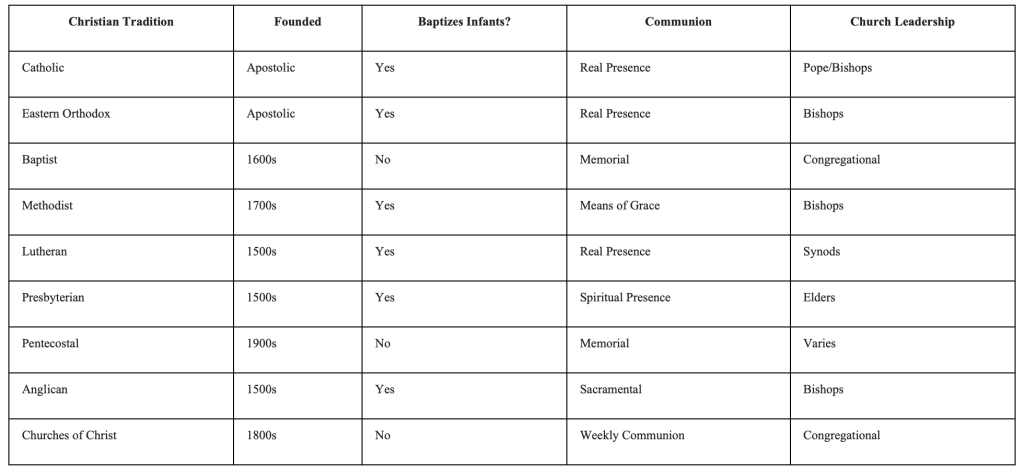
Christian Denominations Comparison Chart
The chart describes broad patterns. Individual denominations and congregations may differ, especially within Anglican, Baptist, Quaker and nondenominational settings.

Frequently Asked Questions About Christian Denominations
Which denomination is closest to the early church?
The answer depends on the kind of continuity being measured. Catholic, Eastern Orthodox, Oriental Orthodox and Church of the East traditions point to ancient liturgy, episcopal succession and an unbroken sacramental life. Protestants often place the greater weight on conformity to apostolic teaching in Scripture. Restoration churches deliberately tried to recover New Testament names and practices. A comparison must specify whether “closest” means historical succession, doctrine, worship or church government.
Which churches baptize infants?
Catholic, Eastern Orthodox, Oriental Orthodox, Church of the East, Lutheran, Anglican, Methodist, Presbyterian, Reformed, Moravian and many Congregational churches baptize infants. They understand baptism in sacramental or covenantal terms and expect the child to be formed within the church.
Which churches practice believer’s baptism?
Baptist, Anabaptist, Restoration Movement, Adventist, Pentecostal, Evangelical Free, Christian and Missionary Alliance and most nondenominational churches baptize people who personally profess faith. Immersion is the usual mode in these traditions.
What is the difference between Catholic and Orthodox Christianity?
Catholic and Orthodox churches share ancient creeds, bishops, apostolic succession, sacramental worship and belief in Christ’s real presence in the Eucharist. The central institutional dispute concerns papal authority. Catholics recognize the pope’s universal jurisdiction; Orthodox churches recognize the historic importance of the bishop of Rome but govern through autocephalous churches and councils of bishops. The Western addition of *filioque*, meaning “and the Son,” to the Nicene Creed and later doctrinal developments also remain points of disagreement.
What is the difference between mainline and evangelical Protestantism?
Mainline describes a group of historically prominent U.S. Protestant denominations, including the Episcopal Church, ELCA, PC(USA), United Methodist Church, United Church of Christ, American Baptist Churches USA and Christian Church (Disciples of Christ). Their national bodies tend to use historical-critical biblical scholarship, ordain women and take more progressive positions on sexuality and public policy, though local congregations vary.
Evangelical describes a theological movement centered on biblical authority, conversion, Christ’s saving work and evangelism. Evangelicals exist within some mainline denominations as well as in conservative Anglican, Baptist, Presbyterian, Wesleyan, Pentecostal and independent churches.
What is the difference between Baptist and nondenominational?
Baptist names a historical family with characteristic teachings about believer’s baptism and local church government. Nondenominational only describes the absence of formal denominational affiliation. Many nondenominational churches are Baptist in practice, while others are Reformed, charismatic or Pentecostal. Their beliefs must be determined from the individual church’s teaching and governance.
What is the difference between Pentecostal and charismatic?
Classical Pentecostalism consists of denominations formed from the early-20th-century Pentecostal movement. Many teach that baptism in the Holy Spirit follows conversion and that speaking in tongues is its initial evidence. Charismatic Christianity brought the practice of spiritual gifts into Catholic, Anglican, Lutheran, Methodist and other churches without requiring members to leave those traditions. Independent charismatic churches may resemble Pentecostal churches but do not necessarily accept the classical doctrine of initial evidence.
Why do some churches use instruments while Churches of Christ do not?
Most Churches of Christ interpret New Testament instructions about singing as the authorized pattern for congregational worship and therefore sing a cappella. Independent Christian Churches emerged from the same Restoration Movement but permit instruments. Both ordinarily practice believer’s baptism by immersion and weekly Communion.
What should a church name tell a visitor?
Names such as Catholic, Lutheran, Presbyterian, Methodist, Baptist and Assemblies of God point to identifiable histories and doctrinal traditions. “Community Church,” “Bible Church,” “Grace Church” and similar names may identify an evangelical congregation without revealing its position on baptism, Calvinism, spiritual gifts, women in ministry or outside accountability. In those cases, the church’s full statement of faith, leadership structure and affiliations are the most useful sources.