

Second Baptist Church Houston has won a major court ruling in its closely watched lawsuit over church governance and member voting rights. A Texas judge upheld the church’s 2023 bylaws that eliminated congregational voting and transferred authority to a Ministry Leadership Team, while allowing part of the lawsuit to continue.
The ruling that ended congregational voting at one of Houston’s largest churches may have settled much of the legal dispute, but what still lingers is the larger question of whether Second Baptist’s new structure reflects the Baptist tradition it professes. Let’s look at how this decision affects Baptist church governance, church autonomy under the First Amendment, and whether ending member voting is consistent with historic Baptist practice.
Second Baptist Church won the central legal battle over its 2023 bylaws this week. Whether its leaders have won the argument over accountability is another matter.
In a 40-page opinion issued July 15, Texas Business Court Judge Grant Dorfman upheld bylaws that eliminated members’ voting rights and transferred broad governing authority to the church’s Ministry Leadership Team. Dorfman dismissed most of the claims brought by Jeremiah Counsel Corporation, an organization formed by current and former Second Baptist members.

The ruling is a major victory for the megachurch, but it is not the unqualified vindication church leaders may suggest.
Dorfman invalidated a separate attempt to amend the church’s articles of incorporation, finding that Second Baptist had failed to provide the written notice required by Texas law. He also allowed Jeremiah Counsel’s claim for an accounting to survive, preserving its ability to pursue access to certain church financial records.
Most importantly, the judge did not find that Second Baptist’s leaders had dealt candidly with the congregation. He concluded that a civil court could not decide some of the members’ central allegations without entering constitutionally protected religious territory.
That distinction matters.
Here’s what the court decided.
The dispute began with a called church business meeting held May 31, 2023. According to the court’s opinion, Second Baptist announced the meeting during May 21 and May 28 worship services at its six campuses. Notices also appeared in two church newsletters.
Members were told that the meeting would “update our Bylaws to protect our ability to continue operating as a biblical church.”
The proposed changes were approved 315-2. The court described Second Baptist as having approximately 94,000 adherents, although that figure should not be confused with the number of active members who regularly attend or would have been eligible to vote.
The new bylaws abolished member voting rights involving the selection of pastors, board members and church officers. Members also lost their votes on future changes to the governing documents, certain expenditures and other church business.
The Board of Trustees was replaced by a Ministry Leadership Team, or MLT. Under the new structure, the senior pastor appoints the initial MLT members. Later members may be nominated by the senior pastor and elected by the existing MLT. The team exercises broad authority over church property, financial resources and other corporate affairs.
The bylaws also changed the process for selecting a senior pastor. In 2024, Ed Young named his son, Ben Young, as his successor without a congregational vote.
Jeremiah Counsel alleged that members were not adequately told what they were being asked to approve. As Katy Christian Magazine’s original report explained, former deacon vice chairman Rob Hungate and other critics argued that the meeting notice concealed changes that fundamentally altered the relationship between Second Baptist and its congregation.
Dorfman upheld the bylaws under a provision of Texas law allowing churches to announce certain meetings orally. The church was not legally required to circulate the complete proposed bylaws or summarize each change before that vote, he found.
The attempted amendment to the articles of incorporation was different. Texas law required written notice containing the proposed amendment or a summary of it. Second Baptist provided neither, and the defendants conceded that point. Dorfman therefore declared the amendment invalid.
That did not restore the congregation’s voting rights. The judge found that those rights had been established in the old bylaws, not expressly guaranteed by the articles of incorporation. Because the new bylaws were validly adopted under the applicable notice law, they remain in effect.
What does ecclesiastical abstention mean?
Much of the reaction to the ruling has centered on the legal doctrine known as ecclesiastical abstention, also called the church-autonomy doctrine.
The principle grows out of the First Amendment. Civil courts cannot decide questions of religious doctrine, determine whether a belief is theologically correct or substitute their judgment for that of a church on core ecclesiastical matters.
That protection is indispensable. The government should not appoint pastors, rewrite doctrine or tell Christians how to interpret Scripture.
But ecclesiastical abstention is not complete immunity from civil law. Dorfman expressly wrote that church autonomy is not an “all-or-nothing” barrier. When a church chooses to organize as a nonprofit corporation, courts may apply neutral legal principles to matters such as corporate notice, governing documents and access to records.
That is exactly what happened here. Dorfman applied Texas corporate law when he invalidated the articles amendment and upheld the bylaws. He also found that church autonomy did not block Jeremiah Counsel’s claim for an accounting.
The constitutional boundary appeared when the court reached the allegation that Second Baptist’s stated desire to remain a “biblical church” concealed the leaders’ actual purpose.
To decide whether that explanation was fraudulent, Dorfman reasoned, a judge or jury would have to determine what the phrase “biblical church” meant to the leadership and congregation. A civil court could not conduct that inquiry without judging a religious assertion.
The resulting decision does not say that the description was honest. It says the court could not constitutionally determine whether it was dishonest.
Apffel questions what happens when courts step back.
Filmmaker Nathan Apffel, director of the documentary series The Religion Business, responded to the ruling by warning that a doctrine created to protect religious freedom can also leave church members with limited remedies when authority is concentrated inside an institution.
“Ecclesiastical abstention was created to protect religious liberty,” Apffel said. “And now the irony is super hard to ignore.”
Apffel’s most important point was also his most measured:
“The question isn’t whether the church should be free from government control. It 100% should be. The question is whether we’ve built institutions so powerful that Christians have fewer rights inside their church institution today than they do outside of it,” he said in a viral post on Instagram on Thursday.
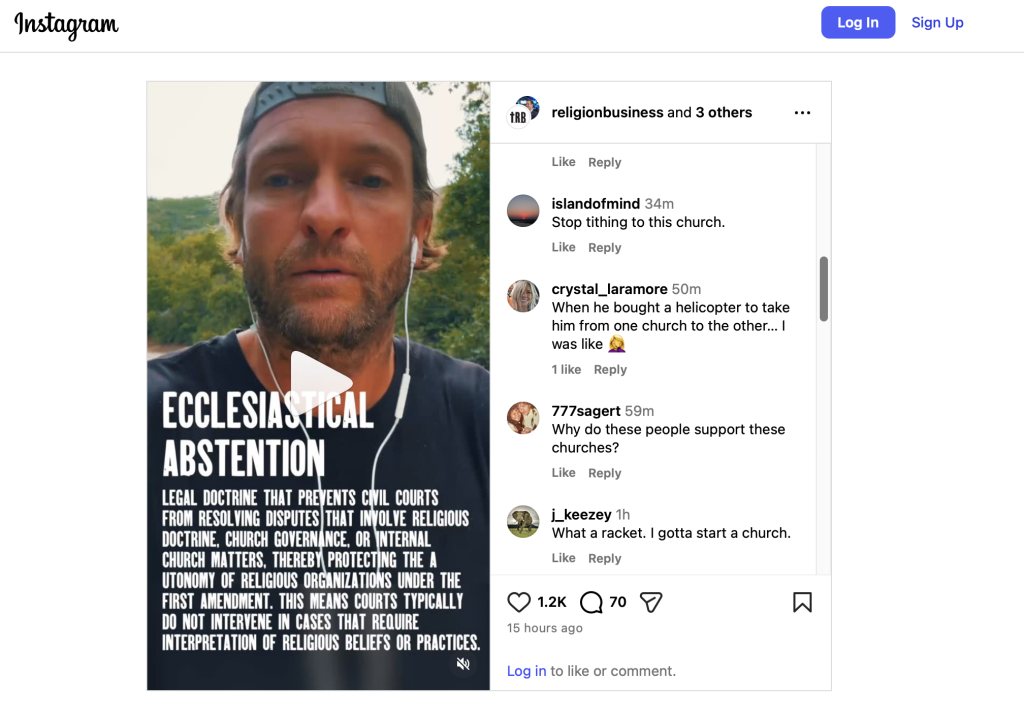

His concern deserves serious consideration, even where some of his language goes beyond what the ruling officially establishes.
“What was a voter-led church is now a family business,” he said.
“Family business” is Apffel’s characterization, not Second Baptist’s legal status. The church technically remains a nonprofit religious corporation. Dorfman did not transfer church assets to the Young family, nor did he award anyone control of the estimated $1 billion in assets cited in news reports and by critics.
The governance transfer occurred through the 2023 bylaws. The court’s ruling largely allows that arrangement to remain in place.
However, that ruling is heavily consequential. The practical result is that Second Baptist’s congregation no longer selects the people exercising corporate authority over the institution. The church is governed by a leadership team whose initial members were appointed by the senior pastor and whose later members are chosen through an internal nomination and election process.
How does this compare with Baptist tradition?
Second Baptist identifies itself as a Baptist church cooperating with the Southern Baptist Convention. Its statement of beliefs affirms local church autonomy, meaning that no denomination, bishop or other outside body controls the congregation.
That autonomy helps explain why the Southern Baptist Convention cannot simply reverse Second Baptist’s bylaws. Southern Baptist churches associate voluntarily, and each local congregation retains authority over its own affairs.
But Baptist autonomy has historically been paired with congregational responsibility.
Article VI of the Southern Baptist Convention’s Baptist Faith and Message describes the church as “an autonomous local congregation of baptized believers.” It then states that each congregation operates under Christ’s lordship “through democratic processes” and that every member is responsible and accountable to Christ.
Those principles exist together. Autonomy protects a local church from control by an outside hierarchy. Congregational governance addresses who exercises responsibility inside the church.
As Katy Christian Magazine’s new guide to Christian denominations explains, Baptist churches have never all followed one identical procedure. Some give pastors and elders more authority than others. Some reserve congregational votes for a limited number of major decisions.
Still, eliminating member voting altogether represents a substantial departure from the congregational model Baptists have historically defended. The fact that a church possesses the legal autonomy to make that change does not settle whether the change is consistent with its stated Baptist identity.
This breach in tradition is a question the church must answer.
Second Baptist defends the ruling.
In a statement published by Second Baptist, Ben Young welcomed the decision.
“We received word that the judge has ruled in our favor in the matter before the court and we are deeply grateful,” Young said. “We remain committed to the work God has called us to through this, His church.”
Jay Sekulow, whose American Center for Law and Justice represents the church, said the decision properly recognized the limits on civil-court involvement.
“From the very beginning of this case, we have maintained that decisions about church governance belong to the Church, not the civil courts,” Sekulow said.
He is correct about the constitutional boundary. Civil judges should not run churches. They should not select pastors or impose their own understanding of biblical governance.
But constitutional protection does not establish that every protected decision is transparent, prudent or faithful to the principles a church professes.
The law can determine whether the minimum notice requirements were satisfied. It cannot require leaders to offer fuller disclosure than the statute demands. It cannot compel them to invite meaningful disagreement or give members a continuing voice once the governing documents remove that voice.
Those are matters of character, stewardship and trust.
Crucial questions remain unresolved.
Dorfman’s ruling did not decide whether members were given a candid account of what they would lose in the 2023 vote. It did not determine whether abolishing congregational voting was consistent with Baptist theology. It did not rule that concentrating authority in the MLT was spiritually wise.
The surviving accounting claim may give members access to relevant financial information. Jeremiah Counsel has also said it plans to appeal and ask Dorfman to clarify portions of the ruling. Until an appeal is filed, however, it should be described only as planned.
The church’s attempted articles amendment also remains invalid. That raises questions about how the older articles’ provisions concerning trustees operate alongside bylaws that replaced the Board of Trustees with the MLT. Those questions require further clarification; they should not be presented as decided.
For now, Second Baptist has secured a substantial legal victory. Its bylaws remain in effect, most of the lawsuit has been dismissed and the scheduled jury trial will not proceed.
Yet the ruling leaves the central moral question untouched.
Religious liberty protects the church from the state. It should not be treated as a substitute for accountability inside the church.
A judge cannot tell Second Baptist what a biblical church must look like. But members, donors and other Baptists are free to ask whether a church without meaningful congregational participation still reflects the Baptist understanding of the church.
The court has drawn its constitutional boundary. Second Baptist must now answer to a different standard—one that cannot be satisfied merely by winning a lawsuit.