BREAKING: HOUSTON, TX — A growing legal battle is casting a long shadow over one of the largest churches in the nation, where members say sweeping bylaw changes were made behind closed doors—and are now being guarded with alarming secrecy.
At Houston’s Second Baptist Church, members can only view the current bylaws by making an appointment with a church administrator, where they’re not allowed to take notes, make copies, or snap photos. In some cases, a church attorney is present to monitor the viewing, according to an exclusive interview with a former Deacon Vice Chairman obtained by Katy Christian Magazine.
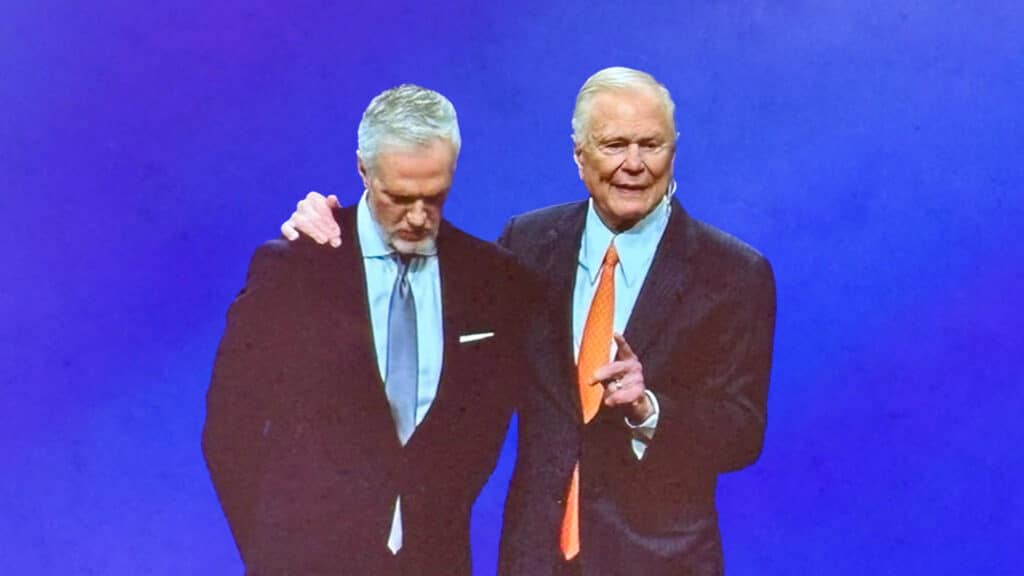
The tightly controlled access is part of what plaintiffs call a broader effort to strip away long-held voting rights and centralize power under senior leadership. Now, church leaders—including longtime pastor Dr. Ed Young and his son, Pastor Ben Young—face a lawsuit alleging they pushed through the changes with little notice and no transparency, fundamentally altering the church’s governance structure.
The 123-page petition, filed April 15 in Harris County’s 55th District Court by a member-led group called Jeremiah Counsel Corporation, claims the new bylaws dissolved the church’s independent board of trustees and granted ultimate authority to a small group—many of them staff or family members of the senior pastor.

The suit alleges that fewer than 200 of Second Baptist’s 94,000 members attended the May 31, 2023, meeting where the bylaw changes were approved, representing less than a quarter of one percent of the church’s membership. Plaintiffs claim the meeting was poorly publicized and conducted without sufficient transparency.
“This action seeks no monetary damages,” Jeremiah Counsel said in an open letter released April 23. “We simply ask for the return of church governance rooted in accountability, transparency, and member participation.”
At the center of the controversy is the shift from a congregational model—where members historically had the right to vote on major church decisions—to a more centralized structure likened by critics to “nepotism,” “a corporate church” and a “family-owned business.”
The new bylaws allegedly removed the independent board of trustees and granted broad, unchecked authority to church leadership, including the Young family.
One former Deacon Vice Chairman, Rob Hungate, who spoke with Katy Christian Magazine described the transformation as “the tale of two cities.”
“Prior to the church business meeting in May of 2023, our church’s governance structure included an independent Board of Trustees composed of mostly Second Baptist Church members,” he said. “Following that meeting, our Board was replaced by a Ministry Leadership Team that is now composed of non-independent folks—either family of our Senior Pastor or church staff. Currently, there is only one, truly independent member of this group.”
Hungate also pointed to what he called one of the most alarming provisions.
“Our Senior Pastor has been given complete control over the business and day-to-day affairs of the Church, which gives him the ability to break any deadlocks in the unlikely event that half of the Ministry Leadership Team voted against him,” he said.
“This means the Senior Pastor has the final and ultimate authority to do as he pleases.”
Internal documents and interviews reviewed by the Christian Post and others highlight widespread concern among church staff and members, particularly regarding financial transparency. Critics warn the new model introduces significant risks, including lack of oversight, potential financial mismanagement, and diminished member trust.
“The Bible is being taught, isn’t it?” one staff member reportedly said in response to concerns—comments some observers say reflect a deeper issue of conformity bias and misplaced reliance on individual leaders rather than structured accountability.
Financial experts warn that centralized control in nonprofit religious institutions can introduce “agency risk” and “moral hazard”—terms used in corporate governance to describe situations where decision-makers may prioritize personal interests over those of the organization, or take undue risks knowing they will not personally bear the consequences.
As one financial analyst noted, “The risks aren’t theoretical. They’re real. Churches must implement strong internal controls, independent audits, and transparent reporting if they want to remain both spiritually and financially healthy.”
Hungate, who began attending Second Baptist in 1981 and has served in multiple leadership roles over the years—including on the Parking Lot Welcome Team, as a Bible Study Director, and on the Bus Captain Committee for Angels of Light—said the changes were kept hidden until well after the vote.
“No copies of the new bylaws were distributed at the church business meeting,” he said. “We were asked to vote on them without having the opportunity to view the new bylaws beforehand or even at the meeting. I first read a copy of the new bylaws in July of 2024—14 months after the church business meeting.”


Upon reviewing the new governance structure, Hungate said the implications were clear.
“Our collective church enterprise approaches $1B in value and deserves the governance of a Fortune 500 company. These new bylaws do not afford that to our church membership who deserve this type of independent, non-conflicted, oversight.”
The former Deacon Vice Chairman also criticized how access to the bylaws is currently handled.
“In order to view our current bylaws, a member must make an appointment with our Church Administrator. During these meetings, the church member is not allowed to take a copy of the bylaws away, make notes or take any pictures,” he said. “Here lately, the Church Administrator will have a church attorney sit in on the meeting with the church member. In comparison, some other churches post their governing documents on their church website.”
Church leadership has not publicly responded to the lawsuit as of this writing. A review of court filings shows that Jeremiah Counsel is not seeking to dissolve the church but hopes to restore member voting rights and reinstate oversight boards that were part of Second Baptist’s governance for decades.
Second Baptist Church, one of the largest churches in the Southern Baptist Convention, grew significantly under Dr. Ed Young’s leadership. Critics of the new bylaws stress that the changes, while possibly well-intentioned, set a dangerous precedent that could lead to spiritual and financial decline.
“This isn’t about politics or theology,” one plaintiff said. “It’s about integrity, stewardship, and honoring the legacy of shared governance that made this church what it is today.”
The former Deacon echoed that sentiment, emphasizing that he and others tried every possible avenue before filing suit.
“We have followed Matthew 18 to the letter,” he said. “We have had personal meetings with our Senior Pastor and church leadership. These meetings have not gone well as they will not talk about this subject… We have written two letters, both very detailed, that described our concerns and listed our remedies. Neither of the two letters were ever acknowledged.”
The lawsuit, he added, was a last resort. “Filing this lawsuit was the last thing any of us wanted to do. But we were ignored at every turn despite all of our heartfelt efforts. Our congregation deserves a voice and Jeremiah Counsel fills that void left by these new bylaws.”
When asked what he hopes will come from the lawsuit, his answer was simple: transparency and restoration.
“We are asking for the restoration of our old bylaws so that a new, qualified, independent Board of Trustees, elected by the members of SBC, can manage the business affairs of our church. A truly independent Board can study the issues and draft appropriate new bylaws. Then a new church-wide vote should be taken.”
The proposed solution also includes open communication with the congregation. “Prior to this new vote, we ask that the bylaws be distributed ahead of time, complete copies with full transparency, so that our members can be informed and make up their own minds.”
Some members, Hungate noted, have already faced repercussions for speaking out, including being removed from committees, ministry positions, and even choir roles.
“There are many ways that folks can disagree,” he said. “We’ve tried the private, closed-door approach, individually and collectively. We’ve tried written correspondence. We’ve tried it all with absolutely no response back from the Senior Pastor or church leadership.”
Despite the internal strife, he remains hopeful.
“This is very fixable and can be done fairly quickly,” Hungate said. “But it takes both sides to work together. Unfortunately, we have been, and continue to be, the only ones sitting at the table willing to talk and work this out.”
The case is pending in Harris County District Court under Judge Latosha Lewis Payne.