
Editor’s note: This article is the first installment in a new Katy Christian Magazine series exploring forgotten histories connected to Katy, Texas and the wider state history that shaped the communities we know today.
The Battle of Medina, TX, was the bloodiest battle in Texas history, yet it remains one of the state’s most forgotten events. Fought in 1813, this vicious event took place about 20 miles south of present-day San Antonio and claimed more lives than any other battle ever fought on Texas soil. Despite its enormous impact on the future of Texas, the Battle of Medina San Antonio has never received the recognition given to later battles like the Alamo or San Jacinto. Before there was Katy, this devastating conflict helped shape the future of Texas in ways that few people today realize.

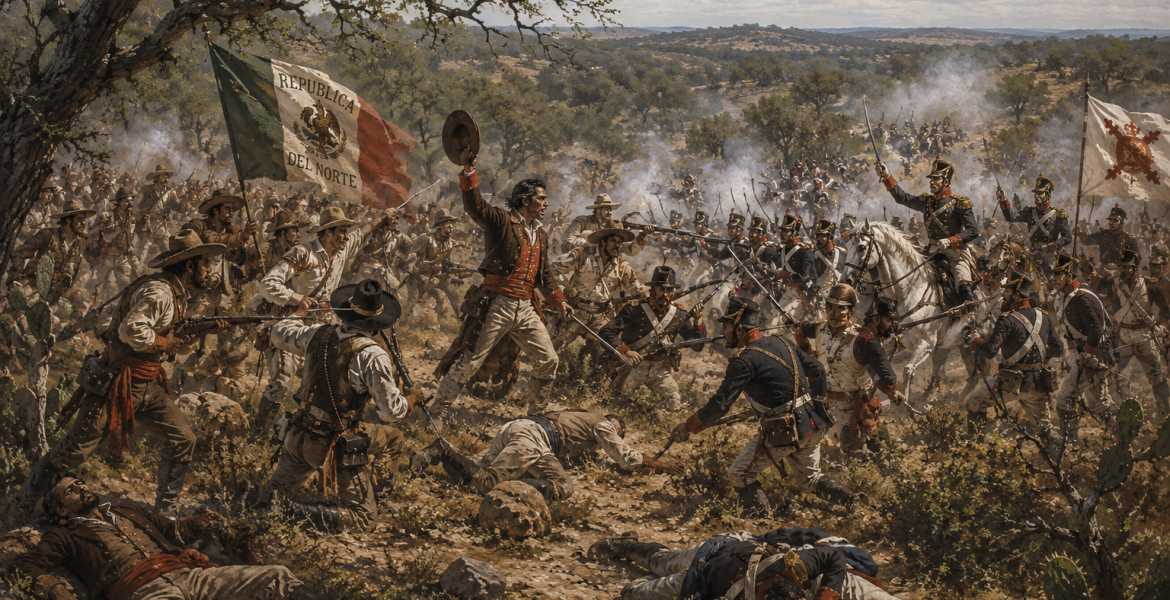
On the morning of Aug. 18, 1813, an exhausted rebel army moved through deep sand south of San Antonio, chasing what its men believed was a Spanish cavalry force on the run.

They had already been marching in the August heat for hours. They were thirsty and exhausted. Their commander, José Álvarez de Toledo y Dubois, had reportedly ordered them not to pursue too far, but the men pressed forward anyway. By the time they reached the oak forest known then as el encinal de Medina, Spanish royalist Gen. Joaquín de Arredondo had chosen his ground, built breastworks and ordered his soldiers not to fire until the rebels came within close range.
The event that unfolded after was not a piece of a famous Texas victory. It was not the Alamo, and it was not San Jacinto. It was the forgotten Battle of Medina, fought about 20 miles south of San Antonio, and the Texas State Historical Association describes it as the bloodiest battle ever fought on Texas soil.
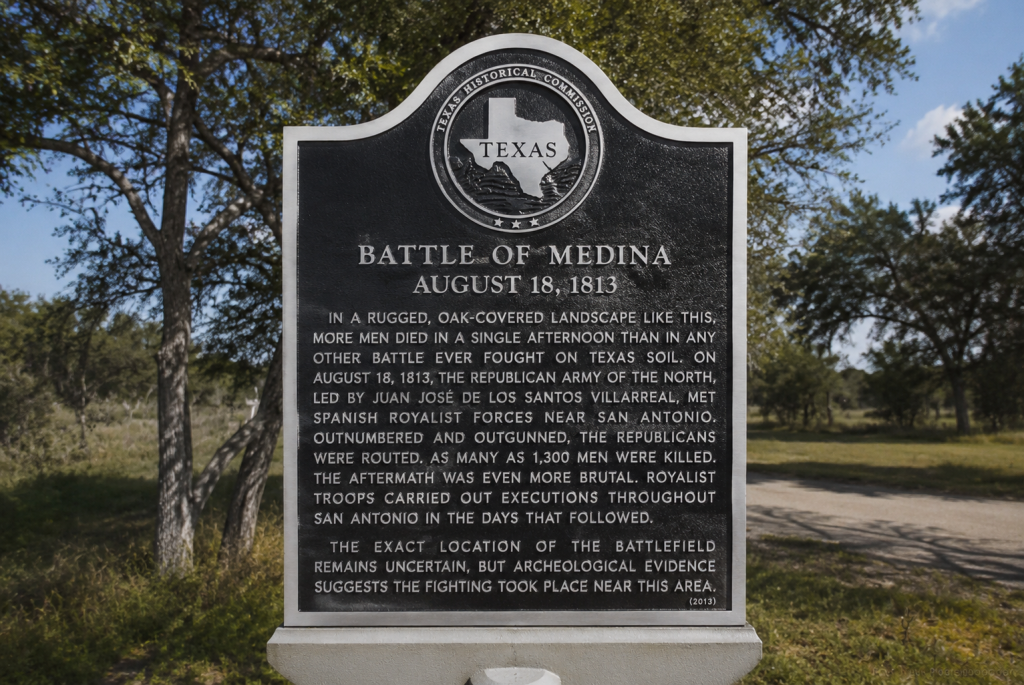
For a battle of that size, Medina occupies a surprisingly small place in public memory. The Texas Historical Commission marker near Leming says the battle “may have taken place” in the general vicinity. The exact battlefield has still not been settled archaeologically, though recent discoveries have given historians new leads. While most Texans can name the Alamo, far fewer can explain why, more than two decades earlier, another army had already fought and died for a different vision of Texas independence.
The story begins in a period when Spain’s empire was under pressure on several fronts. In Europe, Napoleon’s wars had shaken Spain. Across Latin America, independence movements were challenging Spanish rule. Texas was still a province of New Spain, but the borderlands were unstable, and men on both sides of the Sabine River saw opportunity in the unrest.
José Bernardo Gutiérrez de Lara, a supporter of Mexican independence, and Augustus Magee, a former U.S. Army officer, helped organize what became known as the Republican Army of the North. Their force crossed from Louisiana into Texas in August 1812 under a green flag and quickly won ground. They captured Nacogdoches, Trinidad de Salcedo and La Bahía, where Magee died during the campaign. Then they turned toward San Antonio.
By the spring of 1813, the expedition had done something that sounds almost shocking in the context of the portions of Texas history most people learn. The rebels captured San Antonio, and on April 6, 1813, they proclaimed a declaration of independence for the State of Texas under the Republic of Mexico. That was 23 years before the 1836 Texas Revolution.
The victory did not bring stability. The rebel coalition was made up of Anglos, Tejanos, Native Americans, Mexicans and former royalists, and it carried all the tensions one might expect from that mix. After San Antonio fell, Spanish Gov. Manuel María de Salcedo and other royalist officers were executed, a decision that damaged the expedition and cost it support. Gutiérrez was soon pushed aside, and Toledo took command in early August 1813, just as Arredondo was marching north from Laredo with a royalist army.
According to the Handbook of Texas account, Arredondo had about 1,830 men. Toledo had about 1,400. Tejano leaders urged the republican commander to meet the royalists south of San Antonio rather than let the city become the battlefield. On the night of Aug. 17, Toledo’s army camped about six miles from Arredondo’s force between the Atascosa and Medina rivers and planned to ambush the royalists along the Laredo road.
The plan failed almost immediately the next morning. Royalist scouts found the republican force and drew the men forward. The rebels trudged through deep sand for several hours, believing they were pursuing a smaller cavalry unit. Arredondo, meanwhile, waited in a stronger position. When the republican army finally came within range, it was already worn down.
The fighting lasted about four hours. Infantry, cavalry and artillery were all involved, and when the republican line broke, the retreat became a slaughter. The Texas State Historical Association reports that most of the men who were not killed on the battlefield were captured and executed as they fled. Fewer than 100 escaped.
In comparison, at the Alamo, roughly 600 to 800 men from both sides were killed or mortally wounded.
The number of dead varies by account, but the scale was extraordinary. The Witte Museum says more than 1,300 men died fighting for Mexican independence in the 1813 battle. The Spanish royalists lost only 55 men, according to the Handbook of Texas, and those soldiers received military burial as Arredondo’s army returned to San Antonio.

As for the defeated rebels, their bodies were left to rot on the field.
Arredondo then imposed martial law in San Antonio and punished suspected rebel sympathizers and their families. The Gutiérrez-Magee Expedition account from the Handbook of Texas states that royalists shot 327 people in San Antonio. Women connected to suspected rebels, many of them widows and daughters, were imprisoned in La Quinta and mistreated for months, according to the Battle of Medina entry.
One young royalist officer serving under Arredondo would later become far more famous in Texas history. Antonio López de Santa Anna was among Arredondo’s subalterns during the Medina campaign. More than 20 years before he returned to Texas during the 1836 revolution, Santa Anna had seen what happened when a rebellion in Texas was crushed without mercy.
The bodies of the men who fought with the Republican Army of the North were left on the battlefield for years. In 1822, after Mexico won independence from Spain, José Félix Trespalacios, the first governor of Texas under the newly established Republic of Mexico, ordered soldiers to gather the bones and bury them under an oak tree on the battlefield.
That detail alone explains part of why Medina is so different from the better-known battles of Texas history. There was no clean victory to celebrate, no single preserved battlefield that became a pilgrimage site and no black-and-white cast of heroes and villains that later generations could easily turn into a “Texas History” school lesson. The rebellion itself was complex. It was tied to Mexican independence, Spanish colonial rule, U.S. border politics and early Texas separatism all at once.
Even the battlefield resisted easy memory. The Texas Historical Commission has described the location of the Battle of Medina as “forgotten and lost”, and the official marker near Leming notes that the exact site has not been determined archaeologically. In recent years, however, researchers have made progress. The Witte Museum reported that American Veterans Archaeological Recovery and the UTSA Center for Archaeological Research identified a likely site and uncovered musket balls, grape shot, chain pieces and buckle pieces connected to the battle. Texas Public Radio reported in 2025 that artifacts from the period have been found at several sites in Bexar and Atascosa counties.
That ongoing search has changed how some historians talk about Medina. It was part of a longer struggle over who would control Texas, who would claim loyalty to Spain or Mexico, and who would pay the price when rebellion failed.
For San Antonio, the price was severe. Families connected to the republican cause were punished. The city’s population and political life were shaken. The violence after Medina helped shape the distrust and caution that followed Spanish rule into the Mexican period. It also left behind a warning that later Texans would have understood clearly: rebellion could end not only in battlefield defeat, but in reprisals against wives, daughters, neighbors and entire communities.
That may be one reason the battle never became part of Texas memory in the same way as the Alamo or San Jacinto. Medina does not fit neatly into the familiar 1836 story. Its army included Tejanos, Anglos, Native Americans, Mexicans and former Spanish loyalists, and its cause was tied to Mexican independence before the pursuit of Texas independence. Its aftermath was well over a thousand bodies left in the brush and families punished in San Antonio.
The Battle of Medina belongs in the larger collection of histories taught about Texas. It shows that the fight over this land did not begin in 1836, and that early Texans were already caught in questions of empire, independence, citizenship and loyalty long before the players most people recognize entered the story.
Today, the site of the bloodiest battle ever fought on Texas soil is still being pieced together through old records, family histories, metal fragments and careful fieldwork south of San Antonio. More than two centuries later, the search itself has become part of the story.
Most Texans remember the Alamo. Many know what happened at San Jacinto. But years before either battle, an army marched south from San Antonio under a green flag, believing Texas could belong to a different future.
By sunset, that army was nearly gone.