
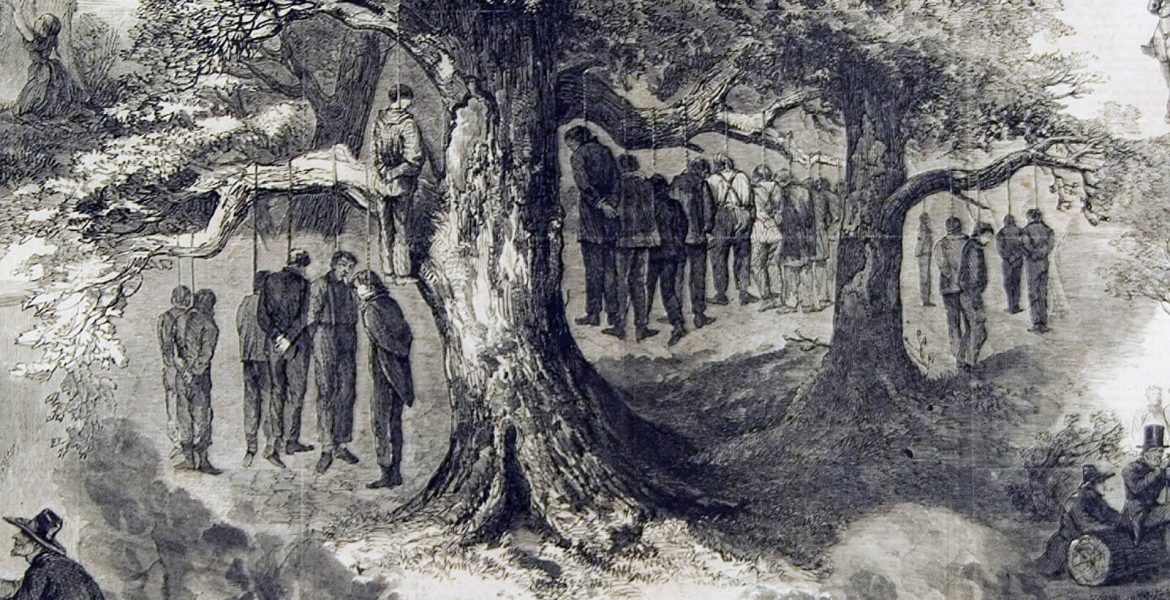
The Great Hanging at Gainesville, also known as the Great Gainesville Hangings, remains one of the darkest chapters in Texas history and is widely regarded as the largest mass hanging in American history. During just 13 days in October 1862, approximately 150 North Texas men were arrested on accusations of treason, insurrection or sympathy for the Union. Before the month was over, at least 40 had been hanged and two others were shot in a wave of vigilante justice fueled by wartime fear, rumor and political hysteria rather than the protections of a lawful court. It is a tragic story that has largely faded from Texas classrooms despite its profound place in both Texas and American history.
Rain fell over Gainesville on Oct. 1, 1862, as armed men began knocking on doors. According to a reconstruction published by the Texas Observer, approximately 70 residents were taken from their homes that morning and confined inside a vacant store. More arrests followed. Within 13 days, roughly 150 men had been swept into custody on suspicion of treason, insurrection or sympathy for the Union.
Before October ended, at least 40 men had been hanged and two others had been shot while trying to escape. Some received hurried trials before an improvised citizens’ court. Fourteen were surrendered directly to a mob. Nineteen were condemned after an earlier decision to release them was reversed without new evidence.
The killings became known as the Great Hanging at Gainesville, an event the Texas State Library and Archives Commission describes as possibly the largest single outbreak of vigilante violence in American history. Today, Gainesville sits about 70 miles north of Dallas, close to the Oklahoma border. In 1862, it was a raw frontier settlement where a man’s politics, birthplace or reputation could place a rope around his neck.

 A Town Divided Against Itself
 A Town Divided Against Itself
Gainesville had grown quickly after the Butterfield Overland Mail route reached the community in 1858. Stagecoaches brought passengers, mail and settlers through a region that had once seemed remote even by Texas standards. Many newcomers came from Tennessee, Kentucky, Missouri, Illinois and Indiana. They were generally small farmers and tradesmen, and relatively few owned enslaved people.
The Handbook of Texas account written by historian Richard B. McCaslin estimates that fewer than 10% of Cooke County’s heads of household owned enslaved people in 1860. Yet much of the county’s political and military leadership belonged to that small slaveholding class. Seven of the 12 men later chosen for the citizens’ court were enslavers. Col. James G. Bourland and Col. William Cocke Young together owned nearly one-quarter of the enslaved people in the county.
Cooke County voters had rejected secession in 1861 by a vote of 221 to 137. The rest of Texas carried the state out of the Union, and many North Texans eventually entered Confederate service, however reluctantly. Their earlier opposition remained part of the local memory. Once the war began to turn against the Confederacy, suspicion settled over the county.
Life along the North Texas frontier already carried a constant sense of danger. Settlers feared raids by Comanche and Kiowa warriors. Stories about Kansas abolitionists drifted south. Several suspicious fires in Texas during the summer of 1860 had been blamed on enslaved people and Northern agitators, helping produce an earlier wave of lynchings. A Northern Methodist minister was killed after someone forged a letter portraying him as an abolitionist.
By 1862, rumors required little evidence to become accepted fact.
The Confederate Conscription Act intensified the anger. Passed in April, it made white men between the ages of 18 and 35 eligible for compulsory military service. New taxes, military impressment and exemptions favoring certain slaveholders added to the resentment. Men who had expected to defend their homes along the frontier faced the possibility of being sent hundreds of miles east to fight in distant campaigns.
Thirty Cooke County men signed a petition protesting the draft exemptions and sent it to the Confederate government in Richmond. Others deserted military units or refused to report. A secretive organization variously called the Peace Party, the Union League or simply “the Order” began attracting men who opposed conscription, favored the old Union or wanted protection against roving criminals and raids.
The organization existed, although its membership and intentions differed sharply from the enormous conspiracy later described by Confederate loyalists. Some members may have discussed seizing military arsenals, aiding deserters or cooperating with a future Union invasion. Others appear to have joined for mutual protection or draft resistance. McCaslin’s research found that the group lacked firm leadership and that its separate factions pursued different purposes.
Rumors placed its membership as high as 1,700. Stories circulated that conspirators planned to capture Gainesville and Sherman, murder Confederate leaders, release prisoners and welcome a Federal army arriving from Kansas. In a county of farms, scattered settlements and rough roads, the alleged uprising somehow grew larger with every telling.
Bourland, serving as the Confederate provost marshal for the region, sent informants into the organization. One spy claimed that brothers Henry and Ephraim Chiles had discussed an armed rebellion. By late September, military authorities ordered the arrest of able-bodied men who had failed to report for duty. Bourland’s troops began their roundup on the rainy morning of Oct. 1.
The arrests reached far beyond the men named by informants. Farmers, mechanics, suspected deserters and outspoken opponents of secession disappeared into Gainesville under armed guard. Their wives and children often had little information about the accusations or when the men might return.
Inside the vacant store, the prisoners waited while the town decided what to do with them.
The Court Beneath the Elm
Neighboring counties sent suspected Unionists before military or Confederate courts. Gainesville’s leaders created their own tribunal.
Young presided over a public meeting where residents voted to establish a citizens’ court. A committee selected 12 jurors, and the community pledged to enforce whatever decisions they reached. Texas law gave this court no recognized authority. Its members acted as investigators, jurors and final arbiters of life and death, with military force standing behind them.
The accusations were treason and insurrection, yet the proceedings offered few of the protections expected in a capital case. The prisoners had no regular judge, no established rules of evidence and no dependable avenue of appeal. The court initially allowed a simple majority of jurors to convict.
All seven men condemned under that rule were hanged.
Henry Chiles was among the first. George Washington Diamond, a Confederate officer and brother of one of the men involved in uncovering the alleged conspiracy, later obtained the tribunal’s records. His surviving account of the proceedings was explicitly intended as a defense of the court, and its descriptions must be read with that purpose in mind. Even so, the account preserves a chilling view of how Gainesville carried out its first execution.
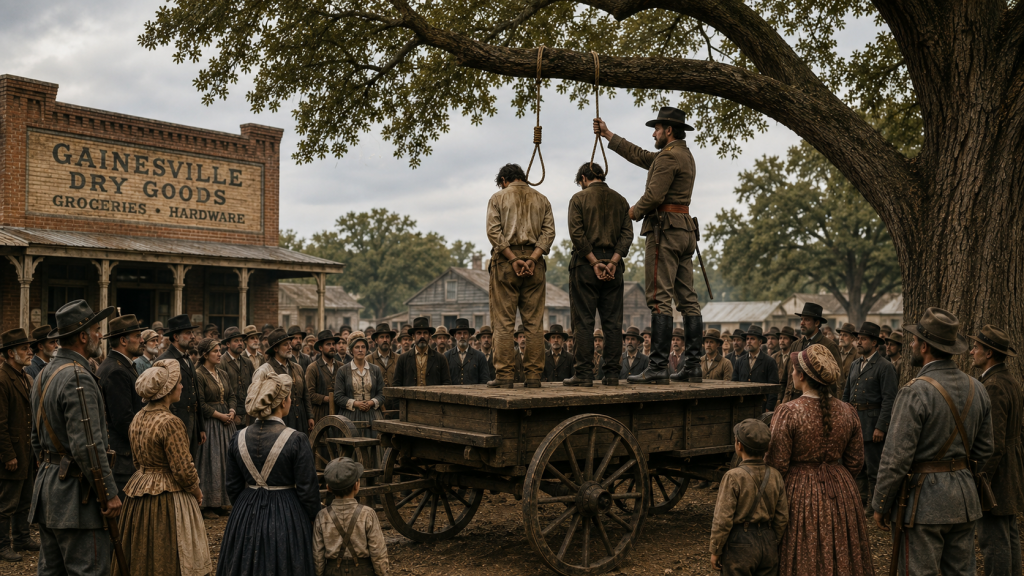
Guards placed Chiles in an open carriage and took him approximately half a mile east of town. A crowd had gathered around a large elm tree. Soldiers stood in a hollow square while the carriage passed through the people and stopped beneath a heavy branch.
The execution warrant ordered that Chiles be hanged “until he is dead dead dead” and ended by asking God to have mercy on his soul. The carriage then moved from beneath him. His body remained suspended until those overseeing the execution were satisfied that he had died, after which it was released to his grieving family.
The elm became Gainesville’s gallows. Men were taken there one or two at a time, with the same town gathering nearby. The machinery of execution remained starkly simple: a rope, a tree limb and a wagon or carriage that could be driven away from beneath the prisoner.
After the first convictions, two jurors objected to the court’s low threshold for imposing death. The panel changed its rules and began requiring a two-thirds majority. That decision spared several prisoners and led the jurors toward releasing many of the remaining men.
The crowd outside had reached a different verdict.
Hard-line Confederates feared that anyone released would join an uprising or return with Union troops. Armed men threatened to break into the prisoners’ quarters and kill everyone inside. According to the Texas Observer’s account of the tribunal, two mob leaders demanded 20 prisoners, and one member of the citizens’ court supplied a list of names. Fourteen men were chosen from it.
They never received trials.
On Oct. 12 and 13, the 14 prisoners were taken to the elm and lynched. Among them was Nathaniel Miles Clark, a Missouri-born farmer who had settled in Cooke County with his wife and children around 1857. Clark owned no enslaved people, opposed secession and hoped to keep his oldest son away from the war. The surviving record contains little connecting him to any planned uprising.
His family remained in Cooke County after his death. Clark’s grave marker describes him as “murdered by a mob” and records final words addressed to his family: “Prepare yourself to live and die. I hope to meet you all in a future world. God bless you all.”

The citizens’ court adjourned, and the remaining captives appeared to have survived the worst. The jurors planned to hold them for several days while the anger in town subsided.
Then William Cocke Young was killed.
On Oct. 16, Young and James Dickson were pursuing men suspected of an earlier killing when they were ambushed. The identities and motives of the attackers remained uncertain. They may have been deserters or fugitives caught in the expanding violence. In Gainesville, their actions were soon connected to the feared Unionist conspiracy.
Young had helped establish the citizens’ court and participated in the first phase of the proceedings. Some later accounts portrayed him as a moderating influence once the mob began demanding more deaths. His murder removed that restraint and gave the crowd a prominent Confederate martyr.
When the tribunal reconvened, several original jurors stayed away. Hard-line Confederates replaced them. The court reopened the cases of 19 men who had already been considered for release.
The jurors heard no meaningful new evidence. They condemned all 19.
Capt. Jim Young, the dead colonel’s son, supervised the executions. The prisoners went to the elm in small groups until each of the 19 was dead. Revenge had entered the proceedings openly, and the citizens’ court supplied it with the appearance of a verdict.
The violence continued outside Cooke County. Five suspected Unionists were hanged in Sherman before Brig. Gen. James W. Throckmorton intervened and prevented further executions. Five more died in Decatur, and a Confederate partisan shot a prisoner in Denton. The Texas State Archives’ Civil War timeline counts 53 suspected Unionists murdered in the wider North Texas violence associated with Gainesville.
Texas newspapers largely approved. Gov. Francis R. Lubbock praised the military response, and the Legislature reimbursed the cost of feeding troops stationed in Gainesville. Confederate newspapers presented the dead as dangerous traitors whose removal had saved North Texas from invasion.
The Northern press later used Gainesville as evidence of Confederate brutality. President Jefferson Davis dismissed Gen. Paul Octave Hébert, the Confederate commander of Texas, amid concerns about martial law and military abuses that included the hangings. Gainesville’s victims were already buried by then, many in graves whose locations would eventually be forgotten.
The Families and the Silence
The final death toll varies because contemporary records disappeared and later accounts counted the victims differently. McCaslin’s Handbook of Texas history identifies 40 men hanged in Gainesville and two shot while attempting to escape. The memorial erected near the execution site bears 42 names. Some older accounts count additional court-martial executions or nearby deaths as part of the same episode.
“At least 40 hanged and two shot” remains the most cautious description. The Great Hanging is often called the largest mass hanging in American history, although its combination of tribunal-ordered executions and outright lynchings makes exact comparisons difficult.
Its effect on Cooke County extended far beyond the number of bodies beneath the elm. Accounts associated with later commemorations describe 42 widows and approximately 300 children left behind. Farms lost the men who worked them. Families faced wartime shortages while carrying the stigma attached to suspected treason. Some fled North Texas. Others remained and learned to keep quiet.
Nathaniel Clark’s oldest son, James Lemuel Clark, received word of the hanging while away from home. A letter remembered by his descendants began, “Dearest mother, oh the horrors of my heart, no tongue can tell upon learning of my father’s death.” His writings later preserved details that might otherwise have vanished with the generation that witnessed them.
The official records offered little help. Diamond had received the papers of the citizens’ court for use in preparing his account, but the original documents were eventually lost. His manuscript remained unpublished for decades. Thomas Barrett, one of the jurors, also wrote a defense of the court. Both accounts became widely available only around the Civil War centennial, long after witnesses and most of their children had died.
By then, Gainesville had built a different public identity.
In 1964, the state placed a pink granite marker near the hanging site. Its wording preserved by the Texas Historical Commission repeats the Confederate interpretation of the Peace Party as a group sworn to destroy the government, kill its leaders and bring Federal troops into Texas. It describes the prisoners as conspirators and presents the executions as the lawful result of their guilt, despite the tribunal’s improvised authority and the 14 men killed without trials.
The tree itself disappeared. Accounts differ on whether it was cut down or burned. The site became a small patch of public land near Pecan Creek, bordered by traffic and commercial buildings. For years, the old marker stood as the principal official account of what happened there.
Local residents began holding private remembrances in 2007, placing 42 white crosses in the park and reading the victims’ names aloud. Plans for a larger 150th-anniversary event in 2012 collapsed amid disagreement over how Gainesville should present the killings. Victims’ descendants continued with their own gathering.
A permanent memorial finally rose near the site in 2014. Two gray granite slabs stand several feet high, one bearing an account of the violence and the other listing the dead. Descendants of eight victims attended the dedication. Colleen Clark Carri, Nathaniel Clark’s great-great-granddaughter, had spent years pressing Gainesville to recognize the men. Her paving stone on the memorial path reads, “On Hallowed Ground.”
The old elm is gone, and the men who gathered beneath it left behind competing stories about what they had done. Confederate loyalists described a town saved from insurrection. Victims’ families remembered neighbors dragged from their homes, condemned under shifting rules and hanged before their wives could bring them back.
The surviving evidence allows both fear and organized opposition to exist in the same history. A secret anti-Confederate movement operated in North Texas, and some members discussed resistance. That evidence never established the vast army of assassins and invaders imagined in Gainesville. Wartime panic turned draft resistance, political dissent, rumor and personal suspicion into one sprawling conspiracy. A court created by frightened citizens then gave those suspicions the power of a death sentence.
For most of October 1862, the road east of Gainesville led to an elm tree. Men entered that road as prisoners, passed through crowds of people who knew their names and returned to their families as bodies. The horror lies as much in the familiarity as in the number killed. Gainesville’s violence came from within the community—from neighbors deciding which other neighbors could be sacrificed to make the town feel safe.
The granite memorial now forces their names back into public view. After more than a century of silence, the men beneath the elm have become difficult to erase again.
Enjoyed this piece? For more overlooked chapters of Texas history, read our stories on the New London School Explosion, the Battle of Medina, the ghost towns near Katy and the legends surrounding Texas’ lost treasures and haunted roads. Each explores a part of the state’s past that is rarely covered in classrooms but remains relevant in the places, culture and stories Texans have inherited.
Feature photo: Frank Leslie’s Illustrated Newspaper, 20 Feb 1864, Public domain, via Wikimedia Commons