
Is Patterson Road really haunted? For generations, Houstonians have shared chilling stories about Patterson Road, Blue Light Cemetery, strange lights, mysterious figures and rumors of devil worship along the lonely stretch of Patterson Road that winds through Addicks Reservoir and Bear Creek in west Houston. Some claim they’ve experienced unexplained encounters, while others insist the stories are nothing more than local folklore. But why has Patterson Road earned a reputation as Houston’s most haunted road? Katy Christian Magazine explored the history behind Patterson Road, Blue Light Cemetery, the forgotten community of Addicks and the legends that continue to attract curious visitors, separating documented history from decades of local stories.
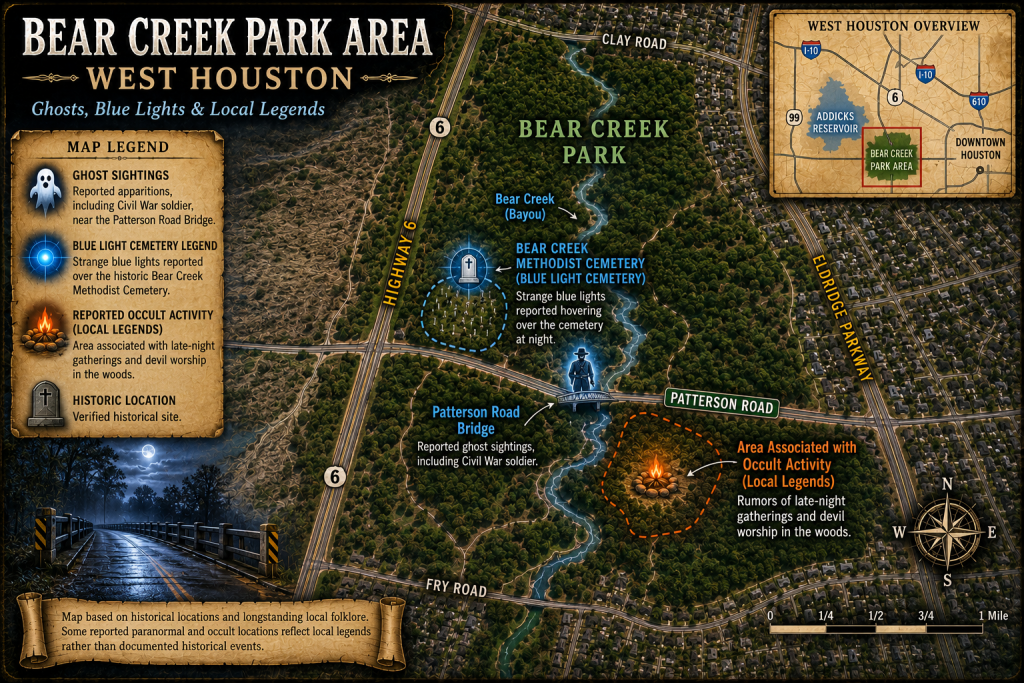
Patterson Road: Houston’s Most Haunted Road?
By day, Patterson Road is an unremarkable drive between Highway 6 and North Eldridge Parkway, skirting Bear Creek Pioneers Park past picnic grounds, playing fields, creeks and heavy stands of trees. After sunset, the familiar landmarks recede and the road seems narrower than it did a few hours earlier. Headlights catch a strip of pavement and the nearest trunks, while the reservoir beyond them disappears into darkness. Water can be heard moving beneath the bridges, insects pulse in the brush, and small sounds carry with surprising clarity through the open window of a car.

The most enduring Patterson Road legend gathers around the bridge over Langham Creek. Its instructions have circulated among Houston teenagers for decades: Drivers are told to pull onto the bridge late at night, stop, switch off the headlights and sit quietly enough to hear what approaches.
The tapping is said to begin softly, with a single metallic tick against the vehicle. Another follows from a different side, then another from behind, until the sound appears to move around the car. No one is visible outside. Some accounts add measured footsteps, a pale figure waiting near the road or shadows that cross the pavement when the headlights come back on.
The unseen marchers are usually described as Civil War soldiers. One version says troops once marched through the area, while another places a battle or skirmish near the creek and leaves the dead somewhere in the surrounding woods. In the legend, the soldiers keep to their old formation and tap against a stopped vehicle because it stands where their path once ran.
The story has traveled well beyond school hallways and campfires. A 2006 local account of a nighttime trip to the Patterson Road bridges described rushing water, nocturnal animals and darkness deep enough to make the wooded road oppressive. Other visitors have reported the familiar tapping while parked on the bridge. In 2013, the Houston Chronicle again included Patterson Road among the city’s best-known haunted locations, showing how far the tale had spread beyond the neighborhoods around Bear Creek.
The details change with the teller. The dead may be Confederate soldiers, troops caught in a forgotten skirmish or men simply marching through the area, but every version ends with the soldiers still walking their route. The lack of one settled account has given the story room to travel, and Patterson Road supplies every new teller with the same dark water, hidden ground and bridge waiting beneath the trees.
The Community the Reservoir Left Behind
The woods were once part of a settled landscape. German immigrants settled Bear Creek around 1850 along Bear, Langham and South Mayde creeks, building farms, a one-room school, a post office, a German Methodist church and a shooting club that hosted meetings, dances, barbecues and traditional competitions. According to the Texas State Historical Association’s history of Addicks, a general store opened near present-day Highway 6 and Patterson Road in 1882. When the post office moved there two years later, it took the name of the community’s first postmaster, Henry Addicks.
Water repeatedly remade the settlement. The 1900 hurricane destroyed Bear Creek and Addicks, and although residents rebuilt, the creeks continued to spill across the low ground. Destructive floods in 1929 and 1935 eventually led the federal government to authorize the Addicks and Barker reservoir project, which would hold stormwater before it reached Buffalo Bayou and force the old community to yield to a new purpose.
Construction during the 1940s emptied much of the old community. Families living north of the railroad and along the creeks had to relocate. By 1948, 40 homes and buildings had been moved or destroyed, including the Bear Creek German Methodist Church, and the Addicks School graduated its final senior class. The U.S. Army Corps of Engineers still manages the reservoir as part of Houston’s flood-control system.
Addicks is a dry reservoir, so most days the old ground remains exposed beneath the trees and grass. Heavy rain can cover it again, changing the routes through the woods and swallowing familiar landmarks beneath floodwater. The setting feels suspended between a park and an abandoned town, with pieces of the former community lying inside land that was intentionally cleared and left undeveloped.
Readers can explore more of that history in Katy Christian Magazine’s guide to Addicks and other ghost towns and lost communities near Katy.
That flood-control history explains the isolation that falls over Patterson Road after dark. Houston grew outward on every side, bringing subdivisions, traffic and commercial development close to the reservoir boundary, while the land inside remained wooded and sparsely lit. A driver can leave a busy intersection and, within minutes, find the city reduced to a glow behind the trees.
Blue Light Cemetery: The Legend That Refuses to Die
Deeper inside the same landscape is the burial ground generations of Houstonians have called Blue Light Cemetery. Reaching it has never felt like arriving at a formal cemetery entrance; accounts describe a small fenced place tucked among the trees, easy to miss unless someone already knows where to look.
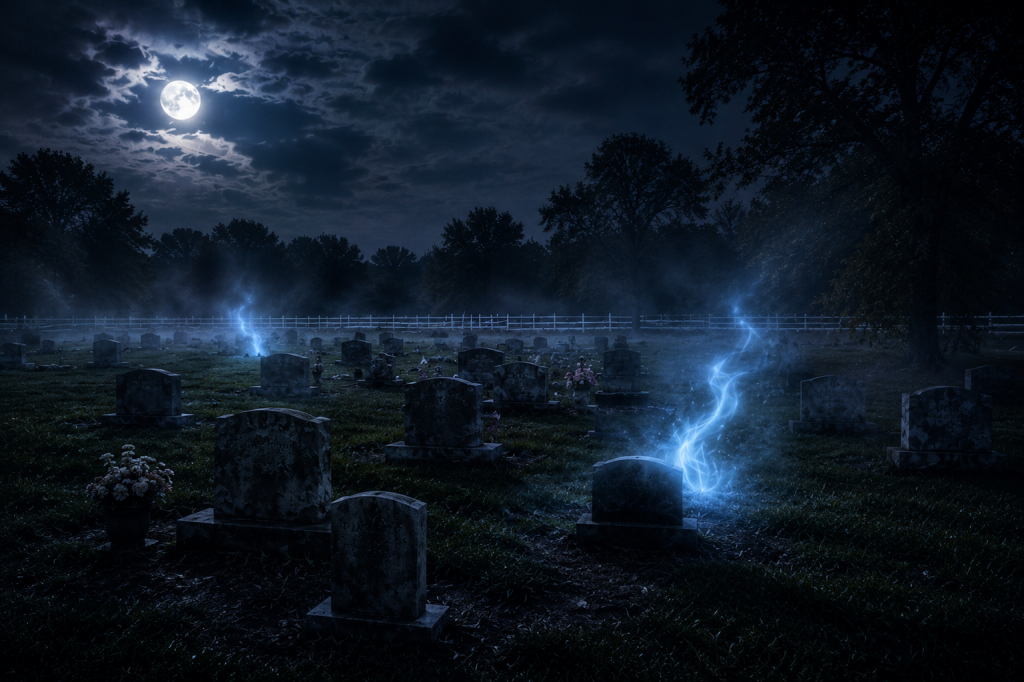 Its real name is Hillendahl-Eggling Cemetery, a family burial ground connected to the German settlers who lived along the creeks before Addicks became a town. The cemetery is associated with the Hillendahl and Eggling families, as well as William Addicks. A German Methodist congregation later built a church near the graves, but persistent flooding made the site difficult to reach and the sanctuary was eventually moved. The Harris County Historical Commission records the congregation’s early years and its departure from the poorly drained ground.
The cemetery stayed behind as the community around it shifted and disappeared. Trees thickened along the old routes, floodwater returned, and the handful of graves became harder to separate from the surrounding woods. Somewhere along the way, reports of an unusual glow attached a second name to the burial ground, and Hillendahl-Eggling became Blue Light Cemetery.
Visitors have described a cold blue glow hanging low over the burial ground or slipping between the trees. In some accounts it is a haze that seems to rise from the graves. In others, it breaks into small moving lights that vanish when someone walks toward them. Stories also mention shadows near the fence and the uncomfortable impression that a watcher remains just beyond the point where the woods become too dark to read.
Explanations for the light have become part of the folklore. Old grave markers may catch and throw back distant light; moisture, swamp gas and passing headlights have also been suggested. Those possibilities have never displaced the accounts of people who entered the woods expecting a neglected cemetery and came away certain that the light moved on its own.
Houston has also had more than one burial ground known as a “Blue Light Cemetery.” The nickname has been attached to Tetter Cemetery near Spring, allowing stories about two remote sites to cross paths as they passed from one part of the city to another. Details that began on Houston’s north side could surface years later in Bear Creek with a new date, a different witness and a location shifted miles to the west.
Hillendahl-Eggling remains one of the last physical traces of the families who lived here before highways, subdivisions and reservoir boundaries remade the map. The graves belong to real people, including children whose lives lasted only a few years or months. The legend may draw visitors into the woods, but the ground deserves the care and restraint owed to any cemetery.

The history of the surrounding woods darkened in November 1971. Four days after the remains of 19-year-old Gloria Ann Gonzales were recovered near Addicks Reservoir, deputies searching the same area found 13-year-old Colette Anise Wilson, who had disappeared five months earlier from a bus stop near Alvin. Wilson had been shot in the head, and Gonzales died from blunt-force trauma. Contemporary coverage of the Wilson investigation recorded how closely the discoveries followed one another, binding two real killings to land already known for its isolation.
More than two decades later, 18-year-old Robbie Bayley was struck in the head with a small ax and left to die in woods near Bear Creek Park. A Houston Press investigation reported that more than 30 teenagers visited his decomposing body during the weeks before two 8-year-old boys finally discovered his remains in August 1993. The path was close enough to nearby subdivisions for local teenagers to reach easily, yet secluded enough for Bayley’s body to remain among the trees for weeks. A jury later convicted Stanley Nicholas of criminally negligent homicide in connection with Bayley’s death.
Authorities did not connect these killings to Blue Light Cemetery or the stories about satanic rituals. Even without such a connection, the cases give the woods a more unsettling history: The same seclusion that makes an engine, footstep or tap sound strangely close at night has also allowed real violence to remain hidden from the neighborhoods only a short distance away.
The Devil Worship Rumors
The devil-worship rumors formed another layer over this already uneasy landscape. They concern neither marching soldiers nor blue lights over the graves, but people who were said to enter the woods after dark and leave signs of what they had done there.
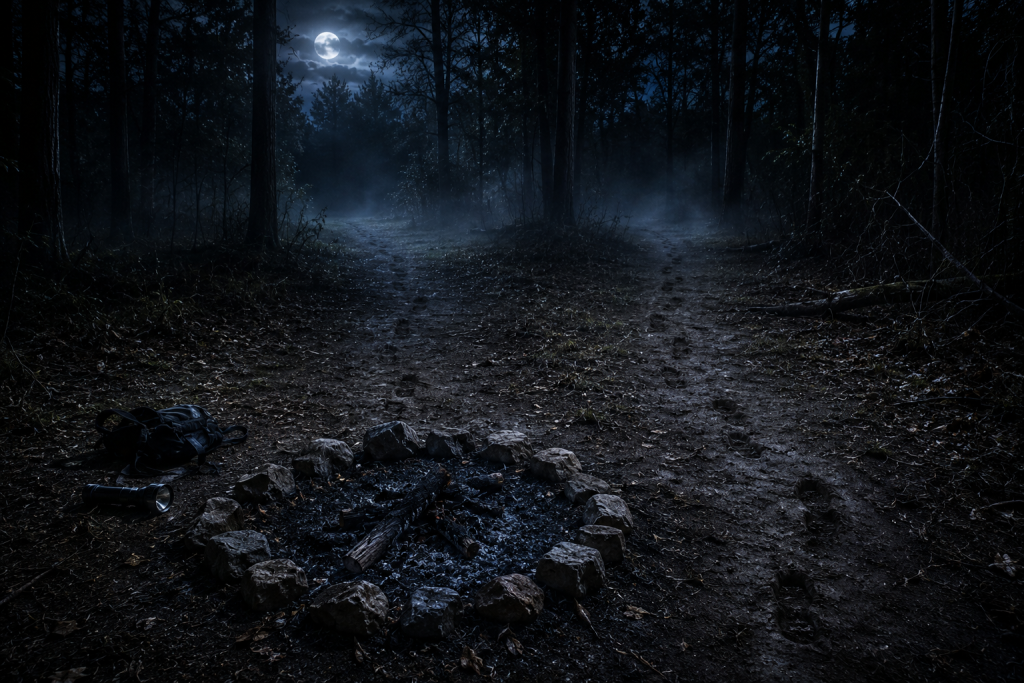
For decades, teenagers have traded warnings about clearings beyond the road where satanic rituals supposedly took place. The stories mention inverted crosses, scorched ground, half-burned candles, animal remains and symbols painted or cut into trees. Some versions include chanting carried through the woods. Others describe unfamiliar cars parked late at night and occupants who noticed when someone else came too close.
The rumor rarely arrives firsthand. A friend found a symbol; an older sibling saw a ritual; someone’s parents remembered police clearing people from the woods years earlier. Repeated often enough, the scattered accounts gathered into a larger story about a hidden altar and a group meeting beyond the road, although the location, witnesses and era changed from one telling to the next.
A large cross photographed in the woods off Patterson Road gave the rumors a physical object around which to gather. Online commenters have called it a memorial, an abandoned religious structure, evidence of a ritual site and an ordinary cross with no sinister history. The photograph became one more piece of the legend, inviting questions about what else might have been built or left beneath the trees.
The shared “Blue Light Cemetery” nickname likely helped unrelated stories migrate into the Patterson Road legend. Rumors from other Houston-area cemeteries mingled with the occult fears of the 1980s and early 1990s, then spread farther once neighborhood stories moved online. A warning once confined to a school, church youth group or subdivision could suddenly reach people across Houston who had never driven the road themselves.
The public record supplies no single beginning for the devil-worship stories. What survives is fragmented: symbols remembered years later, clearings that could not be found again, late-night cars and longtime residents who insist the woods once held things that are gone now. Together, those fragments have allowed nearly any fear about the reservoir to find a home just beyond Patterson Road’s headlights.
Why Patterson Road Still Frightens Houston
Urban legends often weaken when their setting is demolished, renovated or lit well enough to become familiar. Patterson Road has kept much of what first made the stories believable. The reservoir prevented dense development, the cemetery remained behind its fence, the creeks continued to cross beneath the road and floodwater periodically rearranged the landscape around what was left of Addicks.
The result is a mystery that belongs specifically to Houston. Patterson Road requires no distant road trip or ticketed attraction; it lives in the memories of people who grew up in Katy, Bear Creek, Copperfield, Cypress and west Houston. Many first heard about it from a classmate, an older sibling or a parent who once made the same nighttime drive. Years later, the details may blur, but the central question survives: If they stop on the bridge, will the tapping begin for them?
Katy Christian Magazine’s Perspective
Local folklore can be entertaining, and the legends surrounding Patterson Road are part of Houston’s cultural memory. Telling those stories does not require Christians to endorse ghost hunting, attempts to contact the dead or participation in occult practices.
The Bible draws a serious distinction between hearing a spooky story and deliberately seeking spiritual contact. Deuteronomy 18:10–12 warns against divination, sorcery, mediums and attempts to consult the dead. King Saul’s visit to the medium at Endor in 1 Samuel 28 is presented as part of his rebellion and downfall.
Scripture also gives Christians reason not to assume that every apparent supernatural presence is the spirit of a deceased person. Hebrews 9:27 teaches that a person dies and then faces judgment, while other passages acknowledge angels, demons and spiritual deception.
Christians are told in 1 John 4:1 not to believe every spirit, but to test the spirits.
These passages call for sober discernment. Strange lights and sounds may have physical causes, and folklore often grows with every retelling. If an experience is genuinely spiritual, Christians should not automatically interpret it as a harmless human ghost. Scripture recognizes deceptive and demonic spirits and never encourages believers to seek encounters with them for entertainment.
Christians do not need to fear Patterson Road, Blue Light Cemetery or the stories told about them. Confidence in Jesus Christ, whose authority is greater than every spiritual power, allows believers to approach such stories without superstition while still taking the Bible’s warnings about occult involvement seriously.
Patterson Road remains one of Houston’s most enduring ghost stories because the setting has never entirely released its past. The road still crosses dark water, the old community survives in fragments, the cemetery waits beyond the tree line and reports of blue lights and unseen footsteps continue to circulate. Christians can enjoy that folklore while treating the graves with respect, avoiding efforts to invite spiritual contact and keeping their faith firmly rooted in Christ.