
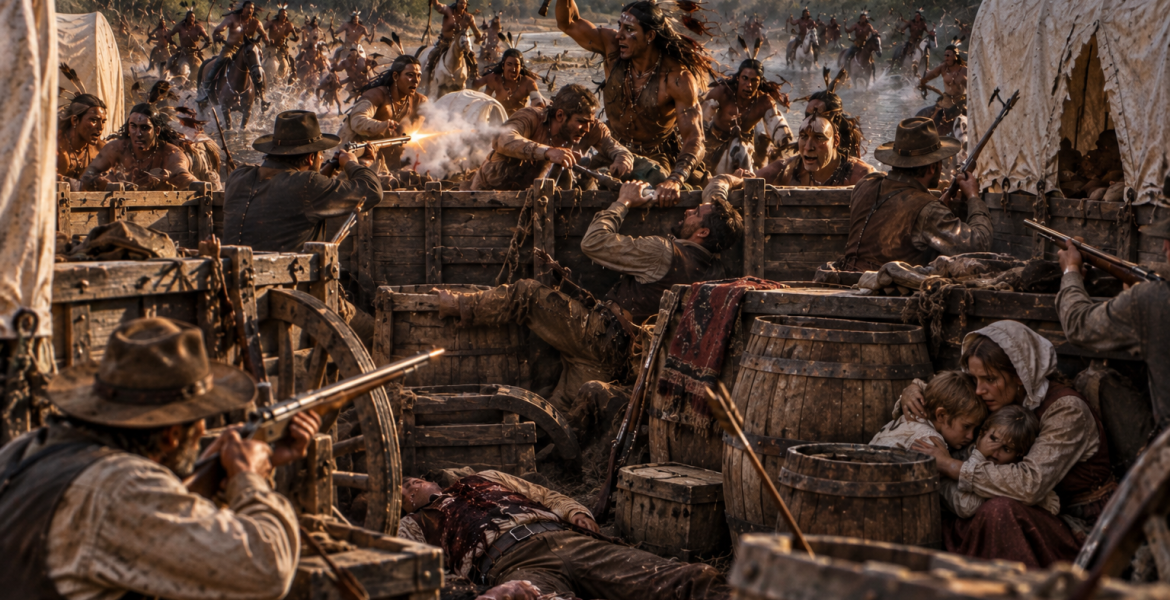
At sunrise in 1839, John Webster’s party emerged from the timber onto open prairie near present-day Leander and saw Comanche riders close behind. The travelers had spent the night forcing two ox-drawn wagons east through ravines and rough country, yet they had covered only about 5 miles. The settlements along the Colorado River—and any hope of help—remained far ahead.
Webster and 12 other adult men unhitched the oxen and pulled the wagons together for cover. Their entire defense consisted of those two wagons on exposed prairie. One man was already wounded. As the riders surrounded them, the settlers began a desperate fight against a force large enough to close every route of escape.
The battle ended with all 13 men dead. Webster’s wife, Dorothy “Dolly” Webster; their son, Booker, about 10; and their daughter, Martha, about 4, were taken captive and separated. Dolly and Martha later escaped on foot. Booker returned through a prisoner exchange. Years afterward, Martha came back to the tract her father had died trying to settle and helped found a community there.


A Land Grant Beyond the Republic’s Reach
Texas was an independent country when John Webster set out for the San Gabriel River. The Republic of Texas was only three years old in 1839. Mexico rejected its independence, and the republic exercised little authority over much of the territory printed on its maps. Mexican forces would invade again and capture San Antonio twice in 1842.
Across the plains, military power belonged largely to Comanche bands. Their country, known as Comanchería, covered much of present-day North, Central and West Texas. The Comanche called themselves Nermernuh, “the People,” and organized themselves into autonomous bands. The southernmost major division, the Penateka, ranged from the Edwards Plateau to the headwaters of Central Texas rivers.
Anglo-American settlement had steadily moved toward those hunting grounds. Stephen F. Austin’s colonists had fought Native groups along the Brazos and Colorado rivers since the early 1820s, when Texas still belonged to Mexico. By the late 1830s, surveyors and settlers were pushing farther west into Comanche country.
Settlers built farms, fenced property, hunted game and surveyed private tracts across land Native people had used for generations. Comanche parties raided settlements for horses and captives. Texans organized pursuits, attacked camps and demanded military protection. The Texas State Historical Association’s history of the Comanche records violence by both sides as 1838 ended.
Sam Houston had tried to build peace through trade. Comanche leaders wanted a recognized boundary between their territory and the settlements, but the Texas Congress refused. A treaty negotiated with Penateka leaders never won Senate ratification. Mirabeau B. Lamar succeeded Houston as president in December 1838 and replaced negotiation with an aggressive military policy.
Lamar also wanted the republic to expand west. In 1839, his government chose the small Colorado River settlement of Waterloo as the site of a new national capital. The town became Austin. Opponents, including Houston, warned that the location lay far from the population centers and remained vulnerable to attacks by Mexican and Native forces. The government nevertheless auctioned city lots that August and moved its offices there in October, according to the Handbook of Texas history of Austin.
While surveyors laid out Austin, John Webster was preparing to move still farther into the interior.
Webster had brought his family from Virginia to Galveston in November 1836, according to Martha’s later account. She also said her father served in the Texas army from January 1837 until March 1839, although historians have been unable to confirm that service. The family spent time around Hornsby Bend and Webberville, east of the new capital.
In April 1838, Webster obtained a first-class headright certificate originally issued to Charles Cavenah. Such certificates could be bought and transferred. A first-class family headright represented one league and one labor, or about 4,605 acres, under the republic’s land-grant system. On paper, Webster controlled a substantial tract. On the ground, the route offered no road, fort or military escort.
Surveyors located his land on the North Fork of the San Gabriel River in June 1838. The Texas Legislature created Burnet County there in 1852. In Webster’s day, the tract stood beyond the settled edge of Travis County and within country traveled by Comanche bands.
Webster appears to have waited about a year before attempting the move. That delay may have followed a series of Comanche attacks and battles around Brushy Creek and the San Gabriel in early 1839. Sometime between June and October, he loaded his household goods and supplies into wagons, gathered livestock and headed west with his wife, two children and 13 adult men.
The Five-Mile Journey Through the Darkness
Sixteen people made the final expedition: John, Dolly, Booker, Martha and 12 other adult men. The 1923 county history identifies several of the men as John Stilwell, a man named Flescher, two Reese brothers, Milton Hicks and Albert Silsbee. Four white men were not identified. The party also included a Black man named Nelson and a Mexican man named Antonio.
They traveled with two wagons, each pulled by three yokes of oxen, as well as a small herd of horses. Dolly later said the group reached Webster’s land near sunset on the fourth day. There they learned that Comanches were close. The settlers reversed course before they had unpacked and headed back toward the settlements on the Colorado River.
The route took them through broken ground around the forks of the San Gabriel. One later account describes an early clash in a ravine in which Silsbee was wounded. By the time the party reached the South Fork, the men faced a decision. Some reportedly favored taking a position along a bluff and making a stand. Webster chose to keep moving, hoping the darkness would hide the wagons and save the animals on which the family’s future depended.
The terrain defeated that plan. Wagons pulled by ox teams could move only so quickly through timber, ravines and uneven prairie. After traveling through the night, the party had covered about 5 miles.
At sunrise, the wagons emerged from the timber onto open ground near present-day Leander. The Comanche riders appeared behind them. Whatever protection the darkness had given the travelers was gone.
The men stopped the wagons, unhitched the oxen and took cover around the two vehicles. The mounted force closing around them vastly outnumbered Webster’s 13 men and controlled the surrounding prairie. Albert Silsbee had already been wounded. Help lay miles away, beyond the riders blocking the route east.
Gunfire broke out across the open ground. Webster’s men fought desperately from the wagons while Dolly, Booker and Martha remained trapped inside the encirclement. Frontier historian J.W. Wilbarger later placed the fight between sunrise and 10 or 11 a.m. Every defender died, taking the battle’s exact duration and its final moments with them.
The burial party found 10 men between the wagons. Silsbee lay dead inside one of them. Nelson and Antonio were found farther away, suggesting they may have tried to break through the surrounding force. The Comanche fighters took Dolly and the children captive, seized the usable property and livestock and pulled the wagons together before setting them on fire.
Years later, Martha remembered that three Comanche leaders—Guadalupe, Yellow Wolf and Buffalo Hump—broke apart the hilt of her father’s sword and kept the pieces. That identification rests on a childhood memory published in 1913, more than 70 years after the battle.
Some of the animals escaped. The county history says wounded livestock, including animals carrying arrows, wandered back toward Hornsby Bend. Their return alerted settlers that something had gone wrong. A rescue party followed the trail, found the bodies and buried the men together near the battlefield.

Their grave predates the cemetery that surrounds it. Davis Cemetery, at 9019 RM 2243 east of U.S. 183 in Leander, began as a family burial ground in the mid-1840s. Its earliest marked grave dates to 1851. The Webster victims had already been lying there for years.
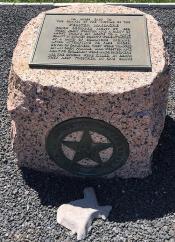
Photo by City of Leander government website
Marker text: “1.75 miles east to the graves of the victims of the Webster Massacre, which occurred August 27, 1839 when John Webster and a party of about thirty, en route to a land grant in Burnet County, were attacked by a band of Comanche Indians. After attempting to flee under cover of darkness, they were trapped on an open prairie. Mrs. Webster and her two children were made prisoners, all the others were killed. In death they rest together in one grave.” (1936)
After the Webster Massacre: Captivity and Two Escapes
The Comanche party divided the three surviving Websters among separate groups. Martha’s biography in the Handbook of Texas draws from Dolly’s captivity narrative, published in 1843, and Martha’s newspaper recollections from the early 20th century. They describe separation, hunger, physical abuse and repeated attempts to escape.
Dolly said the first escape came about a month into captivity. She, Martha and Booker slipped away together and found temporary refuge among a mixed group of Caddos, Mexicans and formerly enslaved Black people. Comanche traders discovered their location and exchanged horses for their return.
The second attempt came in March 1840, while Comanche leaders were traveling to San Antonio for negotiations over captives. Booker was then living with another group and remained behind. On the night of March 15, Dolly left camp with Martha and followed the trail toward San Antonio.
Martha was too weak to walk far, so Dolly carried her much of the way. They traveled for about 12 days. Near the end, they were exhausted, starving and still about 3 miles from San Antonio when Mexican oxcart drivers found them and carried them into town.
Their escape intersected with one of the most consequential confrontations in Republic-era Texas. On March 19, while Dolly and Martha were still making their way south, Comanche leaders entered San Antonio for what became the Council House Fight. Texas officials tried to detain the delegation until other white captives were returned. Fighting broke out inside and around the council house. More than 30 Comanche people, including 12 chiefs, were killed; seven Texans also died.
Texan authorities held surviving Comanche women and children as prisoners. Booker Webster arrived in San Antonio a few days after his mother and sister as part of the exchange that followed. The family’s reunion came in the middle of a crisis that pushed the Texas-Comanche conflict toward even greater violence. That August, hundreds of Comanche fighters swept through Victoria and destroyed the port town of Linnville before Texan forces intercepted them at Plum Creek.
Dolly and Martha eventually returned to Virginia. Dolly died there on July 29, 1845. Booker remained in Texas, attended school and later enlisted in the First Texas Mounted Volunteers during the Mexican-American War. He died in Mexico City on Jan. 16, 1848, before reaching his 20th birthday.
One Child Returned Years Later
Martha Webster returned to Texas with her uncle in 1849. By then, she had lost both parents and her brother. She was still a teenager.
Her first task was legal as well as personal. Martha reclaimed her parents’ headright certificates, including one issued in Dolly’s name. She initially lived in Bastrop, then moved onto her father’s San Gabriel tract in 1852. This was the very land the Webster party had turned back from 13 years earlier.
On Feb. 3, 1853, she married stockman Marmaduke D. Strickling, whose surname also appears in records as Strickland. Their home became the center of a small rural settlement called Strickling. A post office opened there by 1857. In 1861, the couple gave land for a Methodist church. By the 1870s, the community served as a terminal on the stage route between Austin and Lampasas.
Martha and Strickling had seven children. After his death in 1865, she married Charles Munroe Simmons, a farmer and former Union soldier, and had four more. She later lived in Oregon and California, where she continued telling newspapers about the attack and captivity. She died in Alameda, California, on Nov. 21, 1927, at age 91.
Martha also helped preserve the burial place near Leander. She and Thomas and Charles K. Reese, brothers of two of the dead men, placed memorials at the mass grave. The Texas Centennial Commission added the monument in 1936.
The City of Leander’s transcription of the 1936 marker dates the massacre to Aug. 27, 1839, and describes “about thirty homeseekers.” Land and family records place the journey between June and October 1839 and identify 13 adult men, Dolly and the two children, for a likely total of 16 travelers.
Every man who fought beside the wagons died, leaving Dolly and Martha as the family’s witnesses. Dolly recalled the event after months of captivity and a desperate escape. Martha was about 4 when it happened and published her fullest recollections as an older woman. Later writers combined those memories with local tradition and evidence collected decades after the burial.
John Webster’s certificate placed about 4,605 acres under his name. He died on the journey to settle it. Martha returned as a teenager, recovered her family’s land rights and made her home on the North Fork of the San Gabriel. By 1857, the community that formed around her had a post office; a church and stage stop followed.
Today, the men lie together at Davis Cemetery east of Leander. About 35 miles to the west, the former site of Strickling marks the land Martha finally reached. A visitor can follow the family’s story between those two places: the grave where the wagon journey ended and the tract where its youngest survivor began again.
Enjoyed this article? Continue exploring the overlooked people, places and events that shaped Texas in Katy Christian Magazine’s history archive. Read more forgotten Texas history:
- Before Katy, Texas: Indian Raids, Stephen F. Austin and the Forgotten War on Houston’s Frontier
- Six Years After the Alamo, Mexico Invaded Texas Again and Captured San Antonio Twice
- The Battle of Medina: The Bloodiest Battle in Texas History, Yet Most Texans Have Never Heard of It
- The Nueces Massacre of 1862: The Forgotten Texas Civil War Tragedy Where Wounded Unionists Were Executed
- The Great Hangings at Gainesville: Texas’ Darkest Chapter and the Largest Mass Hanging in American History
- Before Jack the Ripper: The Servant Girl Annihilator Who Terrorized Austin, Texas
- Before There Was Katy: 10 Ghost Towns and Lost Communities You Never Knew Existed
- The Battle of Sabine Pass: 47 Confederate Soldiers Stopped a 5,000-Man Union Invasion of Texas
- The 10 Greatest Lost Treasures in Texas: Spanish Gold, Pirate Treasure, Buried Silver & Hidden Fortunes Before There Was Katy