
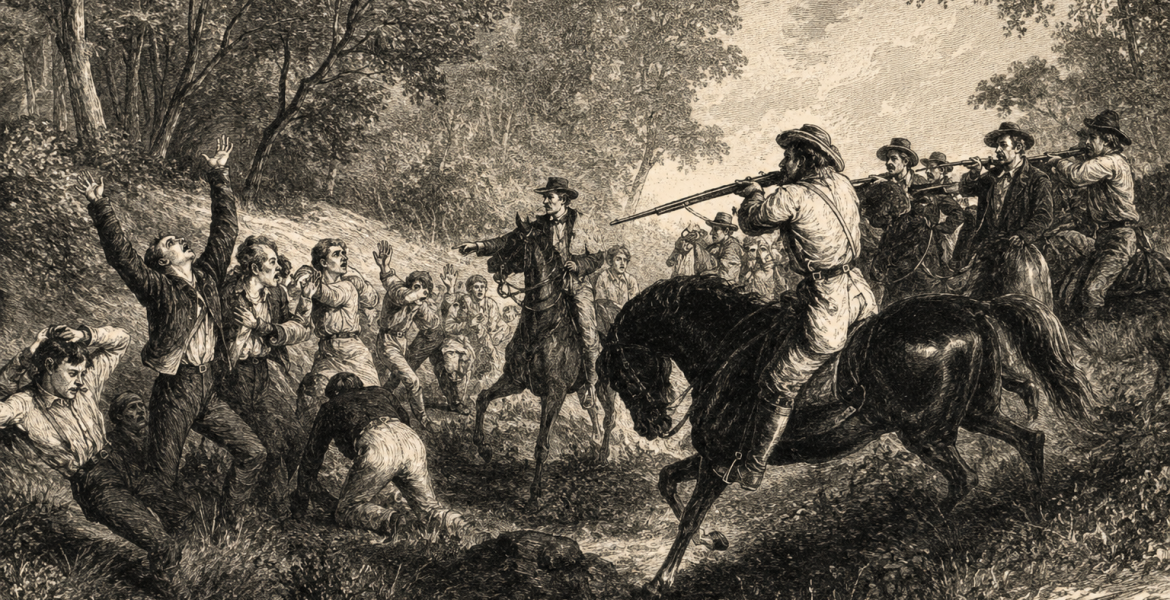
The Nueces Massacre of 1862 began on the evening of Aug. 9, when a group of mostly German Texas Unionists fleeing the Civil War toward Mexico made camp along the Nueces River. Hunting parties returning to camp reported unidentified riders following them, raising fears that Confederate troops had tracked them from the Texas Hill Country. Their leader, Fritz Tegener, dismissed the warnings and allowed the exhausted men to settle for the night on a small, grassy prairie surrounded by cedar trees. He posted only two guards. Nearly 100 armed pursuers were already closing in.
The mood in camp remained relaxed. August Hoffmann, one of the men traveling with Tegener, remembered that they spent part of the evening reciting humorous pieces. What they could not see was that nearly 100 armed pursuers had already found them and were waiting to attack.
The confrontation that followed became known as the Nueces Massacre, one of the most bitterly disputed episodes of the Civil War in Texas. The men at the river were Unionists, most of them German Texans who had refused to fight for the Confederacy. They were trying to cross into Mexico when Confederate and state troops attacked their camp before dawn on Aug. 10, 1862.
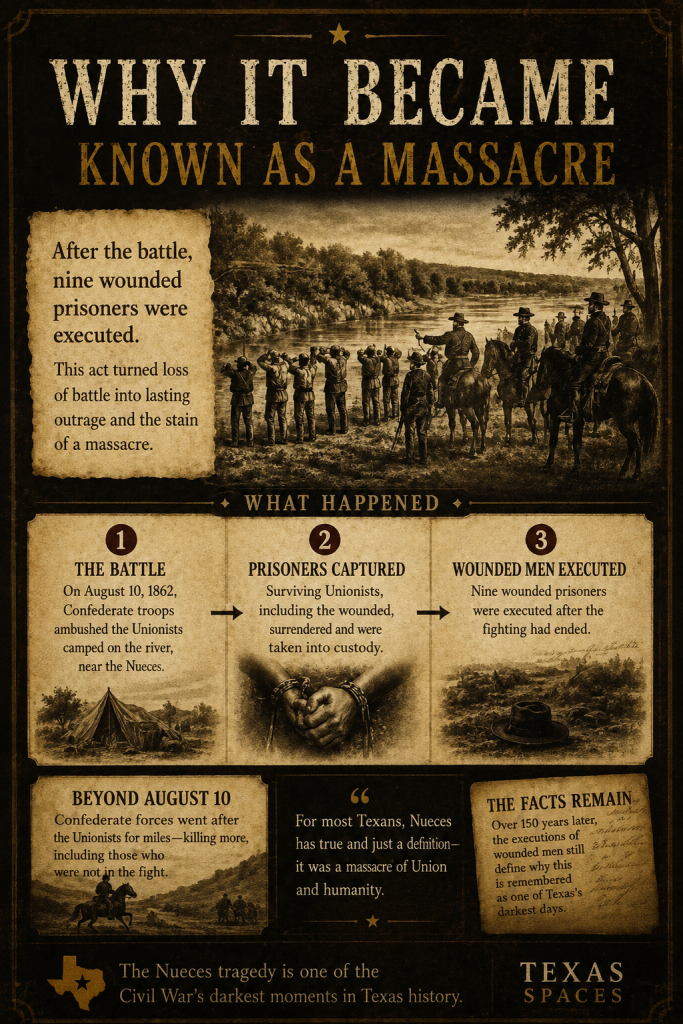
The first stage was a hard-fought battle between armed men. The killing of wounded prisoners that occurred afterward made it a massacre.

A War Reaches the German Hill Country
Texas left the United States in 1861, but thousands of Texans opposed secession. In the statewide referendum held that February, 46,153 voters supported leaving the Union and 14,747 voted against it, according to the Texas State Historical Association’s history of the secession vote. Eighteen counties rejected secession outright.
Opposition ran especially strong among some of the German communities established in the Hill Country. Many of their residents had arrived in Texas during the immigration waves of the 1840s and 1850s. Among them were political refugees who had participated in the failed European revolutions of 1848 and left Germany when monarchies reasserted control.
These immigrants were sometimes called Forty-Eighters. They had already seen governments imprison and exile people for their political beliefs, and some carried a deep suspicion of compulsory military service. A number also opposed slavery.
German Texans did not hold a single political position. The Handbook of Texas account of German attitudes during the Civil War explains that many supported the Confederacy, while others tried to remain neutral. The Unionists were a distinct and highly visible faction, however, particularly around Fredericksburg, Comfort, Sisterdale, Boerne and Kerrville.
Their position became more dangerous in April 1862, when the Confederate government enacted conscription. White men between 18 and 35 could be drafted into military service. The upper age limit soon rose to 45.
The law left opponents of secession facing a decision they had hoped to avoid. Refusing to serve could make a man a deserter or traitor in the eyes of Confederate authorities. Reporting for duty could send him hundreds of miles away to fight and possibly kill soldiers of the United States, the country to which he still considered himself loyal.
Some Hill Country Unionists joined a secret organization known as the Union Loyal League. Its members established lines of communication among communities in Central Texas and Mexico. Couriers carried information between Fredericksburg, Comfort, Sisterdale, Boerne and Castroville and returned with Northern newspapers.
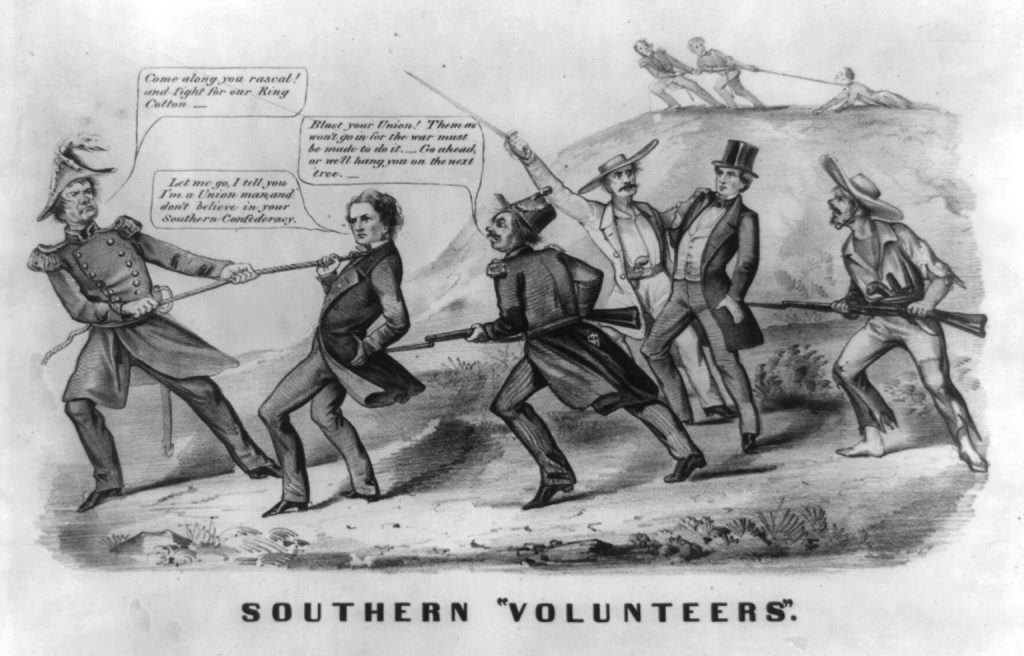
Photo: Unionists throughout the Confederate States, including Germans, resisted the imposition of conscription in 1862. Currier and Ives, Public domain, via Wikimedia Commons
The league’s actual plans remain debated. Members said they had organized to defend their homes against outlaws and attacks. Confederate officials believed the group was preparing an armed rebellion, aiding deserters and arranging to free captured United States soldiers held at Camp Verde.
There is evidence that some members discussed military action. Historian Stanley S. McGowen’s detailed study, “Battle or Massacre?: The Incident on the Nueces, August 10, 1862,” found that the league considered freeing Federal prisoners and helping them escape to Mexico if Union forces entered Texas. League members were also accused of threatening Confederate supporters, while Confederate authorities used arrests and executions to break the organization.
By the summer of 1862, suspicion had turned the Hill Country into a place where neighbors watched one another’s movements. Confederate supporters reported Unionist meetings. Unionists identified informants and suspected traitors in their own ranks. Men disappeared into cedar-filled ravines, and armed parties gathered outside the towns.
Confederate authorities sent Capt. James Duff into the region to enforce conscription. Duff, a Scottish immigrant and former U.S. Army soldier, had joined the Confederate cause and formed a company of partisan rangers. He was appointed provost marshal and proclaimed martial law in Gillespie County and parts of the surrounding counties in late July.
Residents were ordered to swear loyalty to the Confederacy. Duff arrested suspected Unionists and executed two German immigrants he considered dangerous. Some of his own men objected to his methods and considered him unfit to command, according to McGowen’s reconstruction.
The Texas State Library and Archives Commission’s history of wartime dissent records arrests, shootings and the burning of homes during the campaign. Duff’s personal responsibility for particular crimes has been exaggerated in some later accounts, but the coercion was real. German families began leaving their homes or hiding in the rough country outside Fredericksburg.
About 80 men assembled along Turtle Creek, 18 miles west of Kerrville, on Aug. 1. They discussed leaving Texas, and roughly 61 decided to make the journey. John W. Sansom, who traveled with them, remembered 65 men: 59 Germans, five Americans and Pablo Diaz, whom he identified as Mexican.
They placed Tegener in command. Their plan was to ride toward the Devils River, follow it south and cross into Mexico. Some hoped to continue from there to Union-controlled New Orleans and enlist in the United States Army.
Sansom said the men believed a Confederate proclamation permitted people unfriendly to the new government to leave the country. “We wanted to go peaceably,” he later wrote in his account, “and would have gone quietly but for being followed and attacked.”
They did not travel as unarmed refugees. Many carried German rifles, shotguns and Colt revolvers, along with ammunition. Henry Schwethelm, another survivor, described them as mounted on good horses and equipped with rifles and six-shooters. At one stop, the men carved human figures into trees and used them for target practice.
Their weapons would allow them to inflict severe losses when attacked, but their group lacked the discipline of an organized military company. Their route left a visible trail of hoofprints, disturbed camps and signs from pack animals.
Several men reported the departure to Duff, including at least one who warned that Tegener’s party was heavily armed. Duff sent Lt. Colin D. McRae after them with approximately 96 men drawn from partisan rangers, state militia and Confederate cavalry companies.
 The Pursuit Across Texas
 The Pursuit Across Texas
McRae’s detachment began following the Unionists on Aug. 3. The pursuit ran from the Pedernales River down the Guadalupe, then across the Medina and Frio rivers. At an abandoned campsite, Confederate trackers examined the marks left by horses and mules and estimated that 60 to 100 people were ahead of them.
A few additional travelers joined Tegener’s group along the way. The Unionists continued southwest, apparently unaware of how closely McRae was following. Their trail became easier to read as they moved toward a bend in the Nueces.
Confederate scouts located them on the afternoon of Aug. 9, roughly 20 miles from Fort Clark in present-day Kinney County. McRae did not immediately attack. He studied the campsite and waited for darkness.
At about 11 p.m., the Confederate soldiers removed their hats and tied white bands around their heads so they could recognize one another during the night. They left their horses with a guard and approached the river on foot.
McRae divided the force. He took one wing southwest of the camp while 1st Lt. James M. Homsley led another into position to the northeast. The two groups crossed the Nueces and worked through rocks and cedar, trying to close around the sleeping camp without being heard.
A pistol shot from McRae was supposed to signal a coordinated attack. By about 1 a.m., the Confederates had crept within approximately 50 yards of the Unionist position.
Then two men wandered out from Tegener’s camp and stumbled into Homsley’s concealed troops.
A Confederate soldier fired without orders, killing one of the men. The other fired into the darkness and ran back toward the camp. The shot ruined McRae’s surprise and woke everyone along the river.
Sansom was one of the two Unionists first fired upon. Inside the camp, men came out of their blankets and grabbed weapons. R.H. Williams, who fought with the Confederates, remembered that the place was suddenly “in a buzz, like a swarm of bees.”
Gunfire broke out between Homsley’s line and the camp. At least one Unionist caught outside the defensive perimeter died in the crossfire. Homsley attempted a charge, but the defenders drove his men back. The Unionists then tried to break through the Confederate position and were also repelled.
McRae’s wing initially remained quiet, leaving Homsley’s men to exchange irregular fire with the camp through the remaining hours of darkness. Tegener was hit twice. Two Unionists were dead and several more were wounded, but the premature shot had given the others time to organize.
They piled saddles and logs into makeshift breastworks and shifted into an all-around defense. Believing that as many as 200 men had surrounded them, some prepared to remain where they were. Schwethelm later remembered resolving to die at his post if necessary.
Others decided that staying would get them killed.
Between the first exchange of fire and daybreak, an estimated 23 to 28 men slipped through gaps in the Confederate line. Some quietly gathered horses before leaving. Once far enough away that the movement would not be heard, those with mounts climbed into their saddles and scattered toward the Hill Country by different routes.

Several survived the return journey on prickly pear fruit and bear grass. Nine of the men who escaped during the night would later be captured and killed by Confederate or state troops.
Their departure changed the balance at the river. When daylight came, McRae still had close to 90 men available for the attack. Only 30 to 35 unwounded defenders remained inside the camp.
Two Unionists ran after frightened horses as the light began to strengthen. A volley from McRae’s position struck one of them. McRae then ordered his soldiers to advance slowly across the open ground.
The Confederates fired as they moved. When they had closed to within about 30 paces, McRae ordered both wings to charge.
The men behind the saddle barricades continued shooting. Emil Schreiner assumed command after Tegener was wounded and tried to hold the defense together. According to an account later quoted by McGowen, Schreiner called to the others in German, “Let us sell our lives as dearly as we can.”
The Unionists killed two Confederates and wounded 18 or 19, depending on the account. McRae fell with two wounds. Williams remembered bullets passing heavily over a small group of soldiers near him and said the defenders “showed a bold front and dared us to come up.”
Twice, fire from the camp forced attackers to fall back. A renewed charge finally reached the Unionist position. Pistols were fired at close range as Confederate troops entered the camp, and the remaining defense collapsed.
Tegener and several other wounded men escaped through the cedar brakes. Sansom had moved outside the camp with four companions before the final charge. Four of their rifles misfired, leaving only Sansom able to shoot. When he saw the position fall, he saddled a horse, rode away under Confederate fire and crossed to the east bank of the Nueces.
He found a high bluff inside a cedar brake where he could look back toward the battlefield. Sansom remained there until about 10 a.m., watching Confederate soldiers move through the camp and travel between the river and the bodies.
From that bluff, he counted 19 dead Unionists and knew of six wounded men who had escaped.
The Wounded Men in the Cedars
Exactly how many Unionists were killed during the fighting and how many were executed afterward has remained difficult to reconstruct because the surviving accounts count the dead differently.
The current Handbook of Texas summary of the Nueces battle lists 19 men killed in combat and nine wounded prisoners executed several hours later. McGowen’s later examination of the participant accounts offers a more cautious conclusion. He argues that the 19 names associated with the battlefield include men killed during the fight and wounded men murdered after the camp was taken. He found no reliable contemporary record establishing that exactly nine wounded prisoners died at the campsite.
The disagreement concerns the number, not whether executions occurred.
Williams, the Confederate participant, wrote that he and several other soldiers tried to bring water to wounded Unionists. A group of militiamen then carried or dragged wounded prisoners into thick cedars. There, men associated with Lt. Edward or Edmund Lilly’s partisan rangers shot them in the head.
Williams called the perpetrators “cowardly wretches” and described Lilly as a remorseless villain. His account became confusing because he replaced the names of several Confederate officers with fictitious ones, but later research identified Lilly as the officer he had called “Luck.”
Sansom also believed every captured Unionist was killed. “Every man of the Unionist force, wounded or unhurt, who surrendered on the 10th of August, 1862, or subsequently, was put to death,” he wrote.
McRae was seriously wounded, and the command structure appears to have broken down after he fell. Several other officers outranked Lilly and should have assumed control, yet none prevented the killings. McGowen found no satisfactory evidence showing whether a senior officer ordered the executions, knowingly allowed them or failed to understand what was happening inside the scattered camp.
McRae sent someone to Fort Clark for medical assistance. Confederate soldiers buried their own dead in a long trench. The bodies of the Unionists were left among the rocks and cedars.
The 19 men later recorded as having died at the Nueces site were L. Bauer, J. Behrens, Ernest Besler, L. Boerner, A. Bruns, Hugo Degener, Hilmar Degener, Pablo Diaz, E. Vater, A. Vater, Emil Schreiner, H. Markwart, C. Schaefer, L. Scherholz, J.G. Kalenberg, H. Steves, William Tellgmann, M. Weirich and H. Meyershausen.
The names mattered deeply in Comfort and Sisterdale. Hugo and Hilmar Degener were brothers, the sons of Edward and Maria Degener. Their father had fled Germany after the failed revolution of 1848, settled in Sisterdale and became an outspoken antislavery Unionist. He was later arrested by Confederate authorities and forced to post a $5,000 bond after losing both sons.
Pablo Diaz was the one Mexican member Sansom identified in the party. Sansom remembered that Diaz had shared a sleeping area with him, the Degener brothers and A. Bruns shortly before the battle. When the possibility of retreat came up, Hugo Degener objected to abandoning the wounded, horses and supplies. Sansom recalled him saying that he preferred to keep fighting where they stood.
Hugo and Hilmar were both dead by morning.
The pursuit continued after McRae’s surviving force left the Nueces. Confederate and state units caught nine fugitives one or two at a time during the following two weeks. Some were shot and others hanged at locations between the river, Fredericksburg and San Antonio. Their names were W. Boerner, R. Bronkish, C. Berk, H. Flick, F. Tays, A. Luckenbach, L. Riebsamen, A. Riebsamen and H. Stieler.
On Oct. 18, another group from Tegener’s party reached the Rio Grande. Confederate troops under Homsley caught and killed them while they were attempting to cross into Mexico. The account Sansom supplied years later separates the dead into three groups: those who died at the Nueces, those captured afterward and those killed at the Rio Grande.
Eleven survivors eventually reached Union lines and served in the 1st Texas Cavalry, a United States regiment organized in New Orleans. Their names included Sansom, Schwethelm, Jacob Kusenberger, Adolph Zoller, F. and A. Graf, William Hester, Howard Henderson, Tom Scott, W.B. Scott and William Vater. They served from October 1862 until October 1865, and several became officers or noncommissioned officers.
The violence in the Hill Country continued after the survivors scattered. Former Union Loyal League members and Confederate supporters began ambushing one another. Armed riders burned homes, fences, pens and pastures. Families received letters warning that their property had been destroyed and that wives and children were in danger. Places in the region acquired names such as Bushwhacker Creek, Bushwhacker Springs and Bushwhacker Road.
That same autumn, Confederate authorities and local vigilantes arrested suspected Unionists in North Texas. Dozens died during the Great Hangings at Gainesville, where an improvised citizens’ court and a mob carried out the largest mass hanging in American history. The events at Gainesville and the Nueces arose from the same wartime climate: compulsory military service, fear of rebellion and a willingness to treat political dissent as treason.
The Bones Return to Comfort
The bodies at the Nueces remained exposed and unburied after the Confederate troops departed. Animals and three years of weather scattered what was left of them across the battlefield.
After the Confederacy collapsed in 1865, Edward Degener led a party of 25 people back to the Nueces. They searched the ground for bones and carried the remains they could find to Comfort.
The funeral took place on Aug. 20, 1865. Degener stood before the grave as a father burying two sons and as a political refugee who had lost children to the cause he had adopted in America. His Handbook of Texas biography preserves the conclusion of his eulogy:
“The sacrifice that we, the fathers of the slaughtered, made to our country and to liberty, is great and dolorous. We shall, however, console ourselves; we shall be proud of having offered our sons to the Union.”
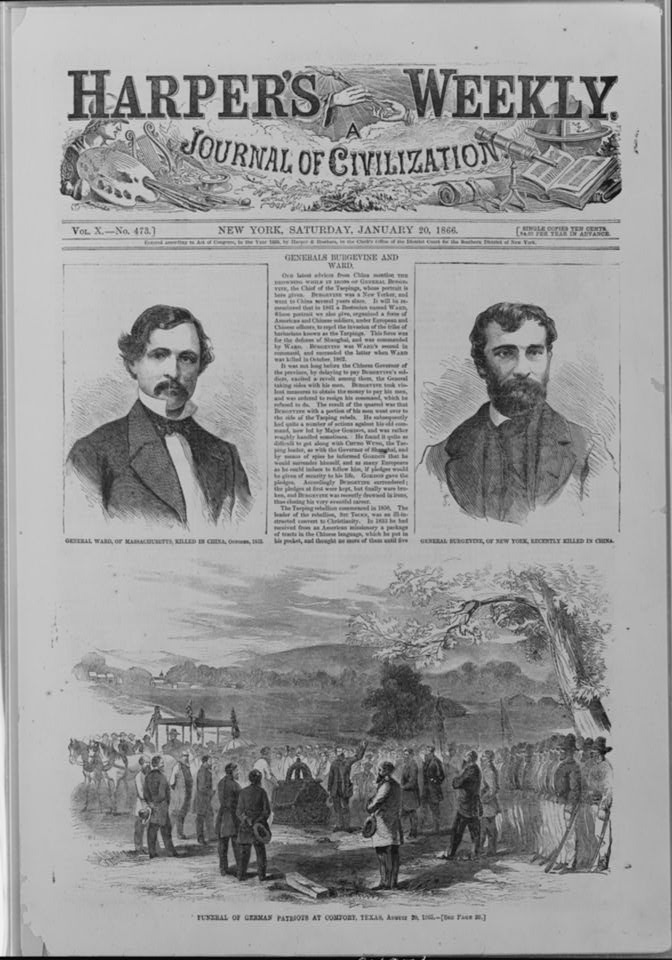
Photo: 1866 story and illustration of Texan-German Unionists’ funeral after the end of the American Civil War. Harper’s Weekly, Public domain, via Wikimedia Commons.
The families placed the recovered remains in a burial ground on High Street in Comfort. Donations paid for a limestone monument, which was dedicated on Aug. 10, 1866, four years after the attack.
The obelisk bears the words Treue der Union—Loyalty to the Union. Its tablets record the names of the men killed at the Nueces and during the pursuit that followed. According to the Texas Historical Commission’s record of the site, the monument stands over the remains recovered after the war and preserves the allegiance for which the men died.
A 36-star United States flag flies at half-staff above the burial ground, reflecting the number of states in the country when the memorial was dedicated. Below it, the German inscription and rows of names still separate the dead according to where they fell: at the Nueces, after capture and along the Rio Grande.
Enjoyed This Series?
Read more untold Texas history from Katy Christian Magazine:
- The Great Hangings at Gainesville: Texas’ Darkest Chapter and the Largest Mass Hanging in American History
- The New London School Explosion: The Deadliest School Disaster in American History Happened in Texas
- Is Patterson Road Really Haunted? The Truth Behind Houston’s Most Haunted Road, Blue Light Cemetery and Devil Worship Legends
- The 10 Greatest Lost Treasures in Texas: Spanish Gold, Pirate Treasure, Buried Silver and Hidden Fortunes
- Before There Was Katy: 10 Ghost Towns and Lost Communities You Never Knew Existed
- Before Jack the Ripper: The Servant Girl Annihilator Who Terrorized Austin, Texas
- The Battle of Medina: The Bloodiest Battle in Texas History, Yet Most Texans Have Never Heard of It