
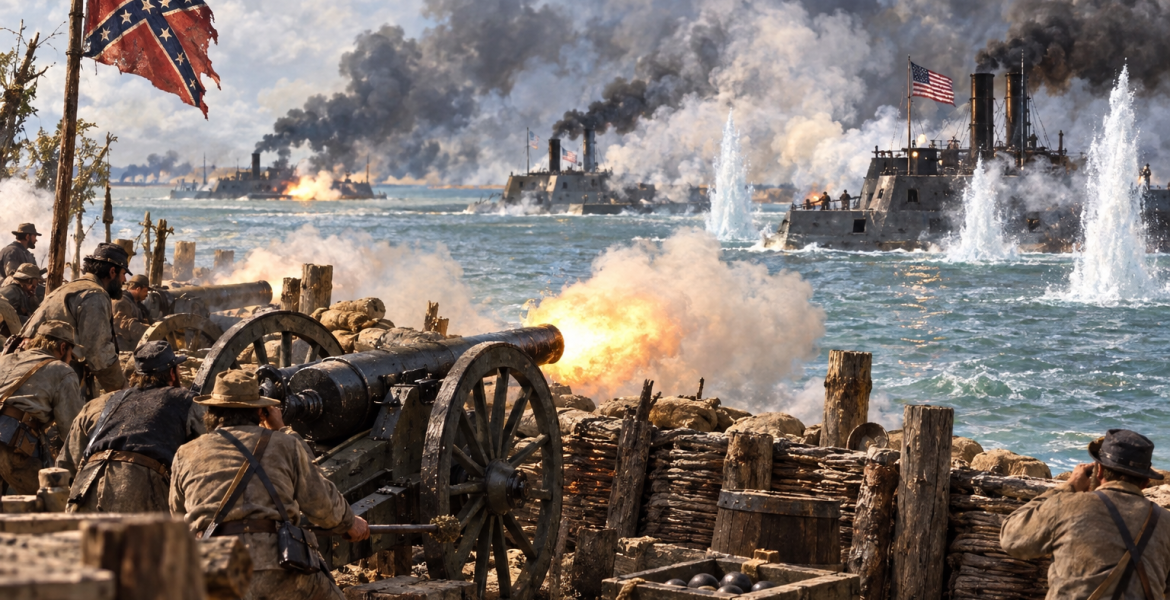
At 3:40 p.m. on Sept. 8, 1863, one of the most remarkable battles of the Civil War in Texas began when four Union gunboats steamed into Sabine Pass, the narrow waterway where the Sabine River reaches the Gulf of Mexico along the Texas-Louisiana border. Their task was to silence Fort Griffin so an invasion fleet waiting offshore could land thousands of soldiers. Once ashore, the Union army planned to use the railroad running from Sabine Pass toward Houston, placing both Houston and Galveston within reach. Waiting inside the unfinished earthen fort, Lt. Richard “Dick” Dowling and fewer than 50 Confederate defenders held their fire until the gunboats came within 1,200 yards.
Thirty-five minutes later, two Union gunboats had been disabled and captured, approximately 350 federal sailors and soldiers were dead, wounded or prisoners, and the remaining vessels were withdrawing. Dowling’s command suffered no casualties. The soldiers waiting offshore never made their planned landing.
The traditional account describes 47 confederate soldiers turning back an invasion force of 5,000. It’s worth noting that the surviving records of the event differ some. The Texas Historical Commission places the Union army contingent at 4,000, while other histories use 5,000, and the National Park Service lists 44 Confederates engaged, while Dowling and later Texas accounts used 47. The precise totals do not significantly alter the extraordinary imbalance. Four armed vessels and an invasion fleet had been turned back by one artillery company in a small mud fort.
Sabine Pass had a railroad connection to Houston. If Union troops established a beachhead there, Houston and Galveston lay along the intended route into the Texas interior.

Why Did the Union Target Sabine Pass?
By September 1863, Texas had belonged to the Confederacy for more than two years. The state’s own 1861 declaration explaining secession defended slavery and white political supremacy in explicit terms. Texas also contained thousands of citizens who opposed secession or resisted Confederate rule. The division had already produced bloodshed, including the Nueces Massacre of German Unionists and the arrests and executions remembered as the Great Hanging at Gainesville.
 Most of the Civil War’s major campaigns were fought east of the Mississippi River, but Texas was a key source of Confederate supplies and foreign trade. Cotton traveled by wagon across the Rio Grande and left through Mexican ports beyond the direct reach of the U.S. naval blockade, and weapons, medicine and manufactured goods came back into Texas across the border. The situation became more urgent in June 1863, when French troops captured Mexico City and Emperor Napoleon III began constructing a French-backed monarchy in place of President Benito Juárez’s republican government. President Abraham Lincoln’s administration feared that antagonizing France could push Napoleon III toward openly assisting the Confederacy. Occupying part of Texas would allow the United States to disrupt Confederate trade through Mexico, control more of the Gulf Coast and establish a military presence near the French intervention.
The strategic situation had changed sharply that summer. Vicksburg fell on July 4, giving the United States control of the Mississippi River and cutting Texas, Louisiana and Arkansas away from the eastern Confederacy. Port Hudson surrendered five days later. Maj. Gen. Nathaniel P. Banks, the Union commander at New Orleans, had troops available and orders to establish a presence in Texas.
Banks chose Sabine Pass, where the Sabine and Neches river system met the Gulf of Mexico. The pass stood near the Louisiana line, making it easier to reach from New Orleans than ports farther down the Texas coast. It also offered a route inland toward Beaumont and a railroad connection to Houston.
Houston was no longer the small settlement founded only 27 years earlier. Railroads radiated from the city, and its location made it a military, supply and transportation center for Confederate Texas. The same region where settlers in Stephen F. Austin’s colony had faced raids and armed conflict four decades earlier now held the inland objective of a federal invasion fleet.
According to the Handbook of Texas account of Banks, the plan called for a quick landing at the mouth of the Sabine, followed by an overland advance on Houston and Galveston. Texas had endured invasions before, including two occasions when the Mexican army had occupied San Antonio in 1842, but this force arrived by sea with steam gunboats, troop transports and the resources of the United States behind it.

Brig. Gen. William B. Franklin received command of the soldiers. The naval spearhead consisted of the USS Clifton, USS Sachem, USS Arizona and USS Granite City, converted civilian steamers carrying 18 guns among them. They would enter the pass, silence Fort Griffin and cover the landing.
The Union had reason to expect success. Federal ships had entered Sabine Pass the previous year after a yellow fever epidemic devastated the Confederate garrison. The defenders abandoned Fort Sabine, and Union sailors destroyed it. Federal troops declined to occupy the town itself because they feared the disease.
The epidemic had killed more than 100 people in the Sabine and Neches communities, including approximately 40 Confederate soldiers. Catherine “Kate” Dorman, who operated a two-story boardinghouse near the water, stayed behind with Sarah Vosburg and Sarah Ann King to care for the sick. Dorman turned her hotel into a temporary hospital while much of Sabine Pass fled.
The Confederates returned and tried to close the entrance more effectively. In March 1863, Maj. Julius Kellersberg began supervising construction of Fort Griffin on the Texas side of the channel. It was a triangular earthwork reinforced with timber and railroad iron, with gun positions facing the two navigable channels.
The Texas Historical Commission records that approximately 500 enslaved men were conscripted to build Fort Griffin. Their forced work created the position from which the Davis Guards later won fame, although the men who built the earthworks largely disappeared from early commemorations.
Fort Griffin was still unfinished when the Union fleet appeared.
Houston’s Irish Artillerymen
The men inside the fort were known as the Davis Guards, Company F of the First Texas Heavy Artillery. The Handbook of Texas describes them as young Irish immigrants recruited from the docks of Houston and Galveston. Most were in their 20s or younger.
Richard William Dowling was born in County Galway, Ireland, in the late 1830s and immigrated with his family to New Orleans. His parents and four siblings died during the 1853 yellow fever epidemic. Dowling moved to Houston and built a successful business while still a young man. He opened a saloon called the Shades in 1857 and later purchased the Bank of Bacchus near the Harris County Courthouse. He married Elizabeth Ann Odlum and entered a family closely connected to the company he would lead during the war.
Dowling joined the Jefferson Davis Guards in 1861. He fought in the Confederate recapture of Galveston on Jan. 1, 1863, then earned notice in a naval engagement at Sabine Pass three weeks later. The Handbook of Texas biography of Dowling credits his accurate fire from an 8-inch gun aboard the steamer Josiah A. Bell and says he helped save the vessel’s magazine from flooding.
At Fort Griffin, Dowling and his men prepared for another attack by practicing with their heavy cannon. Stakes driven beside the two channels marked known distances. The featureless waterway became a measured firing range: when a ship passed a stake, the gunners knew approximately how far away it was and could set their weapons accordingly.
Preparation was paramount because their six smoothbore cannons were not enough to dominate the Gulf approaches. Two were 24-pounders and four were 32-pounders, named for the approximate weight of the solid shot they fired. They could be deadly at the right distance, but Union vessels could bombard the works from beyond their effective range.
Capt. Frederick Odlum and other officers gathered limited reinforcements behind Fort Griffin. If several thousand Union soldiers landed, the little garrison could not expect to contain them. The defenders’ practical chance of stopping the invasion lay in the narrow channels before the landing began.
The Union lost the advantage of surprise when a blockading vessel missed its scheduled meeting with the expedition on Sept. 6. The delay and the activity offshore gave Confederate lookouts time to recognize that something larger than a routine patrol had arrived.
Dowling’s official report, preserved in the War Department’s published records, states that a sentinel saw signals in the Gulf around 2 a.m. on Sept. 7. By daylight, two steamers were taking soundings in the channel and a large vessel lay offshore. More ships arrived until the fleet numbered 22.
The defenders stayed at their guns.
Thirty-Five Minutes in the Channel
The Clifton began shelling Fort Griffin at 6:30 on the morning of Sept. 8. Dowling counted 26 shells during the hourlong bombardment. Most flew over or fell short. One landed inside the works, and another struck an angle of the fort, but Dowling reported no material damage.
His gunners did not answer. The Clifton remained too far away, and every premature shot would reveal the limitations of the Confederate cannon.

At 11 a.m., the Sachem fired at the Confederate steamer Uncle Ben. Those shots also passed over Fort Griffin without effect. The federal ships then stayed beyond range for several more hours while commanders prepared the main assault.
Life continued only a few hundred yards behind the fort. According to the Texas State Historical Association’s account of Kate Dorman, shells landed between the earthworks and her hotel. Dorman and Sarah Vosburg cooked a hot meal, loaded food, coffee and a gallon of whiskey into a horse-drawn buggy, and delivered it to the defenders. They later watched the battle from the hotel roof through a telescope.
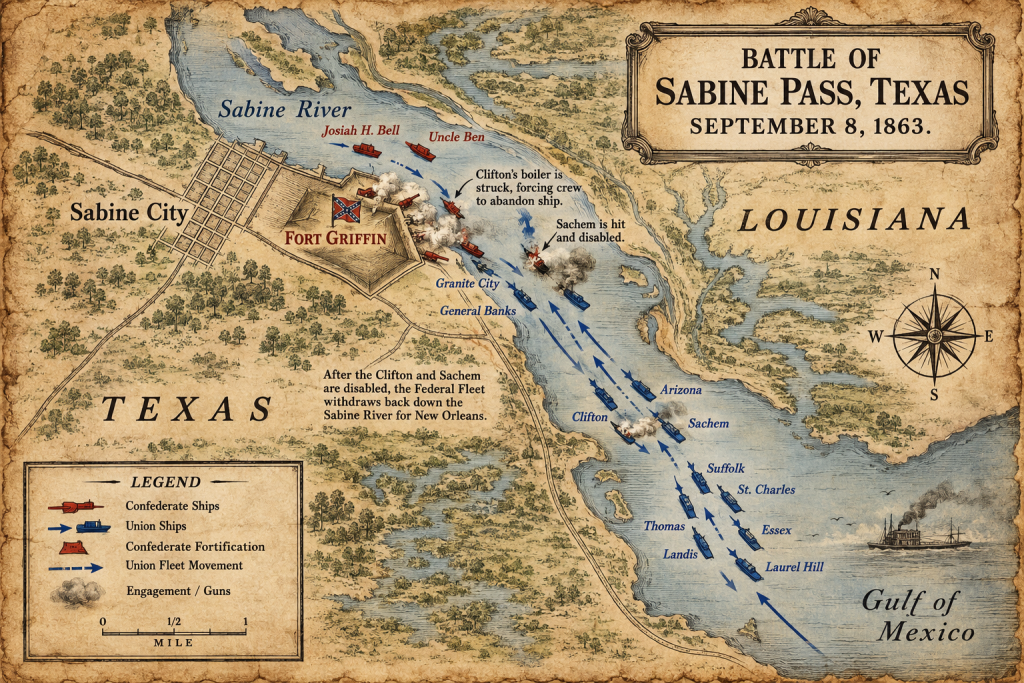
At 3:40 p.m., the gunboats came forward. The Sachem led the Arizona through the Louisiana channel. The Clifton, carrying naval guns and federal sharpshooters, advanced nearer the Texas bank. The Granite City followed as the fleet attempted to bring enough fire against Fort Griffin for the transports to approach.
Dowling held his fire until the leading vessels reached the marked range of 1,200 yards. The crews emerged from cover, loaded the cannon and began firing.
One of the six Confederate guns ran off its platform after an early discharge, leaving five in action. The remaining crews continued at a pace unusual for heavy artillery. The Texas Historical Commission’s reconstruction counts 107 Confederate shots in 35 minutes—roughly one round every 20 seconds across the five working guns.
The Sachem was struck within the first several Confederate rounds. A projectile entered the gunboat’s boiler, releasing steam through the vessel and killing or wounding men aboard. With the disabled ship blocking the Louisiana channel, the Arizona could not pass. It backed away from the action.
The Clifton kept advancing on the Texas side. A Confederate shot cut its tiller rope, leaving the ship unable to steer. It ran aground within roughly a quarter-mile of the fort but continued firing. Then another projectile penetrated its boiler. Steam and smoke filled the vessel, and the crew abandoned the fight.
The Sachem and Clifton surrendered. The Granite City withdrew, and the transports carrying Franklin’s army remained offshore. The attack intended to clear the way for thousands of soldiers had ended before those soldiers could take part.
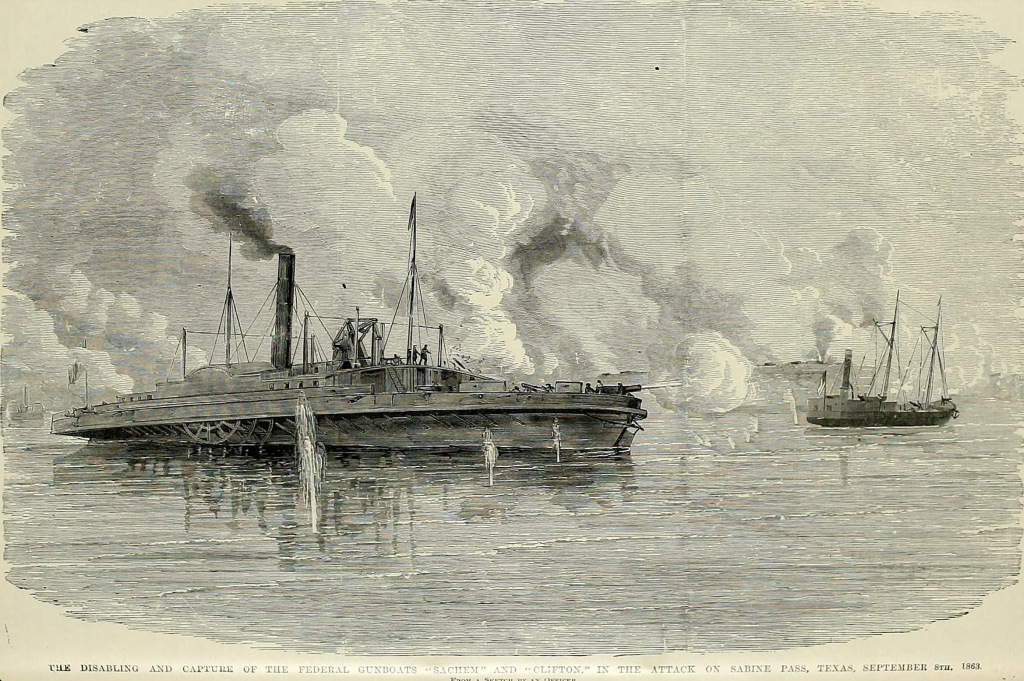
The Confederates capture Clifton and Sachem, Internet Archive Book Images, No restrictions, via Wikimedia Commons
More than 300 federal personnel became prisoners. A Texas historical marker for the Union dead at Sabine Pass records that 28 were reportedly buried in a long trench near Dorman’s hotel, while others were listed as missing and never recovered. Excavations later confirmed the burial location, although erosion has taken much of the site.
Dowling’s command came through the battle without a man killed or wounded.
The End of the Invasion
The Battle of Sabine Pass stopped the Union plan to land near the Louisiana border and advance toward Houston and Galveston. It also delivered a badly needed morale victory to the Confederacy only two months after the defeats at Gettysburg, Vicksburg and Port Hudson.
Houston celebrated men it already regarded as its own. A benefit performance raised $3,000 for the Davis Guards. The soldiers received silver medals fashioned from Mexican coins, and the Confederate Congress adopted a formal resolution thanking them. Dowling’s report praised the entire command and declared, “not a man flinched from his post.”
The victory did not end Union operations against Texas. Banks changed routes. In November, federal troops landed at Brazos Santiago near the mouth of the Rio Grande and occupied Brownsville. Union forces established positions along portions of the lower coast and later held Matagorda Peninsula. They never converted those footholds into the planned advance through Houston and the Texas interior.
Sabine Pass remained in Confederate hands until the war’s final weeks. Fort Griffin was strengthened with captured weapons in anticipation of another attack, then gradually reduced as the threat shifted elsewhere. Confederate troops spiked its remaining cannon and abandoned it in May 1865.
The battle’s defenders became symbols in postwar Texas, sometimes in accounts that polished away the harder parts of the story. The stakes, the artillery practice, the boiler hits, the captured vessels and the absence of Confederate casualties are all documented. So are the enslaved laborers forced to build the fort and the federal sailors buried near the shore after being scalded, struck or drowned in a channel far from home.
Dowling did not live long enough to grow old with the story. He returned to Houston after the war, resumed his businesses and invested in real estate, oil, gas and a steamboat. Yellow fever killed him on Sept. 23, 1867. He was about 30 years old and left behind a wife and young children. The disease that had killed most of his immediate family in New Orleans also ended his life in Houston.
Sabine Pass suffered its own later disaster. On Oct. 12, 1886, a hurricane destroyed all but two houses in the town and killed 86 people. The riverport never fully recovered. Its fate belongs to the same violent Gulf Coast history later seen when the 1900 hurricane devastated Galveston and nearly destroyed Katy. Sabine Pass did not disappear completely, but its decline resembles the histories of the lost settlements and ghost towns around Katy, where railroads, floods, storms and changing trade routes decided which communities endured.
Remaining Evidence of the Battle of Sabine Pass
The original Fort Griffin is long gone. Erosion and later changes to the ship channel removed the earthworks and made its exact location difficult to identify. The battlefield survives as Sabine Pass Battleground State Historic Site, operated by the Texas Historical Commission at 6100 Dowling Road in Port Arthur.
Visitors can see a scale model of the fort and battle, a 1930s bronze statue of Dowling, a monument to the Union dead and outdoor exhibits explaining the engagement. Four ammunition magazines remain from the site’s later service as a U.S. coastal artillery battery during World War II.
Sabine Pass is a constrained waterway bordered by low coastal ground. The Union possessed the ships, guns and thousands of men, but only a few vessels could move through the channels toward Fort Griffin at one time. Dowling’s crews had measured those channels and rehearsed the shots. For 35 minutes, the enormous difference in manpower waiting offshore meant almost nothing.
The Union later occupied stretches of the lower Texas coast, but the invasion that appeared off Sabine Pass on Sept. 8, 1863, got no farther than the channel. Its transports turned back, Houston remained beyond reach and the planned landing never occurred.
At the historic site today, the earthwork is gone. The channel remains—the narrow stretch of water where thousands of soldiers waited while fewer than 50 men prevented them from coming ashore.
Enjoyed this article? Continue exploring the overlooked people, battles, disasters and communities that shaped Katy, Greater Houston and Texas in Katy Christian Magazine’s history archive. Read more from our Forgotten Histories series:
- The Nueces Massacre of 1862: The Forgotten Texas Civil War Tragedy Where Wounded Unionists Were Executed
- The Great Hangings at Gainesville: Texas’ Darkest Chapter and the Largest Mass Hanging in American History
- Six Years After the Alamo, Mexico Invaded Texas Again and Captured San Antonio Twice
- Before Katy, Texas: Indian Raids, Stephen F. Austin and the Forgotten War on Houston’s Frontier
- The Battle of Medina: The Bloodiest Battle in Texas History, Yet Most Texans Have Never Heard of It
- The 1900 Galveston Hurricane Nearly Wiped Katy, Texas Off the Map
- Before There Was Katy: 10 Ghost Towns and Lost Communities You Never Knew Existed
Editor’s note: This article examines the Battle of Sabine Pass as an important event in Texas military and local history. The Confederacy fought to preserve slavery, a purpose stated openly in Texas’ 1861 declaration of secession, and approximately 500 enslaved men were forced to construct Fort Griffin. Recognizing the documented artillery skill of the Confederate soldiers who fought there should never obscure the government and institution their fort protected or the suffering of the Union sailors and soldiers who were killed, wounded or captured. Katy Christian Magazine presents this history for education and understanding, without celebrating the Confederate cause or minimizing the battle’s human cost.