
One night in the summer of 1872, someone rang a cowbell in Pitkin Taylor’s cornfield. When the elderly man came outside, he was shot and severely wounded by supporters of William Sutton, a DeWitt County lawman whose faction opposed the Taylor family. Taylor died from his wounds about six months later. At his funeral, his son Jim and other relatives vowed to avenge his death.
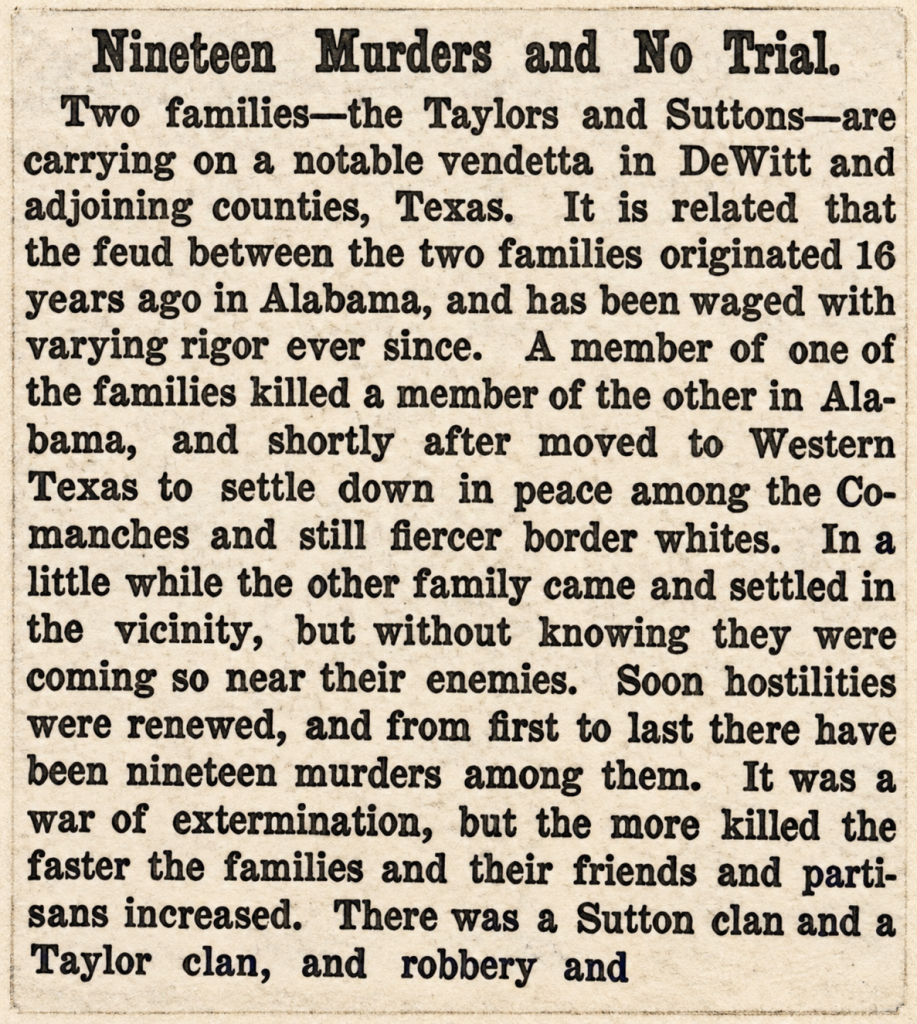
Nineteen Murders and No Trial, An archival St. Louis newspaper clipping chronicling the escalating violence and deep-seated vendetta of the Sutton-Taylor Feud in DeWitt County, Texas (Image public domain and courtesy of The Olden Times).
The feud took shape during Reconstruction, when disputes over livestock theft became entangled with resistance to Texas’ postwar government. Members of the Taylor family and their allies clashed with local lawmen and the State Police, which served the Republican administration in Austin. Some Taylor men had killed soldiers, and officers on the opposing side killed men they had arrested. Relatives and friends joined the factions to avenge people they had lost, spreading violence through the surrounding communities.

The Sutton–Taylor feud centered on DeWitt County, around present-day Cuero. One conventional tally puts its death toll at 35 people, nearly three times the roughly dozen commonly associated with the Hatfield–McCoy feud. Those figures are estimates from different accounts. The description of historian Chuck Parsons’ book at University of North Texas Press follows the Texas conflict into the 1890s and quotes a review counting 80 deaths across three decades, which is a substantially broader history than the central years of the feud.
In 1868, deputy sheriff William Sutton killed Charley Taylor while pursuing men accused of horse theft. Two years later, State Police under Capt. Jack Helm arrested and killed Henry and William Kelly, two sons-in-law of Pitkin Taylor. Such killings gave Taylor relatives personal reasons to seek revenge against lawmen associated with the Reconstruction government. Jim Taylor later joined forces with John Wesley Hardin, an outlaw who had escaped from the Cherokee County jail in October 1872. Together, they would kill Helm the following summer.

Gunfighter, John Wesley Hardin, joined the Sutton–Taylor feud at the behest of his cousin, Emanuel “Mannen” Clements. Public domain via Wikipedia Commons.
How the factions formed
Clinton was then the DeWitt County seat, a settlement on the Guadalupe River about five miles southwest of present-day Cuero. Its courthouse, stores and saloons served a countryside where livestock disputes could bring armed men into town.
The Taylor faction drew on an extensive family descended from settler Josiah Taylor. His sons Pitkin and Creed, their relatives, in-laws and friends supplied its core. William Sutton, a deputy sheriff, had his own network of allies. Parsons’ publisher makes an important distinction: William was the only Sutton involved. The names eventually identified two groups whose membership extended beyond their families.
Violence involving Taylor men preceded the killings usually described as the feud’s beginning. In 1866, Buck Taylor killed a Black sergeant who came to a dance, and Hays Taylor killed a Black soldier in an Indianola saloon, according to TSHA.
In 1868, Sutton led a posse pursuing suspected horse thieves and killed Charley Taylor at Bastrop. That Christmas Eve, he killed Buck Taylor and Dick Chisholm at Clinton after Buck accused him of dishonesty in a horse transaction. The killings became a rallying point for the Taylor faction.
The conflict grew during Reconstruction, when Texas was struggling over the authority of its postwar government and the rights of formerly enslaved people. Republican Gov. Edmund J. Davis’ State Police could cross county lines and arrest offenders when local officers failed to act. The force included Black, Hispanic and white officers, and hostility toward it reflected both political opposition and resentment of Black lawmen.
There were also documented abuses. Jack Helm, elected DeWitt County sheriff in 1869, became a State Police captain in 1870. That August, men under his command arrested Henry and William Kelly, two sons-in-law of Pitkin Taylor, and shot them. Women of the Kelly family witnessed the killings, and their accounts produced a public outcry. Helm was suspended in October and dismissed from the State Police in December, although he continued as county sheriff.
Historians have interpreted the opposing factions differently. In The Feud That Wasn’t, James Smallwood argues that the Taylor network’s cattle rustling, horse theft and attacks on law officers formed part of a broader resistance to Reconstruction. The documented killings by Helm’s men also gave Taylor relatives specific deaths to avenge.
By the time Pitkin Taylor was shot outside his home in 1872, his family had already buried men killed by officers associated with its enemies.
Hardin, a broken truce and a steamboat killing
Jim Taylor’s alliance with John Wesley Hardin brought a particularly dangerous gunfighter into the struggle. Born in Bonham in 1853, Hardin was the son of a Methodist preacher. He had killed a Black man at 15 and spent much of the following years fleeing authorities. He surrendered in Cherokee County in September 1872 and escaped jail the next month. During the feud, he aligned himself with Jim Taylor.
Helm, meanwhile, had moved to Albuquerque, Texas, in Wilson County, after the State Police were abolished in April 1873. At his blacksmith shop, he worked on an invention intended to destroy cotton worms. He received a patent for an improved version on May 20.
On July 18, 1873, Jim Taylor and Hardin killed Helm at the shop. The former captain who had pursued the Taylors was dead, but Sutton and other allies remained.
Authorities briefly secured a negotiated peace. On Aug. 12, 1873, 40 men signed a treaty. Among them was Reuben H. Brown, the Cuero city marshal and a leader on the Sutton side. The agreement soon broke down.

Sutton moved to Victoria and eventually prepared to travel from Indianola, the busy port on Matagorda Bay. Accounts differ about his intentions: some say he planned to leave permanently; others say he was following cattle to a northern market.
On March 11, 1874, Sutton and his friend Gabriel Slaughter were aboard the steamer Clinton when Jim Taylor and his cousin Bill Taylor reached the dock. The cousins killed both men on the vessel’s deck.
Rewards of $500 were offered for each Taylor. Brown arrested Bill on April 3 and received the reward. Bill would eventually be held at Indianola, awaiting proceedings over the killing that had taken place at its waterfront.
Prisoners, a hurricane and the long aftermath
On June 20, 1874, Sutton supporters retaliated against three men in custody at Clinton: Kute Tuggle, Jim White and R.P. “Scrap” Taylor. The men had arranged to drive cattle for Hardin, been arrested on cattle-theft accusations and been brought back to DeWitt County. A mob took them from the courthouse and hanged them.
Texas Ranger Capt. Leander Harvey McNelly’s Special Force was assigned to help suppress the feud in 1874. Its intervention failed to produce an immediate peace.
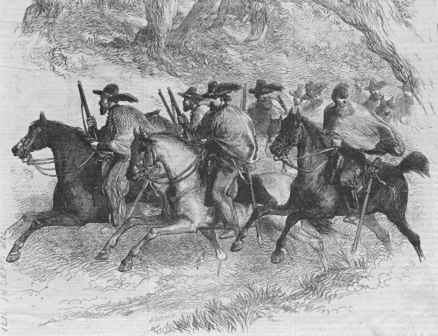
An early depiction of a group of Texas Rangers, c. 1845. Public domain via Wikipedia Commons.
The following September, people crowded into Indianola for a trial connected with the feud. The town was then Texas’ second-ranking port, a center for steamship traffic, immigration and trade with the interior. It occupied low ground along Matagorda Bay.
Twenty-five years before the hurricane that devastated Galveston and nearly destroyed the young town of Katy, another major storm swept across that coast.
Beginning Sept. 15, 1875, water from the bay flooded Indianola’s streets. The storm lasted into Sept. 17. When it subsided, only eight buildings were undamaged. Estimates of the dead range from 150 to 300.
Bill Taylor escaped from jail during the disaster. He later sent Brown a message threatening to kill him. On Nov. 17, Brown was shot dead while gambling in a Cuero saloon. He was 23 and had resigned as marshal the previous year. Accounts differ about the attackers, and no one was brought to trial for his death.
The next month brought the killing commonly used to mark the feud’s end. On Dec. 27, 1875, a Cuero posse killed Jim Taylor and two companions at Clinton.
Related violence continued. On Sept. 19, 1876, Dr. Philip Brassell and his son George were murdered at their home near Yorktown. Several men associated with the Sutton faction were implicated. Eight were charged.
That October, Texas Ranger Lt. Jesse Lee Hall moved his company to Cuero to suppress the remaining violence. After arresting five Sutton faction leaders, he reported, “The agony is over.”
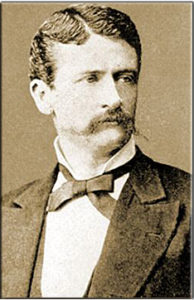
In late 1876, Texas Ranger, Capt. Jesse Lee Hall, lead his command to Cuero, Texas, and ended the feud. Public domain via Wikipedia Commons.
The Brassell proceedings continued for more than 20 years. According to TSHA’s history of the feud, they produced one conviction. The convicted man was eventually pardoned.
Read more from Katy Christian Magazine’s Texas history series:
- The Great Hangings at Gainesville: Texas’ Darkest Chapter and the Largest Mass Hanging in American History
- Six Years After the Alamo, Mexico Invaded Texas Again and Captured San Antonio Twice
- The Battle of Medina: The Bloodiest Battle in Texas History
- The Webster Massacre: A Texas Wagon Train Made Its Last Stand. Every Single Man Was Killed.
- Before There Was Katy: 10 Ghost Towns and Lost Communities You Never Knew Existed
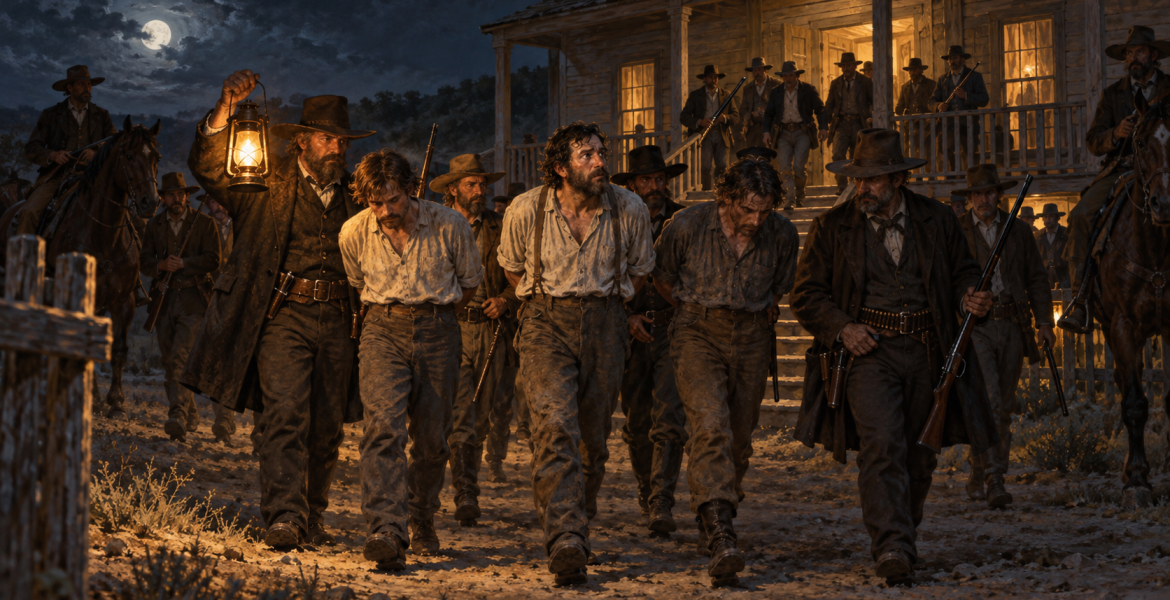
Feature photo: An AI-generated recreation depicting members of the Taylor faction being led away under arrest during the height of the Sutton-Taylor Feud in 1870s DeWitt County, Texas.