
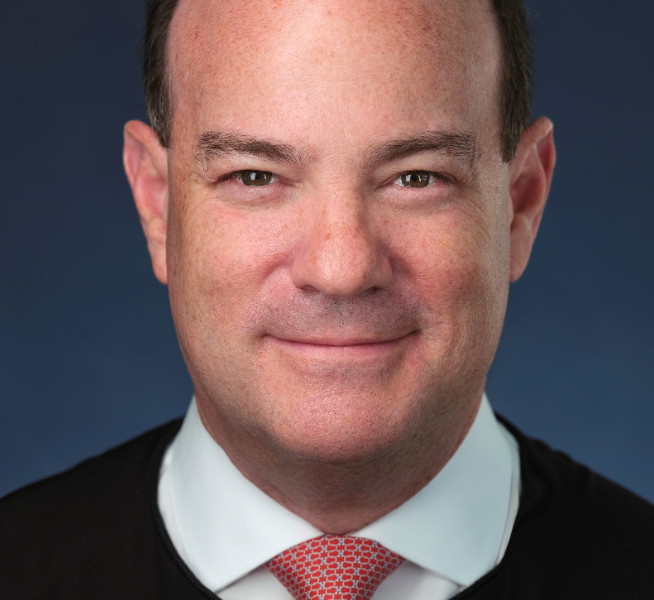
The Second Baptist Church Houston lawsuit is entering a new phase as Jeremiah Counsel Corporation prepares to ask Texas Business Court Judge Grant Dorfman to follow-up on his July 15 ruling upholding the church’s 2023 bylaws that eliminated member voting rights.
HOUSTON — Jeremiah Counsel Corporation is preparing to ask Texas Business Court Judge Grant Dorfman to reconsider portions of his ruling upholding the 2023 bylaws that eliminated voting rights for members of Second Baptist Church in Houston.
“We are planning to file within the next week or two,” Jeremiah Counsel Director Douglas Y. Bech told Katy Christian Magazine in a July 23 phone interview.

Bech, a former securities lawyer, has belonged to Second Baptist since 1989. He previously served as chairman of the deacons and spent 20 years on the church’s Board of Trustees, including as vice chairman, according to Jeremiah Counsel’s list of directors.
His comments provide the clearest account yet of how Jeremiah Counsel plans to challenge the July 15 decision and what its leaders believe Dorfman got wrong. They also reveal how the conflict has affected members who remain connected to Second Baptist but no longer worship there as they once did.
The 40-page opinion and order upheld the church’s 2023 bylaws, which abolished congregational voting and transferred authority to a self-perpetuating Ministry Leadership Team. The court dismissed most of Jeremiah Counsel’s claims, including allegations arising from what plaintiffs described as a misleading notice before the May 31, 2023, business meeting.
The decision did not give Second Baptist everything it sought. Dorfman invalidated an attempted amendment to the church’s articles of incorporation because members did not receive the written notice required by Texas law. Jeremiah Counsel’s claim for an accounting also survived, leaving open its effort to examine certain church financial records. Jeremiah Counsel was given associational standing to file this case.
Katy Christian Magazine examined the ruling, the ecclesiastical abstention doctrine and the dispute over Baptist governance in its July 17 analysis. It first reported on the lawsuit and restrictions placed on members seeking to review the new bylaws in May 2025.
One dispute concerns the relationship between Second Baptist’s articles of incorporation and its bylaws.
Before 2023, the church’s bylaws stated that every member present at a church business conference was entitled to vote. Jeremiah Counsel argues that the older articles also contemplated congregational authority by establishing elected trustees and committing the church to the customs of Baptist churches affiliated with the Baptist General Convention of Texas.
“When he said there was no conflict between the charter and these new bylaws, we believe that there are conflicts and inconsistencies which we will provide in our request for a rehearing,” Bech said.
The fraud allegations presented a separate problem. Members were told that the May 2023 meeting would “update our bylaws to protect our ability to continue operating as a biblical church.” Jeremiah Counsel argued that the notice concealed the loss of voting rights and the replacement of elected trustees with the Ministry Leadership Team.
Dorfman concluded that a court could not decide whether the phrase “biblical church” was fraudulent without hearing evidence about what church leaders and members understood those religious words to mean. He dismissed claims based on the allegedly misleading or undisclosed nature of the notice under the church-autonomy doctrine.
Bech believes the court drew that boundary in the wrong place. He argued that a jury could consider what members were told about the governance changes without deciding what doctrine or theology, Christianity or Scripture, requires.
He also drew a distinction between religious doctrine and the established customs of a denomination.
“Customs are very different from doctrine,” Bech said. “Baptist churches have certain customs.”
According to Bech, the court also relied too heavily on the church’s account of a question asked during the May 2023 meeting. Second Baptist’s defendants have maintained that a member asked about voting and received an answer from then-Senior Pastor Ed Young. Bech said the question concerned whether the church would continue holding business meetings, not whether members would retain their votes.
“We have recordings of that meeting,” Bech said. And the member who asked the question signed an affidavit stating that he did not ask about voting. That member asked about whether there would be business meetings in the future.”
Bech added that Young did not say that all “voting” would be eliminated in his response. According to Bech, Young said the church could not continue conducting business in the same way with 94,000 members.
Jeremiah Counsel also plans to challenge the court’s analysis of the duties church officers and directors owed to members.
The court found that fiduciary duties were owed to the nonprofit corporation rather than individually to each of Second Baptist’s approximately 94,000 adherents. Bech contends that this misses Jeremiah Counsel’s argument: The alleged duty ran to the congregation collectively as the body being asked to vote. Jeremiah Counsel believes that there is a duty to tell members the significance of what they are being asked to vote upon.
The court also found that Texas law did not require Second Baptist to distribute the full proposed bylaws or summarize every change before the vote. It held that the oral and newsletter announcements satisfied the statutory notice requirements for a meeting to amend the bylaws.
That resolves the minimum notice required under the statute, but it does not answer the question that has troubled members since the changes became known: Why were they not directly told that approving the bylaws would end their right to vote?
The effect on the congregation is already visible, according to Bech. He described members who have left Second Baptist, retained their memberships while worshipping elsewhere or continued attending certain ministries without participating fully in Sunday services.
People who once believed the church belonged to its congregation now find themselves deciding whether to remain in a church where the congregation no longer selects its governing leadership.
The disagreement reaches beyond corporate documents because Second Baptist continues to identify itself as a Baptist church cooperating with the Southern Baptist Convention.
Baptist churches have historically joined two ideas that are sometimes confused in discussions of the lawsuit. Local autonomy protects a congregation from control by a bishop, denomination or outside governing hierarchy. Congregational governance gives the members of that autonomous church a meaningful role in choosing leaders and making major decisions.
The Baptist Faith and Message describes a New Testament church as “an autonomous local congregation of baptized believers.” It adds that each congregation operates under Christ’s lordship “through democratic processes” and that each member is responsible and accountable to Christ.
As Katy Christian Magazine’s guide to Christian denominations explains, Baptist churches do not all conduct business identically. Some give pastors or elders greater authority, while others reserve congregational votes for a limited number of major matters. Meaningful congregational responsibility, however, has remained one of the tradition’s defining features.
Second Baptist’s bylaws now use a substantially different model. The senior pastor appointed the initial members of the Ministry Leadership Team. Future members may be nominated by the senior pastor and elected by the existing MLT. The congregation no longer votes for the senior pastor, church officers, governing board members, changes to governing documents or certain major expenditures.
A Baptist church’s autonomy gives it considerable freedom to structure its own affairs. That freedom does not erase the tension between Second Baptist’s current structure and the democratic congregational model described in the Baptist Faith and Message. The court determined what Texas law and the Constitution allowed it to decide. It did not determine whether the new system remains faithful to the Baptist tradition Second Baptist claims.
If Jeremiah Counsel ultimately succeeds, Bech said its directors would seek trustee nominations from church members. The organization would then propose six new trustees, reflecting the number specified in the older governing documents, and ask members to elect them.
Those trustees would prepare new bylaws and restore congregational participation, he said.
He rejected the suggestion that Jeremiah Counsel’s directors brought the lawsuit because they wanted to regain personal power. The organization’s stated remedy places the decision back before the congregation rather than permanently installing Jeremiah Counsel’s leaders.
Efforts to resolve the dispute outside court have already failed. Bech said the parties participated in mediation in March, but the mediator reported in April that no settlement appeared possible.
Following the ruling, Second Baptist published statements from Senior Pastor Ben Young and Jay Sekulow, chief counsel of the American Center for Law and Justice, which represents the church.
“We received word that the judge has ruled in our favor in the matter before the court and we are deeply grateful,” Young said. “We remain committed to the work God has called us to through this, His church.”
Sekulow said church governance belongs to the church rather than civil courts and praised Dorfman for applying the church-autonomy doctrine.
Katy Christian Magazine contacted Second Baptist Church for comment on Jeremiah Counsel’s planned request for rehearing and its allegation that the church’s current governance structure departs from Baptist congregational tradition. The church did not respond by publication time.
Jeremiah Counsel now intends to ask Dorfman to revisit his conclusions. Whatever happens in the next court filing, Second Baptist will still face the practical task of rebuilding trust with members who say they surrendered their governing authority without being told what the vote would do.
Feature photo: Judge Grant Dorfman