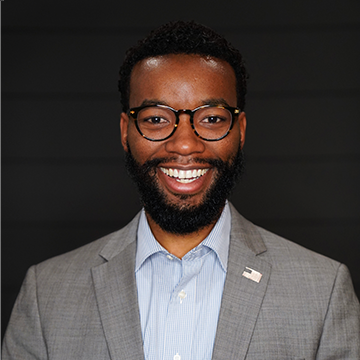
FORT BEND COUNTY, Texas — A sworn complaint prepared for the Texas Ethics Commission accuses Fort Bend County Precinct 4 Commissioner and Democratic county judge candidate Dexter McCoy of violating Texas campaign finance laws through alleged reporting deficiencies in seven campaign finance reports filed between January 2025 and July 2026.
The complaint alleges reporting deficiencies involving out-of-state political contributions, campaign travel disclosures, expenditure descriptions, account balances and possible personal use of campaign funds. It asks the commission to determine whether violations occurred, impose any appropriate civil penalties, order corrected reports and examine McCoy’s campaign depository records.
McCoy is the Democratic nominee for Fort Bend County judge and will face Republican County Judge Daniel Wong in the Nov. 3 general election. He has represented Precinct 4 on Commissioners Court since January 2023.
Katy Christian Magazine emailed McCoy a detailed list of questions about the complaint and offered him an opportunity to respond to its allegations. He had not responded as of publication.

The 149-page copy obtained by the magazine identifies the respondent as Dexter Lorance-Navario McCoy and describes itself as a sworn complaint. Its cover states that the complete submission spans 765 consecutively numbered pages, with the full versions of McCoy’s seven campaign finance reports filed separately because of their size.
The copy provided to the magazine does not display the complainant’s name, signature or verification. It also lists Exhibit L, described as a Fort Bend County filing index, as “to be supplied.” The remaining materials include a 22-page complaint, annotated pages from McCoy’s campaign finance reports and federal or state registration records for political committees named in the filing.
Katy Christian Magazine could not independently confirm whether the Texas Ethics Commission has formally accepted the complaint. Under the commission’s confidentiality rules, the agency and its employees generally may not disclose whether a sworn complaint has been filed while it remains under preliminary review. The commission has made no public finding that McCoy violated state law.
The first count concerns six contributions totaling $9,500 from four federally registered political action committees based outside Texas: Woolpert Inc. PAC, Michael Baker International PAC, AtkinsRéalis USA Holdings LLC PAC and HNTB Holdings Ltd. PAC.
According to the complaint, McCoy’s reports did not identify the contributors as out-of-state PACs and left the federal identification fields blank. The attached records include Federal Election Commission registration forms for all four committees.
The complaint says McCoy’s reports correctly included identification numbers for three other political committees on the same contribution schedules. It alleges the repeated omissions violated requirements governing the acceptance and disclosure of contributions from out-of-state committees.
A second count identifies nine travel-related expenditures that allegedly did not appear on Schedule T, the portion of a Texas campaign finance report used to disclose political expenditures for travel outside the state. Schedule T calls for the traveler’s name, method of transportation, departure and destination locations, travel dates and the political purpose of the trip.
The expenses cited in the complaint include lodging in Washington during the Congressional Black Caucus, lodging and a meal connected with the 2024 Democratic National Convention in Chicago, airfare connected with a conference in Oakland, lodging and dinner during an Atlanta conference, a hotel stay in Montgomery, Alabama, and lodging and ground transportation in Chicago.
Some of the associated airfare appeared on Schedule T, according to the filing, while hotel, meal, rideshare or seat-upgrade expenses connected with the same trips did not. Two of the seven reports reportedly contained no Schedule T.
The third count alleges that 21 expenditures exceeding $285,000 were reported with descriptions that failed to explain the campaign or officeholder activity associated with the expense. The cited descriptions include “Donation,” “Consulting fee,” “Media Consulting,” “Digital Advertising,” “Printing” and “Catering.”
Texas reporting rules require more than an expense category. A campaign must also provide a brief description explaining the candidate or officeholder activity connected to the expenditure.
Among the questioned transactions is a $40,000 payment to Fort Bend First PAC reported simply as a “Donation.” The complaint says the PAC used the same Richmond post office box listed as McCoy’s campaign mailing address. It also says the PAC and McCoy’s campaign paid four of the same vendors.
The complaint does not allege that McCoy served as the PAC’s treasurer or governing officer, and its attached state filing identifies someone else as treasurer. It asks the commission to determine the relationship between the campaign and the committee and trace the disposition of the $40,000 payment.
Ten payments totaling more than $69,000 were described only as consulting fees, according to the filing. The complaint also cites three payments to Human Age Digital: $25,000 on Jan. 16, 2026, followed by separate payments of $80,000 and $61,000 on Feb. 9. Each was described as “Digital Advertising.”

Another entry reported a $20,158 payment to Expose Excellence with the incomplete description, “Event sponsorship and expenses for Africa.”
A fourth count alleges that several expenditures were placed in categories that did not match the services described. The filing cites a $41,610 payment to Lake Research Partners categorized as consulting even though its description said “Polling” and the reporting form provided a separate polling-expense category.
Other examples include $9,076 in canvassing reported as office overhead, $19,800 in media work listed as consulting and $10,000 in executive coaching categorized as office overhead. The complaint also identifies several digital fundraising payments reported as consulting expenses, although a later payment to the same vendor was placed in the form’s fundraising category.
The fifth and largest accounting allegation involves $229,138.76 in discrepancies between the closing balances reported across four transitions from one reporting period to the next.
The filing’s calculations identify differences of $205,682.79, $4,062.95, $7,933.73 and $11,459.29. Two additional differences—$1,541.67 and $1,997.19—fell within the state’s permitted tolerance, and the complaint expressly declines to allege violations based on those amounts.
The complaint also says five reports listed a combined $1,238.52 in unitemized expenditures that were not included in their reported expenditure totals.
Those calculations allege that figures in the reports do not reconcile from one period to the next. They do not establish that campaign money disappeared. The complaint asks the commission to review the campaign’s depository records and determine the correct balances.
The sixth count concerns McCoy’s 30-day pre-election report for the March 3 Democratic primary. The document was received Feb. 2, covered the correct reporting period and was submitted by the deadline, according to the complaint.
The allegation instead concerns the report-type box. McCoy’s filing checked “January 15” rather than “30th day before election,” which the complaint says caused the document to appear under the wrong category in the county’s public index.
The complaint does not accuse McCoy of missing the report or filing it late. It alleges that the incorrect designation made the report harder for voters to locate as a pre-election disclosure. Fort Bend County’s campaign finance portal cautions that the absence of a report from its website does not, by itself, establish that a candidate failed to file one.
The seventh count raises possible personal-use questions involving $10,000 in executive coaching and a campaign-financed vehicle.
McCoy’s reports list four payments to BreakingBounds LLC between December 2024 and October 2025, each described as “Executive coaching.” The complaint argues that the coaching provided a personal professional benefit rather than paying for an activity connected to McCoy’s official duties or campaign.
The campaign also reported 11 monthly payments of $1,141.23 to Houston Police Credit Union, totaling $12,553.53, for what the reports described as a “Campaign vehicle.” The payments ran from July 2025 through June 2026. The filing says McCoy’s reports showed no reimbursements for personal use of the vehicle and asks the commission to determine its ownership, financing terms and use.
That allegation does not establish that McCoy used the vehicle for personal purposes. It asks the commission to investigate whether personal use occurred and whether the campaign received any required reimbursement.
The complaint relies heavily on the campaign’s own filings, which are made available through the Fort Bend County financial-report database. It also cites prior commission decisions involving omitted travel disclosures, incomplete expenditure descriptions and inaccurate contribution balances.
Under the Texas Ethics Commission’s enforcement process, staff must first determine whether a sworn complaint meets the required form and falls within the commission’s jurisdiction. The respondent then has an opportunity to deny the allegations, provide records, correct reports or present other evidence. The commission may dismiss a complaint, negotiate a resolution, assess civil penalties or proceed to a hearing.
McCoy remains the Precinct 4 commissioner while campaigning for county judge. He won the Democratic nomination in the May runoff and will face Wong in November. Katy Christian Magazine will update this report if McCoy provides a response or if the Texas Ethics Commission issues a public order concerning the allegations.