
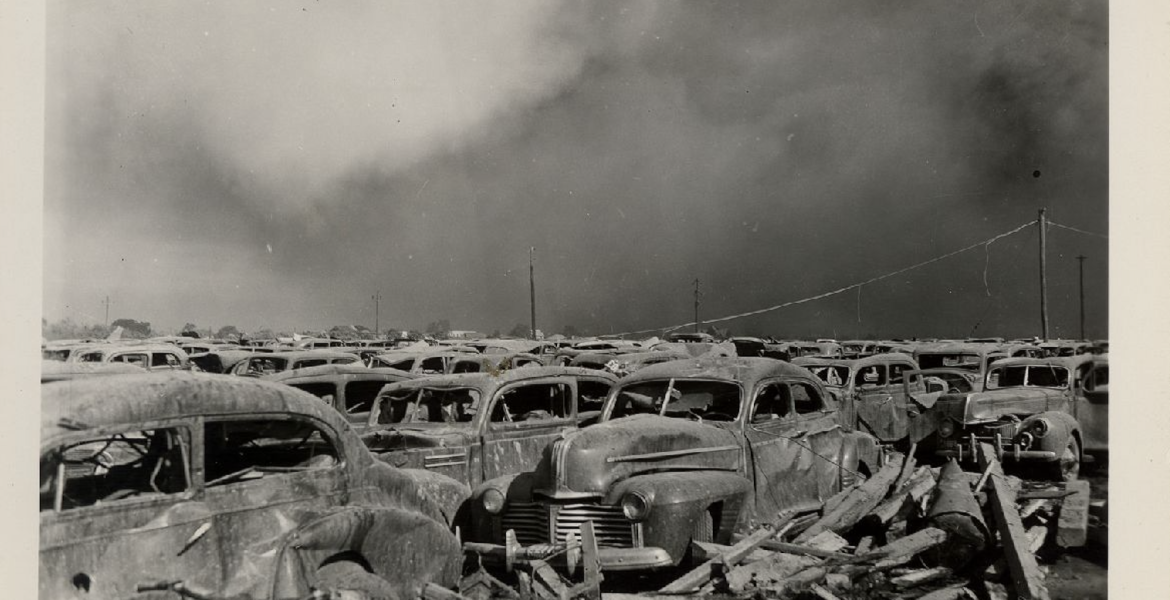
After the Grandcamp’s cargo of ammonium nitrate exploded, crews tried to tow the burning High Flyer clear of the same waterfront.
At 9:12 a.m. on April 16, 1947, the French freighter Grandcamp exploded at the Texas City docks on Galveston Bay, southeast of Houston. Nearly 16 hours later, a second ship blew apart in the same harbor. The 1947 Texas City disaster left a recorded 581 people dead and thousands injured. It remains the deadliest industrial accident in U.S. history.
Earlier that morning, George L. Biggs’ father pointed out an orange glow over the docks from their dining room window. It came from the fire aboard the Grandcamp. His father suggested driving past for a closer look. His mother said they didn’t have time. They were taking George to Galveston to get his eyes checked.
A stiff north wind was blowing. Across the bay in Galveston, the Weather Bureau recorded 56 degrees. Texas City Police Chief W. L. Ladish sounded the fire siren. Men gathered along a warehouse wall to watch the smoke. On the pier, firefighters moved a hose into place.

The Biggs family had made it as far as Sixth Street on their way to Galveston. George’s father said the blast felt like being slapped hard across the face. He told George and his brothers to get out of the car and run home. Then he went to get their sister Bonnie Jean from school.
People ran through the prairie in front of the Biggs house to get away from the fires. George’s father returned with Bonnie Jean, and the rest of the family took shelter at a Catholic church in Dickinson while he stayed behind to help at the docks. Everyone in the family survived with only minor injuries, according to Biggs’ account.
 What caused the 1947 Texas City disaster?
 What caused the 1947 Texas City disaster?
Longshoremen had been loading sacks of ammonium nitrate fertilizer aboard the Grandcamp since April 11. By the morning of April 16, they had put more than 2,300 tons in its cargo holds. The French had acquired the American-built freighter after World War II, and the fertilizer, produced at U.S. Army ordnance plants, was bound for Europe.
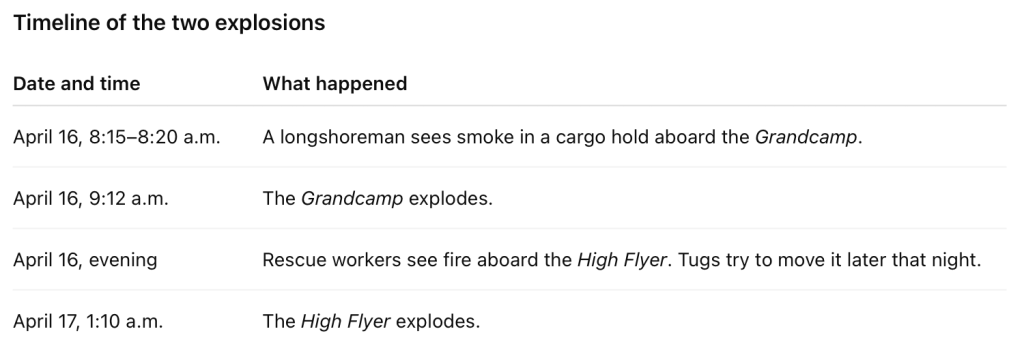
Between 8:15 and 8:20 a.m., a longshoreman saw smoke rising from below the cargo in the No. 4 hold. The men tried portable extinguishers. The smoke let up briefly, then came back with flames. The first officer ordered that no water be used in the hold, and the captain ordered the men out and the hatch covered. The Coast Guard’s board of investigationlater found that sealing the hold delayed getting water to the fire. The board found indications that the crew tried to smother it with steam. The evidence on that point was inconclusive.
The Texas City Fire Department answered the call at 8:33 a.m. A tarp over the hatch swelled and tore as the fire grew. Residents and port workers gathered to watch orange smoke rise from the freighter. Ammonium nitrate can feed a fire by releasing oxygen. The fire heated the fertilizer in the hold until the cargo detonated and tore the ship apart.
The Coast Guard board blamed the original fire on unauthorized smoking below deck. Its members also noted that witness accounts varied and that some of the people best placed to tell them what had happened were dead or too badly injured to testify. The city’s historical account says the source of the fire was never established.
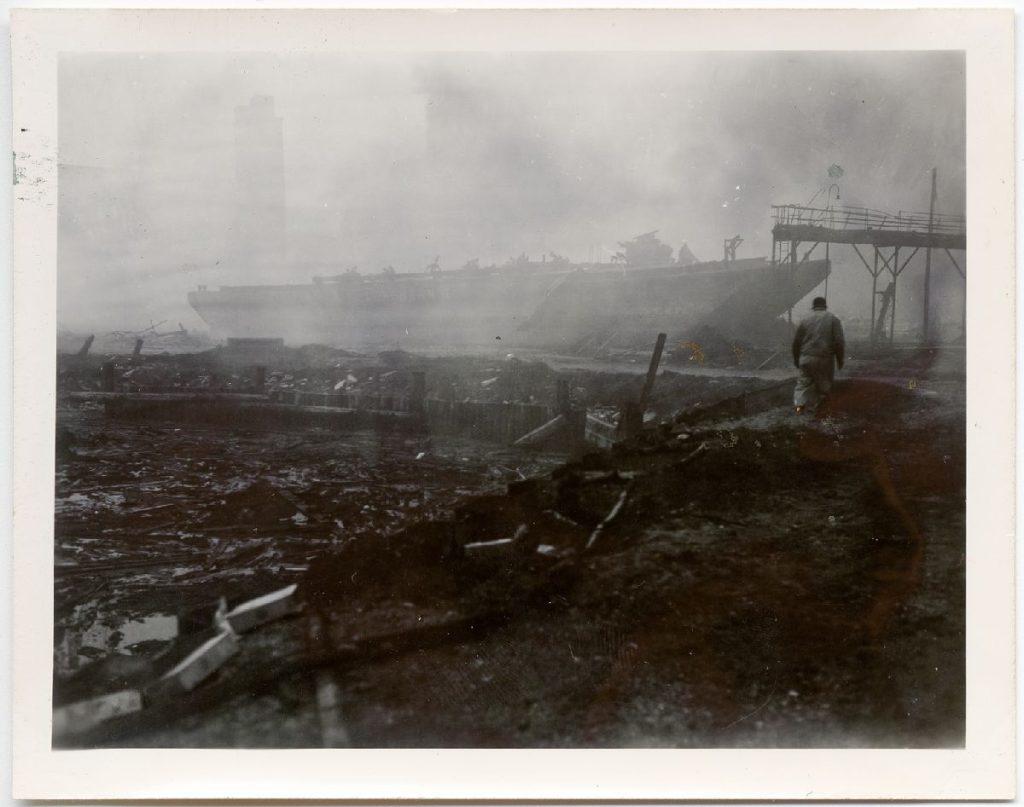
Photo: A man walks past debris at Slip No. 1 in Texas City on April 18, 1947, two days after the Grandcamp exploded. A barge is visible through the haze.
Charles Tellus Townsend, University of Houston Libraries Special Collections
The Grandcamp explosion devastated the waterfront
The first blast killed 27 Texas City firefighters, including Fire Chief Henry J. Baumgartner, according to the National Fallen Firefighters Foundation and the state’s memorial roster.
The blast destroyed four fire trucks, wrecked warehouses along the docks and devastated the nearby Monsanto chemical plant. Debris set fire to oil and chemical storage tanks. The shock shattered windows in Houston, about 40 miles away, according to Texas City’s historical exhibit.
George Biggs remembered a smell in the air after the blast. Years later, working at Monsanto, he smelled it again near the part of the plant that made styrene.
Dockworker Pete Suderman recalled being thrown across the pier along with pieces of the decking. Away from the docks, Nattie Morrow had watched the smoke from her back porch. She was sitting at the kitchen table with her baby when the blast tore the door from its frame and sent it sliding across the floor into the table.
“The house toppled to one side and sat off its piers at a crazy angle,” Morrow recalled in an account preserved by Moore Memorial Public Library. The blast damaged or destroyed at least 1,000 homes and other buildings.
Texas City had no working hospital. Volunteers set up first-aid stations in city buildings, and firefighters came from Galveston, Houston and nearby military bases. Coast Guard boats ferried survivors to Galveston, where John Sealy Hospital took in the injured. The island city had lost thousands of people in the 1900 Galveston hurricane. Army personnel and Red Cross volunteers reopened Fort Crockett’s hospital on the island to take more patients.

Lydia Eisenhauer Biegert, who had worked in John Sealy’s emergency room, crossed the causeway with a physician and several medical students. At a Texas City clinic, she and a medical student stitched up schoolchildren cut by flying glass. They worked without anesthetic, she recalled in an account preserved by Texas City’s firefighters’ union.
The High Flyer exploded nearly 16 hours later
The morning blast tore the High Flyer loose from some of its moorings. It drifted alongside another cargo ship, the Wilson B. Keene, which was loaded with flour. The High Flyer carried ammonium nitrate fertilizer and sulfur. Its engine was already apart for inspection when the first ship exploded, leaving it unable to get out of the harbor under its own power.
By about 6 p.m., rescue workers had seen fire aboard the High Flyer. Tugs from Galveston reached the slip around 11 p.m. Crews cut the freighter’s anchor chain and tried to pull the ship clear. It stayed in the slip. Smoke and fumes forced the men aboard to get off, and an evacuation was ordered around 12:55 a.m., according to the Coast Guard’s investigation.
At 1:10 a.m. on April 17, nearly 16 hours after the first blast, the High Flyer exploded. It wrecked the Keene and demolished part of a pier and most of a warehouse. By then, most people had cleared the waterfront. The city’s accountsays the second blast killed at least two people. The Coast Guard’s 1947 report records one reported death.
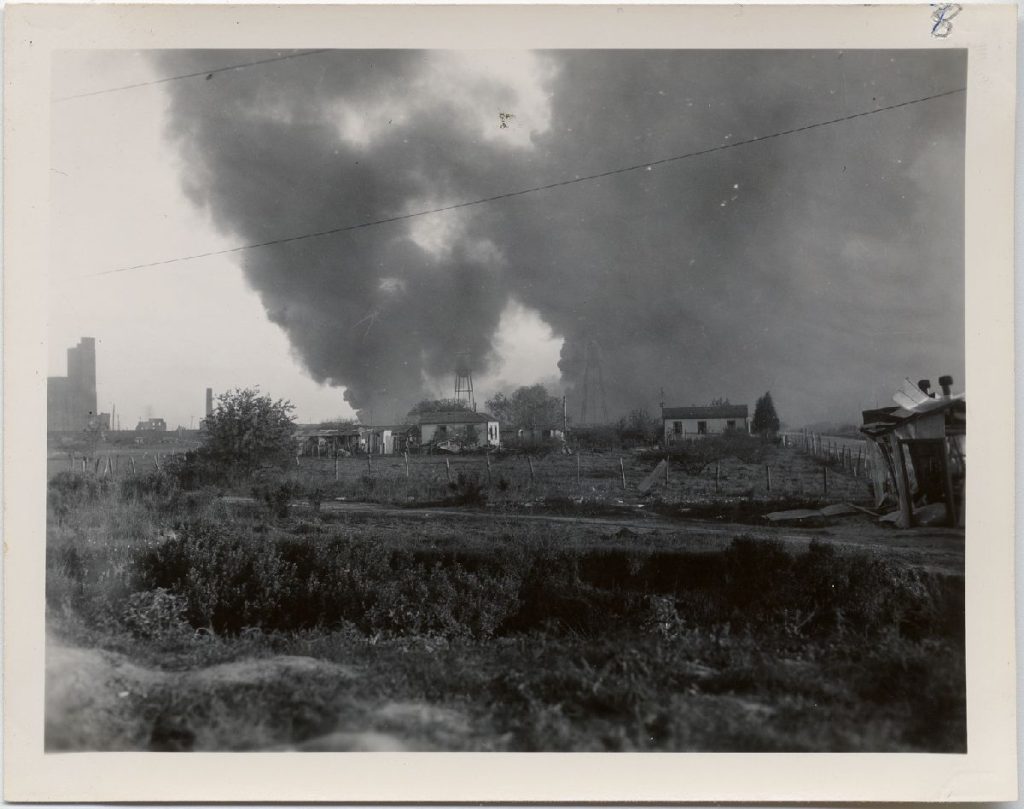 Photo: Smoke from burning oil tanks rises behind homes in Texas City on April 18, 1947, after the Grandcamp and High Flyer exploded at the port.
Charles Tellus Townsend, University of Houston Libraries Special Collections
How many people died in the Texas City disaster?
The recorded death toll was 581, according to Red Cross and Texas Department of Public Safety figures cited in the Handbook of Texas. The first blast killed more than 500 people, according to the U.S. Army Corps of Engineers.
The exact toll remains uncertain. The explosion destroyed Monsanto’s personnel and payroll records, and many dockworkers moved from job to job. Some families never recovered their relatives’ remains. The high school gymnasium became a temporary morgue. Outside, the names of the dead who had been identified were written on blackboards.
How the disaster changed safety rules and emergency response
A decade earlier, the New London school explosion had prompted Texas to regulate how utilities gave natural gas a warning odor. At Texas City, investigators found that shipping officials had described the fertilizer improperly on shipping papers and that the Grandcamp had taken torn bags aboard in violation of cargo rules.
The Coast Guard cited Texas City and an explosion at Brest, France, when it issued emergency rules in August 1947. Ships needed Coast Guard authorization to load or unload large shipments of ammonium nitrate. The agency could require them to move the work away from crowded parts of the port. In 1949, Texas City industries and public agencies organized the Industrial Mutual Aid System so members could call on one another when an emergency overwhelmed any one of them.
Families and businesses also went to court. In 1953, the U.S. Supreme Court ruled in Dalehite v. United States that the claims in the case fell within an exception to the Federal Tort Claims Act and could not proceed. Congress set up a separate compensation program in 1955. By 1957, the Army had approved 1,394 claims totaling about $16.5 million.
Remembering the victims of the Texas City disaster
On June 22, 1947, Texas City held a funeral for the 63 unidentified victims. The caskets were set out in six rows, each with a wreath. Catholic and Protestant clergy and a rabbi took part in the service. The burial ground became part of Memorial Park. In 1962 the city turned the Grandcamp’s recovered anchor into a memorial.
At the city’s April 11, 2026, memorial service, Alvin Loeckle recalled losing his maternal grandfather, who was on the deck of one of the ships when it exploded. Loeckle was in third grade that spring, The Post Newspaper reported.
“I just remember the teacher saying, ‘Run!’ and we all ran,” he said.
Feature photo: Wrecked cars sit in a parking lot about a quarter mile from the Texas City blast site on April 18, 1947. Courtesy of Special Collections, University of Houston Libraries.