

Harris County mailed about 2.7 million voter registration cards ahead of the midterms. Annette Ramirez, the county’s voter registrar, told Houston Public Media in September that she expected more than 100 thousand to come back as undeliverable.
By November, the Texas secretary of state counted 282,402 Harris County registrations on the suspense list, up 84,033 from March. That was the largest increase by count in Texas. About one in 10 Harris County registrations carried a flag that meant the registrar needed to confirm the voter’s address.
The county’s published election reports bring to mind one question: How many voters with an address flag showed up for the Nov. 3 election and cast a ballot?
Harris County’s suspense count rose 42.4%, close to the statewide increase. Next door in Fort Bend, the increase was 8.3%.

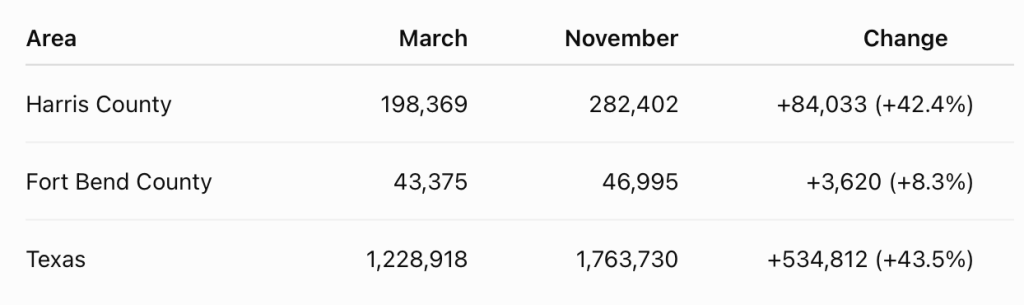
Figures from the Texas secretary of state’s voter registration reports for March and November.
Harris County’s voter rolls grew by 43,225 registrations between the two reports. The number outside suspense fell by 40,808. In Fort Bend, registrations outside suspense rose by 10,352.
In November 2024, 279,846 Harris County registrations were on suspense, a slightly higher share of the county’s rolls than this November.
The county reported a higher count in September.
Ramirez put the Harris County count at roughly 300,000 in an interview with ABC13 published Sept. 1. Later that month, the Defender reported more than 319,000 based on records from her office. Those records included 16,923 registrations that listed Katy in the city field. The state’s November report came in below both September figures.
To explain the difference, the county and state would need to identify when each count was taken and which registrations it included.
Returned registration cards can put a voter on suspense. Ramirez also cited returned jury summonses and Postal Service change-of-address information. The state’s two snapshots give the net increase. The registrar’s records would show how many flags were added and cleared, when those changes happened and how many started with a card that came back in the mail.
Fort Bend’s signed mailing contract established a Jan. 7 deadline for sending about 525,000 cards, unless the county directed otherwise. It requires the vendor to furnish dated batch logs or postal receipts on request. Votebeat reported in February that redistricting and problems with the state’s voter registration software had delayed mailings in some counties. Postal receipts and return logs could show whether more of Fort Bend’s returned cards were processed before the March count.
A Katy resident admitted voting illegally

Ada Ngozi Otuka, a British citizen and lawful resident who lived in Katy, pleaded guilty in July to illegally voting in the 2020 federal election. She also admitted falsely claiming U.S. citizenship on her Texas voter registration and on a Statement of Residence, the form voters use to confirm where they live. Voting records showed she also cast ballots in 2012, 2016, 2018 and 2024, federal prosecutors said. Fort Bend County notified her in June 2025 that it was examining her registration, according to the plea agreement reported by the Houston Chronicle.
In Harris County, Samuel James Hall, another British citizen, admitted in May that he voted illegally in the 2024 federal election. The county registrar’s office told ABC13 it learned Hall was on the rolls in June 2025, seven months after the election. Hall then canceled his registration. Katy Christian Magazine also reported on Oct. 30 federal charges against Ali Khan, a La Porte resident whom prosecutors described as an illegal immigrant and a DACA recipient. Prosecutors allege Khan voted in 2024. They also charged Mohammed Omar Hassan, a Houston resident and lawful permanent resident, alleging he voted in 2022 and 2024.
The day after those federal charges were announced, Texas Attorney General Ken Paxton announced arrests in an illegal-voting investigation that began with a tip about ballots allegedly cast in Harris County. His office said investigators checked 2026 voting records and confirmed through the Texas Department of Criminal Justice that several people were on parole when they voted. Warrants were issued in Montgomery County. The announcement left open whether any of the people arrested had been on the suspense list.
Here are the questions the new audit needs to answer.
The state’s citizenship review flagged 2,724 registrations statewide in October 2025. By September 2026, the secretary of state said 578 of those voters had demonstrated citizenship and referred 117 cases of possible noncitizen voting to the attorney general for investigation. Those referrals preceded the Nov. 3 election. How many came from Harris or Fort Bend, which elections did they involve, and what did investigators find?
An otherwise eligible voter on suspense who still lives in the county can sign a Statement of Residence and cast a regular ballot. The same form is also used when voters report a move within the county. Harris County posted its official election reconciliation on Nov. 10. Fort Bend reported 1,070 provisional ballots, of which 825 counted and 245 were rejected.
After losing a 2022 race for district judge in Harris County, Erin Lunceford argued that voters on the suspense list had cast ballots without confirming their addresses. Her expert relied on a roster that showed who checked in. He assumed the voters were already on the list when they arrived and hadn’t checked whether any cast provisional ballots. The First Court of Appeals upheld the election result in February.
The 2024 state audit found that Harris County’s voter list differed from the state’s during the 2021–22 cycle. Auditors also said they could not review how many address-confirmation notices the county mailed. The secretary of state said the county corrected the earlier problem with its voter list. The new audit covers the 2025–26 elections.
Harris County Voter Registrar Annette Ramirez should explain why 84,033 more registrations were on suspense in November than in March. Her office must explain what triggered the address flags, how many it cleared and how many were still in place when voting began.
Further, County Clerk Teneshia Hudspeth should account for what happened at the polls. How many flagged voters confirmed their addresses and cast ballots? Did the county document or refer any cases of suspected double voting or someone knowingly using a false address to vote?
The Texas secretary of state’s office could release preliminary findings on the Nov. 3 election in July 2027. Its schedule calls for the full audit of the 2025–26 elections in July 2028.
Ramirez and Hudspeth should compare the voter rolls with check-in records, residence forms, provisional ballot decisions and incident reports now. Both offices should publish what they find, explain what they still can’t account for and fix any errors before the next election. Harris County voters deserve those answers before they go back to the polls.
Feature photo by Casey Robertson on Unsplash