
Submission by Tom DeWeese, American Policy Center
“The moment the idea is admitted into society that property is not as sacred as the laws of God, and that there is not a force of law and public justice to protect it, anarchy and tyranny commence.” — Founding Father John Adams
The Kelo v. New London Supreme Court decision remains one of the most controversial rulings in American history, fundamentally changing the national debate over eminent domain, private property rights and the government’s authority under the Fifth Amendment. The 2005 ruling allowed governments to take private property for economic development projects, igniting a nationwide debate over the meaning of “public use” and the constitutional protections afforded to homeowners and landowners. At the center of the case was Connecticut homeowner Susette Kelo, whose legal battle against the city of New London became one of the most significant property rights cases in modern American history. This article examines the landmark Supreme Court decision, its lasting impact on private property rights in the United States and why it continues to shape debates over eminent domain, government power and constitutional property protections today.
Today, the very root of our nation’s freedom, prosperity and private property ownership by individual citizens is under attack across the nation. Eminent domain is the weapon of choice, allowing private corporations to take property under the excuse of the “common good.” Wind and solar farms, carbon-capture pipelines and massive AI data centers now cover vital farmland and private neighborhoods. Property owners are given no choice in the matter. It’s gone. How is that possible in a nation built on the concept of private property ownership and protection?

For decades, we have faced the globally organized juggernaut called “Sustainable,” designed by powerful forces to completely change and control human society. From the beginning of the plan, however, our nation, which is based on the concept of private property, has stood in the way.
Now the tool every tyrant has ever dreamed of for complete control is in their hands: AI. The train for control is ready to leave the station, but the way is blocked by those infernal property rights. What can be done to allow tyranny to commence?
The real answer was found just over 20 years ago and is now in full swing. Here is the story. It started with five black robes named Stevens, Souter, Ginsburg, Kennedy and Breyer. In 2005, the Supreme Court of the United States handed down an opinion that shocked the nation.
It was the case of Susette Kelo et al. v. City of New London, Connecticut, et al. The issue was whether the government’s taking of property from one private owner to give to another private entity for economic development constituted a permissible “public use” under the Fifth Amendment.
In 2000, the city of New London saw a chance to rake in big bucks through tax revenue from a new downtown development project that was to be anchored by pharmaceutical giant Pfizer. The company had announced plans to build a $270 million global research facility in the city.
The local government jumped at the chance to transform 90 acres next to the proposed research facility. Its plans called for the creation of the Fort Trumbull development project, which would provide hotels, housing and shopping areas for the expected influx of Pfizer employees.
There were going to be jobs and revenues a-go-go in New London. Just one obstacle stood in the way of these grand plans: There were private homes in that space.
No muss, no fuss. The city fathers had a valuable tool in their favor. They would simply issue an edict taking the land by eminent domain. To get started, the city created a private development corporation to lead the project. Its first priority was to obtain the needed property.
Put yourself in the shoes of the homeowners in that targeted neighborhood. You bought a home for your family. It was a place you could afford in a neighborhood you liked. The children made friends. You intended to stay for the rest of your life.
However, as you planted your garden, landscaped the yard, put up a swing set for the kids and molded your property into a home, certain city officials were meeting around a table with developers. In front of them were maps and photographs of your home. They talked about dollars. Big dollars. Tax revenue for the city and huge profits for the developer. Expensive condos, hotels and a shopping center with all the trimmings began to take shape.
You weren’t asked for input or permission. You weren’t even notified that your home had been targeted until the whole project was finalized and the only minor detail left was to get rid of you.
Susette Kelo bought a nice little pink house in the quiet New London neighborhood that had been targeted. Little did she imagine that the warm, comfortable place would soon become the center of a firestorm. She had spent considerable time and money fixing up her little pink house, a home with a beautiful view of the bay. She planted flowers in the yard, braided her own rugs for the floors, filled the rooms with antiques and created the home she wanted.
Less than a year later, the trouble started. A real estate broker suddenly showed up at her door representing an unknown client. Susette said she wasn’t interested in selling. The real estate agent’s demeanor then changed, and Kelo was warned that the property would be condemned by the city. A year later, on the day before Thanksgiving, the sheriff taped a letter to her door stating that her home had been condemned by the city of New London.
Then the pressure began. A notice came in the mail telling her that the city intended to take her land. An offer of compensation was made, but it was below the market price. The explanation was that because the government was going to take the land, it was no longer worth the old market price. Therefore, the lower price was “just compensation,” as called for in the Fifth Amendment. It was a “fair price,” the homeowners were repeatedly told.
Some neighbors quickly gave up, took the money and moved away. With the loss of each one, the pressure mounted. Visits from government agents became routine. They knocked on the door at all hours to demand that Susette sell. Newspaper articles depicted her as unreasonably holding up community progress. They called her greedy. Finally, the bulldozers moved in on the properties that had already been sold. As they crushed the houses, the neighborhood became unlivable. It looked like a war zone.
When a homeowner gave in and sold, the house was immediately crushed by a bulldozer. The next homeowner then came under intense pressure to sell. More phone calls, threatening letters and visits by city officials came at all hours, demanding that they sign a contract to sell. Finally, the intimidation began to break down even the most dedicated homeowners’ resolve. In tears, they gave in and sold. Amazingly, once they sold, the homeowners were classified as “willing sellers.” As each house was bulldozed, the massive machine moved next door and sat there like a huffing, puffing dragon, ready to strike.

Eventually, Susette’s little pink house stood nearly alone in the middle of a demolition site. More than 80 homes were gone; seven remained. As if under attack by a conquering army, she was surrounded, with no place to run but the courts. The United States was built on the premise of protecting private property rights. How could a government possibly be allowed to take someone’s home for private gain? Surely justice would prevail.
Under any circumstances, the actions of the New London government and its sham development corporation should have been considered criminal behavior. It used to be. If city officials were caught padding their own pockets or those of their friends, it was considered graft. That’s why federal racketeering laws were created.
Finally, her case was heard by the highest court in the land. It was such an obvious case of government overreach against private property owners that few considered there was any chance of New London winning. The city was backed in its appeal by the National League of Cities, one of the largest proponents of eminent domain, which argued that the policy was critical to spurring urban renewal through development projects.
Property rights legal organizations, particularly the Institute for Justice, came to Susette’s rescue and served as her advocate before the high court. They were joined by a wide array of groups, including AARP and the Southern Christian Leadership Conference, which the Rev. Martin Luther King Jr. helped found. This was widely seen as a civil rights case.
The Supreme Court had always stood with the nation’s founders on the vital importance of private property. There was precedent after precedent to support the belief that it would do so again. However, to the shock of everyone involved, private property rights sustained a near-death blow that day.
This time, five black robes named Stevens, Souter, Ginsburg, Kennedy and Breyer shocked the nation by ruling that officials who had behaved like Tony Soprano were in the right and that Susette Kelo had no ground to stand on, literally or figuratively.
These four men and one woman ruled that the United States Constitution was meaningless as a tool to protect individuals against the wants and desires of government. Their ruling in the Kelo case declared that Americans own nothing. After deciding that any property was subject to the whim of a government official, it was a short trip to declaring that the government could confiscate anything we own, anything we create and anything we have worked for in the name of an undefined common good.
In defending the decision, Justice John Paul Stevens wrote, “Promoting economic development is a traditional and long accepted governmental function.” He mentioned not a word about the long tradition of government in the United States standing for the rights of the individual. Not surprisingly, The New York Times and The Washington Post supported the decision.
Justice Sandra Day O’Connor, who opposed the court’s decision, vigorously rebutted Stevens’ argument. She wrote in her dissent from the majority opinion, “The specter of condemnation hangs over all property. Nothing is to prevent the State from replacing any Motel 6 with a Ritz-Carlton, any home with a shopping mall, or any farm with a factory.”
Justice Clarence Thomas issued his own rebuttal to the decision, specifically attacking the argument that this was a case about “public use.” He accused the majority of replacing the Fifth Amendment’s Public Use Clause with a very different public-purpose test.
“This deferential shift in phraseology enables the Court to hold, against all common sense, that a costly urban-renewal project whose stated purpose is a vague promise of new jobs and increased tax revenue, but which is also suspiciously agreeable to the Pfizer Corporation, is for a ‘public use,’” Thomas wrote.
Incredibly, after the Supreme Court decision dealt a severe blow to the nation’s oldest and most revered right of private property ownership, the entire action by the New London government turned out to have accomplished virtually nothing it had promised. There was no great “revitalization” of downtown. The New London private redevelopment project was never completed. The proposed hotel-retail-condo “urban village” was never built, and the developer failed to secure the necessary financing.
Pfizer, whose employees were supposed to provide much of the clientele for the project, had opened its research facility in 2001. The company announced in 2009, after acquiring Wyeth, that it would close the New London facility the following year and consolidate operations at its campus in nearby Groton.
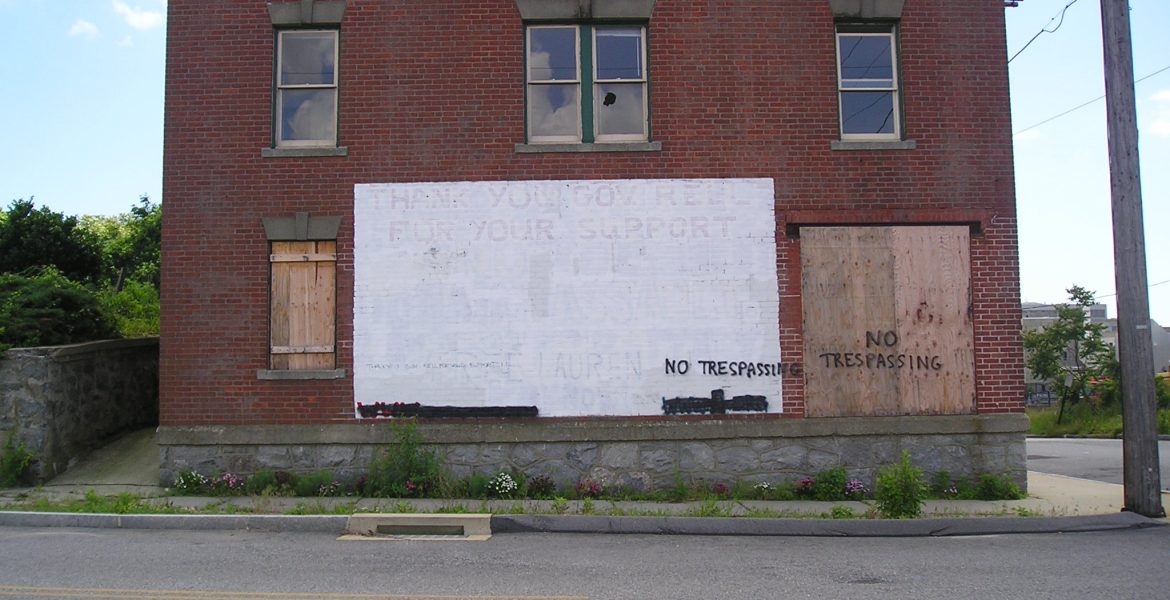
Much of the land where the Fort Trumbull homes once stood remained vacant for years. After Hurricane Irene in 2011, part of the closed redevelopment area was used to hold storm debris, including tree branches and other vegetation. The hotel, retail and condominium development envisioned at the start never materialized. New London opened a city recreation center on the Fort Trumbull peninsula in 2025, and other development has since been proposed, but the original project and its promised economic benefits were never delivered as presented.
The precedent created by the Kelo decision for government takings of land across the nation has grown to unimaginable levels.
In a 5-4 decision, the Supreme Court said it was acceptable for a community to use eminent domain to take private land or destroy and reorganize an entire neighborhood if the project was expected to benefit the community. Specifically, “positive” meant unquestioned government control and more tax dollars.
The Kelo decision changed the rules. The precedent was set. Land can now be taken at the whim of a power elite. The tyrants have the tool for control they have always dreamed of. They call it the common good. Mission accomplished.
Featured photo: I, Nard, CC BY-SA 4.0 <https://creativecommons.org/licenses/by-sa/4.0>, via Wikimedia Commons