

Attorney and pastor Jon Alworth shares his journey to sobriety and the Houston recovery ministries helping others rebuild.
Jon Alworth had already seen what alcohol could do to a family before he ever walked into rehab himself.
His mother died at 61 from alcohol-related complications, including liver failure. Her father died at 62 from liver failure. His father’s father died at 62 from alcohol-related complications. By the time Alworth began looking at his own life and his own addiction, he had already watched the same destruction move through multiple branches of his family.

“For me, addiction was genetic,” Alworth said. “It runs in the family.”
Alworth, a practicing attorney, went to rehab in 2013. He has now been sober for over a decade, and the life he leads today carries the weight of what he survived, what he witnessed and what he believes God has done with all of it.
Alworth serves as an assistant pastor at New Covenant Church in Humble, where he was ordained in 2019. He is also the lead pastor of Break Every Chain, a recovery ministry that began at the church in 2015. He also serves on the board of directors at Open Door Mission, a 110-bed facility serving addicted and homeless men, and he volunteers there weekly. Additionally, he hosts “Recovery Through Christ,” a 25-minute radio show airing Wednesdays on 100.7 The Word.
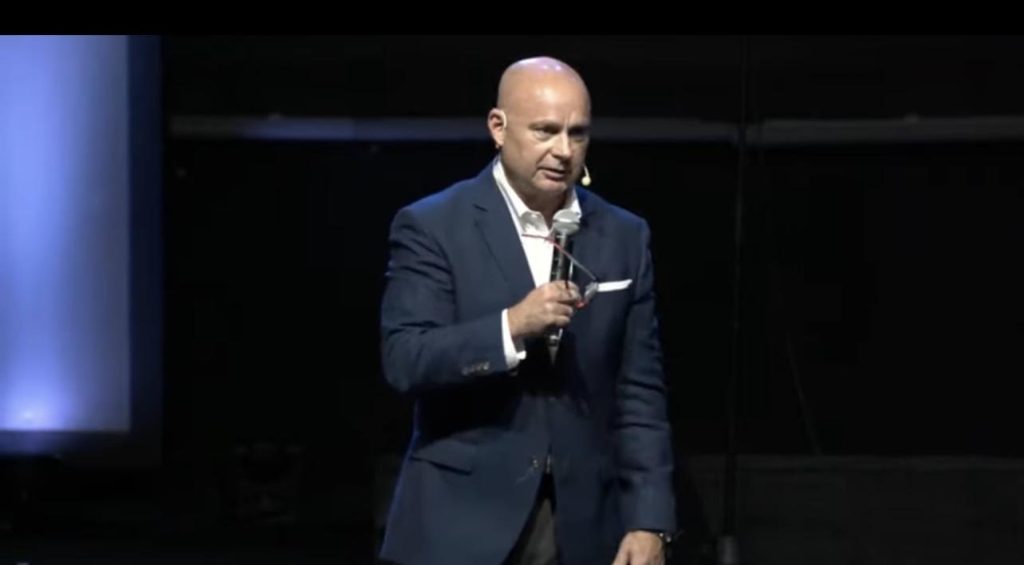
Even with this plethora of involvements, Alworth still practices law full time as a personal injury attorney.
His calendar is crowded, even after scaling back a few things after a season that included a church plant in the Heights, two radio shows, ministry work, his law practice, marriage and caring for a niece who lived with his family for six years.
“I still do,” Alworth laughed, when told he had a lot going on. “But it’s a little more manageable now. I had to choose between being Senior Pastor of a church and our recovery ministries, and after extensive prayer, realized that God’s calling on my life is in recovery and deliverance ministry.”
The work, he said, comes from gratitude.
“I just feel like God’s given me so much, transformed my life, that I just can’t help but give back,” he said. “And the Bible, of course, says, ‘To whom much is given, much is expected.’”
Break Every Chain began after Alworth and others at New Covenant Church wanted a recovery ministry with freedom to follow the Holy Spirit and place Jesus Christ openly at the center of the process. Break Every Chain was built with its own structure and its own Christ-centered 12 steps.
The ministry meets weekly at New Covenant Church, and it has also expanded into Open Door Mission. Every Tuesday, Alworth and others bring Break Every Chain into the mission from 6 to 7:30 p.m. On Thursdays, the ministry meets at New Covenant Church.
A typical Break Every Chain meeting feels, in some ways, like a church service. There is praise and worship. There is a biblical message. Then the group breaks into men’s and women’s groups for discussion.
People speak openly and vulnerably about their struggles, their victories, and the message from that night. The room is diverse, with some people in the room having years of sobriety under their belts, and others still fighting for the first few weeks. Some may have relapsed recently and come back anyway. A small portion are addiction-free and attend because they feel called to help.
Alworth sees all of it as discipleship.
He said the first step in recovery is honesty, and that alone can be hard for people whose pride, shame or fear keeps them from saying what is true.
“A lot of people, and certainly men, have a big problem with this,” Alworth said. “They can’t, because of their pride, they can’t admit they have a problem. They can’t admit that they need help.”
Break Every Chain works with people struggling with alcoholism, drug addiction and pornography addiction. Alworth’s language around recovery keeps returning to surrender, confession, fellowship and the long work of walking with Christ.
In the traditional 12 steps, he said, phrases such as “higher power” or “the God of my understanding” leave room for broad interpretation. Break Every Chain rewrote the steps into what it calls Christian 12 Steps.
“We put Jesus Christ in the middle of it,” Alworth said.

That does not make recovery simple. Alworth emphasizes that sobriety is not like a one-time religious moment that erases every struggle afterward. He describes it as a daily walk, one that continues through conviction, confession, forgiveness and the choices that come after a person leaves a meeting.
“You don’t go to church the first day, hear this wonderful sermon, go to the front, answer an altar call and give your life to Jesus, and then that’s it,” Alworth said. “That’s just the beginning.”
He said true Christ-based recovery mirrors the Christian walk.
“You just continue to walk it out with Jesus,” he said.
That daily walk matters because addiction rarely leaves a person’s life untouched. In Alworth’s work at Open Door Mission, he recognizes that the majority of the men carry far more than a substance problem. Some of them have been intensely traumatized through homelessness, crime, mental illness, broken families, gaps in education, gaps in employment and the heavy shame that follows people after years of damage.
“Mental illness, crime, homelessness and addiction all go hand in hand,” Alworth remarked.
He noted that for many who struggle with addiction, sobriety is only one step in a whole path the person must undertake in order to regain- or possibly build for the first time- a functional life.
Some men come in with criminal records that make it hard for them to find work. Some lack high school diplomas, computer skills or resumes. Some have been living off the street or in a car, and others have been in prison. Some have burned bridges with their family. The majority have gone through traumas and adversities they rarely voice aloud.
Alworth knows his own path back came with advantages.
“I have a law degree,” he said. “It was pretty easy for me to bounce back on my feet, but a lot of these people don’t have that.”
That sentence encapsulates the reason his work at Open Door Mission matters so much to him.
The mission offers spiritual support, but it also helps men build the basic pieces of a livable future. If a man does not have a high school diploma, he can work toward his GED. If he does not know how to use a computer, he can learn. If he needs a resume, staff and volunteers can help him put one together. Open Door Mission also works with WorkFaith, a program that provides job training and connects people with additional resources. The mission works with second-chance employers who are willing to hire men trying to rebuild after addiction, homelessness or incarceration.
“If you can’t use a computer these days, you’re kind of out of luck,” Alworth noted.
Counseling is also part of the work, as is trauma support. Alworth described many situations where the men have lived through broken families, years on the street and painful experiences that shaped the way they see themselves and the world.
“So many of these people have gone through so much trauma,” he said. “They come from broken families. Bad things happen to them out on the street.”
The goal is to use every available resource to help them stand again.

“We try to use every tool in the toolbox,” Alworth said.
The practical work is a quintessential step in maintaining sobriety for the long haul. A man who gets sober still has to find somewhere to live, apply for jobs and learn how to answer questions about the years addiction took from him. He still has to face his family, his record, his health, his habits and the quiet hours when old cravings return.
Alworth described how helping people escape addiction benefits the entire community.
“It’s in everybody’s interest to try to help people get to escape the bottom of addiction,” he said. “It just cuts down on crime. It cuts down on government benefits. It makes people productive citizens who are now paying taxes and helping everybody out.”
In his years, Alworth has witnessed enough relapse to speak honestly about recovery. He described how relapse statistics in the first year of attempting sobriety can range widely, and that alcohol can be especially difficult to quit because it is everywhere.
“If your addiction is alcohol, it’s at every street corner,” he said.
His mother, who struggled heavily with alcoholism, experienced that difficulty.
“She went to eight rehabs before she passed away,” Alworth said.
The first time she experienced delirium tremens, he said, it scared her enough that she got sober for a couple of years. Then she went to New Orleans on a business trip. People around her were drinking.
“She thought, ‘Well, I can have just one,’” Alworth said. “And she never really regained long-term sobriety after that, sadly.”
That lesson became fixed in him.
“One’s too many and a thousand’s not enough,” he said.
Alworth pointed to the shame surrounding addiction as a major culprit in perpetuating the cycle. He has witnessed firsthand how it keeps people sick. He described how people in addiction often believe their mistakes have disqualified them from love, forgiveness or usefulness.
“The devil wants us mired in shame and guilt,” he said.
He points people back to scripture, including stories of men God used after serious failure.
“The devil wants you to think, ‘I’ve made too many mistakes. God doesn’t love me. God can’t forgive me. God certainly can’t use me,’” Alworth said. “And those are all lies from the pit of hell.”
He mentioned David, Moses and Saul, who became Paul. Each had grave sin in his story. Each was still used by God.
“God has sometimes used those that have made the biggest mistakes in the most powerful ways,” Alworth said.
One of the stories that stays with him is a man who once worked as an EMT. The man, who has shared his testimony publicly on Alworth’s radio show, injured his back and became addicted to painkillers. When doctors became more reluctant to prescribe them, and when pills became harder and more expensive to get, he found cheaper opioids and heroin on the street.
At first, the man drew a line. He told himself he would never inject drugs. Then, addiction moved the line.
“The thing about addiction is people cross lines that they never thought they’d cross,” Alworth said.
Eventually, the man was injecting heroin and fentanyl. Alworth called it “a miracle that he’s alive.”
The man found Jesus, went through the program at Open Door Mission and now works there helping others seek sobriety.
“That’s the kind of work that God does,” Alworth said. “If you work in the recovery ministry for long enough, you’re gonna see miracles. You’re gonna see deliverance.”
There is joy in the story too, and Alworth wants people to hear that part. For many, sobriety can sound like a life stripped of fun, celebration or relief. Alworth remembers thinking that way.
“There was a time in my life where I thought, ‘Well, I can’t have any fun on a Friday or Saturday night without going out and getting a buzz,’” he said.
Now he talks about going to concerts sober. He has seen the Eagles and Santana in Las Vegas in recent months.
“I remember every bit of it, and I’m not going to have a hangover,” he said.
He called it “the joy of sobriety.”
His radio show, “Recovery Through Christ,” has become another arm of the ministry. Some episodes are biblical teachings on recovery, faith and sobriety. One recent show focused on practical ways to strengthen faith by attending church meetings and reading the Bible. Another compared the traditional 12 steps with Break Every Chain’s Christian 12 Steps, while another focused on the joy of sobriety.
About half the shows, Alworth said, are messages or “mini sermons.” The other half feature guests who are doing kingdom work in the community.
He has interviewed people from prison ministries, halfway houses, recovery ministries and other local organizations. He has also invited people on the show simply to share their testimonies.
“I bring guests who are doing kingdom work in the community,” Alworth said.
The show gives ministries, people in addiction or recovery and their loved ones access to resources and messages of hope. Listeners witness stories from people who have survived addiction, incarceration, homelessness and despair. They’re reminded that someone else has walked through the dark and come out alive.
Alworth said he would like to hear from people who have testimonies to share or ministries that serve people in recovery, prison ministry, homelessness or related community work. He said he has a conversation with potential guests beforehand to make sure the fit is right, but he prefers the interviews themselves to unfold naturally.
“I kind of like it to get organic and see where the Lord leads us,” he said. If you’re interested in sharing your testimony with Alworth, or even on the radio, he invites you to text him at (832) 475-8642.
For Alworth, the work continues because the need continues. Men are still walking into Open Door Mission with nowhere else to go. Families are still living with the fear of relapse. People are still trying to rebuild after addiction has taken their health, their homes, their jobs or their names. Some are still carrying shame so heavy they cannot imagine God wanting anything to do with them.
Alworth has lived close enough to addiction to know what it can take. He has also lived long enough in sobriety to know what can be built afterward.
“God is so good,” he said. “It’s such a joy to work in this field.”