
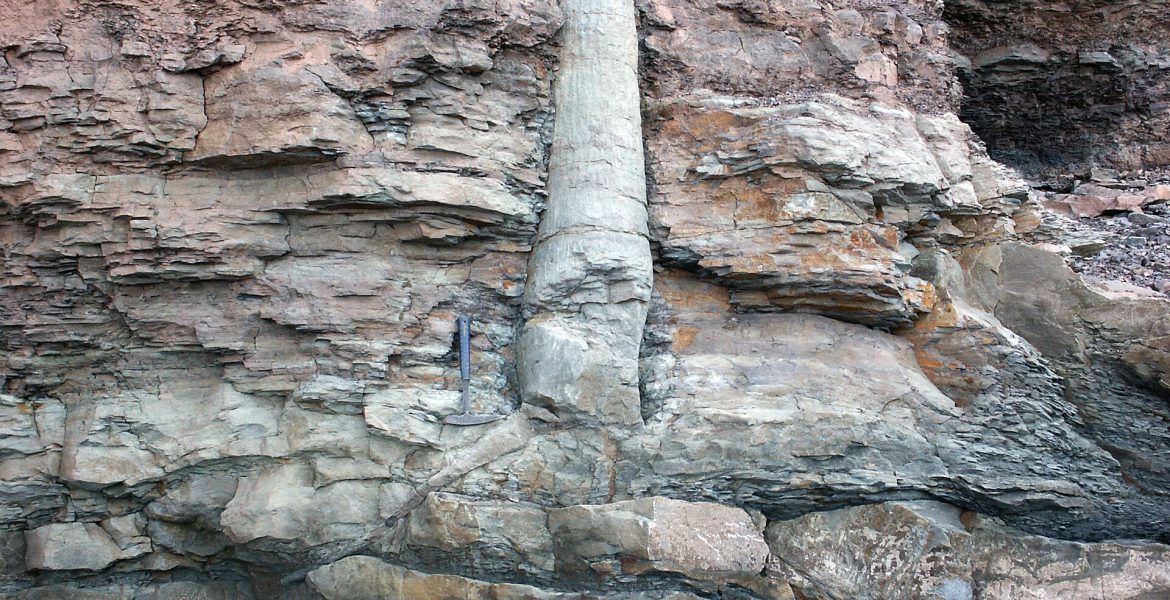
An upright tree trunk locked in stone raises a practical question: how long can a dead tree stand before it rots, collapses or gets carried away?
That question has followed fossilized trees for decades, particularly the sort which creation researchers peg “polystrate fossils.” The term refers to fossils, often tree trunks, that pass vertically through more than one layer of sedimentary rock. Creation researchers have long argued that these fossils poke serious holes in explanations that depend on slow, gradual sediment buildup around dead trees over long periods of time.

The fossils themselves are real. At Yellowstone National Park, the National Park Service reports some fossilized trees were torn from the ground and transported, while others remained where they grew. In both cases, they were buried by volcanic deposits. The agency also describes repeated catastrophic lahar flows, or volcanic mudflows, consuming forests and preserving layer after layer of fossil trees.
The U.S. Geological Survey gives a similar description of Yellowstone’s volcanic past, explaining that lahars moved like “wet cement,” leveled forests and buried trees under volcanic debris. USGS also notes that many of Yellowstone’s petrified trees are upright, with some buried where they grew and others transported downhill in debris flows before settling vertically.
Florissant Fossil Beds National Monument in Colorado gives another striking example. The park preserves giant petrified redwood stumps, and National Park Service material explains that a volcanic mudflow buried an ancient redwood forest. A separate NPS page on volcanoes and fossils says lahars can preserve petrified wood and may bury trees and forests under thick volcanic mud, sometimes leaving standing stumps behind.
Why does this jargon and these geological findings matter? Upright trees, under regular conditions, do not remain so forever. A dead trunk exposed to air, insects, weather and decay does not remain standing while layer after layer of earth builds up around it. Burial would have to have occurred fast enough to protect the wood before ordinary decay destroyed it. Even mainstream geology recognizes that rapid burial is what preserves trees upright.
Modern catastrophes have shown how quickly a landscape can change. The 1980 eruption of Mount St. Helens leveled forests, moved huge volumes of sediment and sent trees into Spirit Lake. A scientific study of sediment flows from the 1980 and 1982 eruptions found that transported stumps and logs were deposited in several positions, including upright, with 4% to 13% of the transported stump and log population deposited as upright stumps.
Creation researchers point to those modern examples because they show how sudden events can rapidly shift the landscape in ways that people assume must take ages. Answers in Genesis argues that Mount St. Helens helped provide a modern model for how upright logs could be buried rapidly and later mistaken for forests that grew in place over long spans of time.
These fossils belong in a larger discussion about the history of the earth. Genesis describes the Flood as a real act of judgment, with waters covering the earth and destroying life outside the ark. Genesis 7:19 says, “And the waters prevailed exceedingly upon the earth; and all the high hills, that were under the whole heaven, were covered.”

While one upright fossil tree, by itself, may not settle every scientific question, the point is that rapid burial, and why it might have occurred, should elicit examination. The record written under the surface of the earth contains signs of catastrophe, and Christians have every reason to bring that evidence into the Flood discussion.
Paleontology is far from a neutral field. Everyone brings a different framework to the evidence, making debates among secular and biblical paleontologists common. Secular geologists usually explain upright fossil trees through local events such as volcanic eruptions, mudflows, river flooding or coastal changes. Creation researchers look at the same need for rapid burial and argue that these features fit naturally within the conditions expected during Noah’s Flood.
Jesus Himself referred to Noah’s generation when speaking about the days before His return. “But as the days of Noah were, so shall also the coming of the Son of man be,” He said in Matthew 24. He described people eating, drinking, marrying and going on with ordinary life until the Flood came and took them away.
Noah’s Flood was judgment, and it was also mercy, because God provided the ark. The same account that records destruction also records salvation for those who believed God and entered the refuge He provided.
Secular culture often treats the Flood as a myth, a children’s story or a symbol stripped of history. Upright fossil trees push against that easy dismissal. They raise fair questions about rapid burial, sediment layers and the widely pushed assumptions about the past.
Christians do not need scientific permission to trust Genesis. Scripture stands first. But the physical evidence? It’s out there.
Feature photo: Michael C. Rygel, CC BY-SA 3.0 <https://creativecommons.org/licenses/by-sa/3.0>, via Wikimedia Commons