
Submission by Tom DeWeese, American Policy Center
The Declaration of Independence is the root of the ideals of American freedom. It was the first document to openly define our disagreements with the King of England, who controlled the colonies. Even more importantly, the Declaration specifically outlined the foundation of liberty, including limited government overreach in the lives of citizens, the absolute need for private property ownership to guarantee personal freedom, and the ability to build personal wealth.
It must be noted that America’s Founding Fathers were strongly opposed to creating a democracy in which a majority would decide the actual direction the nation would take. They recognized that mob rule by 51% would not ensure liberty and could instead lead to tyranny. That’s what Ben Franklin meant when he said, “A Republic, if you can keep it.” The American Republic, unlike almost every nation on earth, created a government not to dictate our rights, but to guarantee the “God-given rights” of every citizen, no matter what the mob demanded. “We hold these truths to be self-evident, that all men are created equal, that they are endowed by their Creator with certain unalienable Rights, that among these are Life, Liberty and the pursuit of Happiness.”
A study of history will clearly show that this historic document was written in large part by Thomas Jefferson, with only a few edits and changes made through Continental Congressional debate. These were Jefferson’s ideals, and they were revolutionary in a world of kings and personal whims. Thus, the 250-year celebration America is to celebrate this coming July 4th is really a celebration of the Declaration of Independence and Thomas Jefferson’s greatest gift to posterity.

Perhaps you can understand my shock when I received an email from the Thomas Jefferson Foundation announcing that Virginia Governor Abigail Spanberger will be the keynote speaker at Jefferson’s home, Monticello, as the Foundation sponsors an Independence Day celebration. And it gets even more shocking, as the Foundation’s celebration will also include a naturalization ceremony to “welcome dozens of new American citizens.”
Actually, if you have visited Monticello in recent years, you may not be too shocked as to why the Foundation has decided on a governor who is pushing to turn Virginia into a government dynasty bent on taxing every citizen action and eliminating private property. In short, the day celebrating Thomas Jefferson’s greatest accomplishment will be keynoted by someone who would likely be considered one of his worst political enemies. And who will be the “new Americans”? You can probably guess.
I used to be a proud donor to Monticello and enjoyed my visits to this historic home of a true hero, but in recent years that experience has changed. The tours always begin at the front door of the mansion as the guide asks visitors about their impressions of Jefferson. “A great man, a Founding Father, the author of the Declaration of Independence” are the usual responses. Then the tour guide begins: “Well, yes, he was all of those things, but did you know that while he promoted freedom, he was also a slave owner?”
And so it begins. A tour inside the house is laced with details such as “the slaves did this” and “the slaves did that” in this room. Throughout the property, the “slave experience” has become the central message. Take a look at the Thomas Jefferson Foundation webpage and you’ll see much more on the topic, including “Thomas Jefferson’s Enslaved Household,” which under the subtitle “Legacy” says, “Jefferson’s enslaved household was central to his wealth, influence, and daily life. Despite his public denunciations of slavery, he maintained and expanded his holdings, freeing only a small fraction of those he enslaved. His story underscores the contradiction between the ideals of liberty he championed and the reality of his own enslavement of hundreds of people.”
This is from the Foundation that says its purpose is to honor and promote Thomas Jefferson. They indicate that Jefferson became wealthy and powerful off the backs of slaves who were forced to work in his fields. The fact is Jefferson was not a rich man and died deeply in debt. Yet he kept the farm going and continued to provide for them.
Yes, America during his lifetime had a different attitude concerning African Americans. It was a time when, throughout society, blacks were considered lower class and inferior. Because of society’s view of them, they often were not educated or equipped to provide for themselves independently. Much of the economy was based on slavery established by the British Empire, which created the colonies. That’s the way it was, and Jefferson and other Founding Fathers inherited that way of life.
Jefferson was opposed to slavery and worked to end it in society. But he also knew that freeing his own slaves would subject them to danger. There is no record that he ever mistreated them. He worked with them to gain skills as he experimented with the ways he grew crops. If he freed them, where were they to go? The laws of the day could have seen them arrested and resold, perhaps into cruelty.
Yet today, Jefferson, George Washington, and other slave-owning Founding Fathers are condemned and judged by modern standards, while their efforts to change society are often ignored. None of that is mentioned in the Thomas Jefferson Foundation’s presentations. Instead, Jefferson is largely presented as a hypocrite who publicly hated slavery while prospering from it.
So, as the Thomas Jefferson Foundation pushes forward, claiming it is simply presenting the facts, a close look at its documentation reveals what critics believe is its broader agenda and explains why it focuses so heavily on slavery and appears comfortable having Governor Spanberger as its keynote speaker while promoting “naturalization.” Read this carefully: “Monticello recognizes that the health of our democracy and that of our environment are deeply entwined. The link between democracy and the natural world is one that Jefferson himself insisted upon… We commit to deepening our historical landscape interpretation, improving community access to our trails, and reducing our carbon footprint.”
When did Thomas Jefferson join the World Economic Forum?
There you have it: Thomas Jefferson’s beloved plantation, Monticello, is now viewed by critics as captive to a modern ideological movement dedicated to dismantling the traditional legacy of America’s Founding Fathers and the Republic—not democracy—they created.
This July Fourth, I’m tempted to attend the Monticello celebration and watch as Jefferson turns over in his grave while Spanberger speaks under his roof.
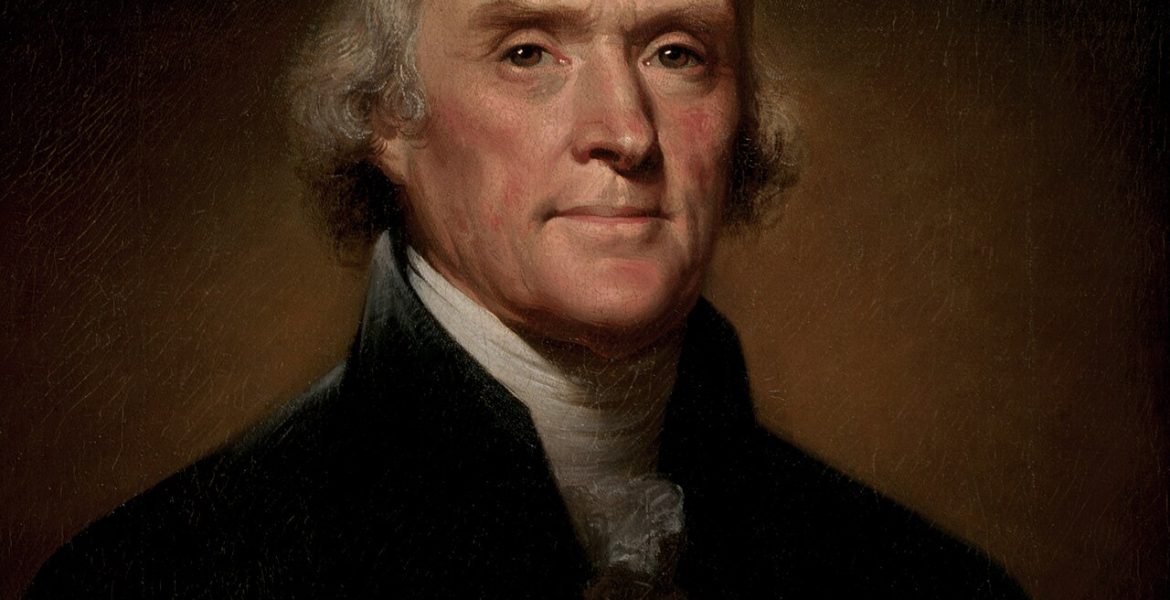
Feature photo: Official Presidential Portrait of Thomas Jefferson by Rembrandt Peale (1800), via Wikimedia Commons. Public domain.