
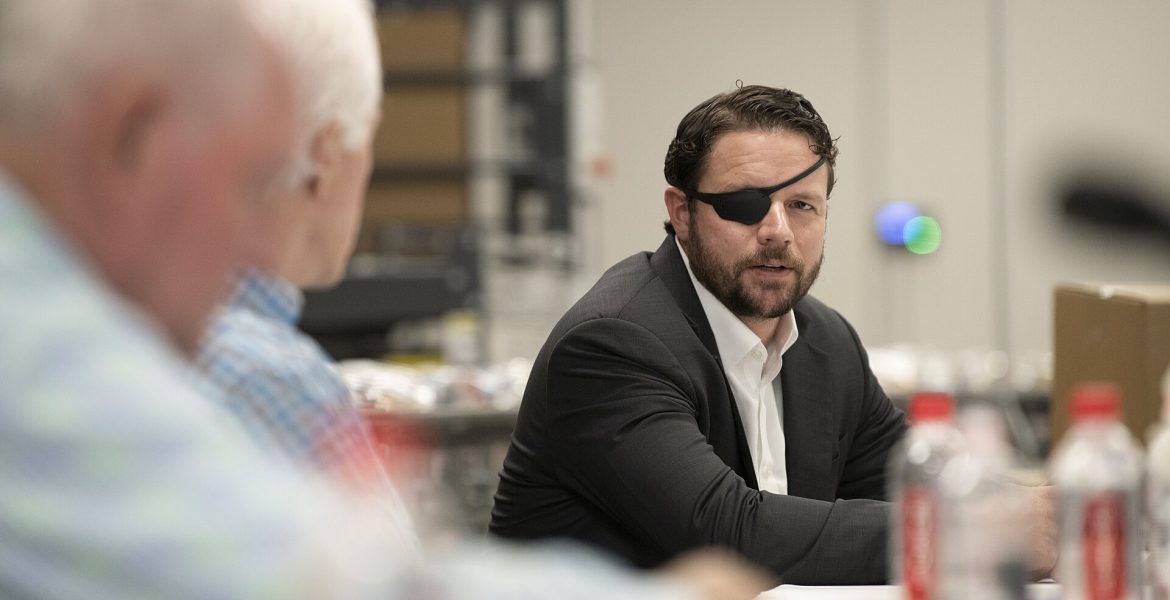
When Dan Crenshaw first ran for Congress in 2018, he looked like the future of the Republican Party.
A former Navy SEAL who lost his right eye to an IED blast while serving in Afghanistan, Crenshaw entered national politics with a story that instantly commanded respect. His service, sacrifice and composure made him a standout candidate in Texas’ 2nd Congressional District, and his early appearances on the national stage suggested something even bigger. Many conservatives believed the young congressman from Texas had the potential to become a national leader, perhaps even a future presidential contender.

For a time, it appeared that trajectory might become reality. In Washington, he quickly built a national profile, becoming a regular presence in national media and one of the most recognizable young Republicans in Congress.
Yet this week, Republican voters in his own district (TX-02) delivered a stunning rebuke, choosing State Rep. Steve Toth over the four-term incumbent in the Republican primary. To observers outside the district, the defeat may have seemed surprising. To many grassroots conservatives within the district, however, the outcome was years in the making.
The tension between Crenshaw and portions of his conservative base has long been brewing.
In 2022, Katy Christian Magazine published an article examining comments in which Crenshaw suggested that Jesus could be viewed as an “archetype.” For many Christian voters in a deeply conservative district, the remarks raised serious concerns.
The article circulated widely among local conservative activists and church communities.
A follow-up story days later described a discussion of the issue at a Montgomery County Tea Party meeting, where grassroots activists openly questioned the congressman’s views, and he reportedly snapped at a teenage girl.
What began as a public inquiry into Crenshaw’s theological beliefs quickly transcended into something more dangerous: a growing sense among some voters that their congressman was drifting away from the people and principles that had helped elect him.
Policy disagreements and controversies alone rarely defeat an incumbent. In politics, personality often matters just as much as ideology.
During the presidency of Bill Clinton, for example, many conservatives strongly opposed his policies. Yet people who met Clinton personally often described the same effect: when he entered a room, he connected with people. He spoke to everyone, listened, and left people feeling respected, even those who disagreed with him politically.
Dan Crenshaw’s style, according to many grassroots activists in his district, was very different.
Rather than building personal relationships with the local activists who form the backbone of Republican politics, Crenshaw increasingly developed a reputation for being dismissive and abrasive in his interactions. Some described a congressman who seemed to speak down to voters rather than listen to them, someone who appeared more interested in national recognition than in local relationships.
Over time, that perception eroded the goodwill that had initially carried him into office. Other publicized disagreements compounded the growing frustration.

Crenshaw openly referred to members of the House Freedom Caucus as “grifters,” a remark that angered many conservatives who view the group as one of the few factions in Washington consistently fighting for limited government and constitutional principles.
Further, his openness to certain red-flag gun law proposals also raised concerns among Second Amendment advocates in a district where gun rights are deeply valued.
Each of these moments by itself might not have been fatal to a political career. But together they created a pattern that many grassroots voters interpreted as a sign that their congressman had become disconnected from them.
As dissatisfaction with Crenshaw grew, opposition began organizing.
Local activists increasingly discussed the need for a primary challenger. Conservative talk radio also amplified the frustration. Houston radio host Michael Berry repeatedly criticized Crenshaw on air, giving voice to concerns that had been building among voters for years.
By the time State Rep. Steve Toth entered the race, the groundwork for a serious challenge had already been laid. Toth brought name recognition within conservative circles and a reputation as a reliable ally of grassroots activists.
For the first time since Crenshaw entered Congress, voters had a candidate who could credibly channel the dissatisfaction many felt. The primary election ended up being an issue of who voters believed they could trust, rather than an issue of policy differences. The trust in Crenshaw, as shown by his defeat, had eroded.
.
What makes Crenshaw’s defeat particularly notable is how much potential he once had. When he first arrived in Washington, he was widely seen as one of the most promising young leaders in the Republican Party, as a decorated veteran with national visibility and a compelling personal story that resonated with Americans across the country.
With humility and a stronger connection to the grassroots voters who propelled him into office, his political future might have looked very different.
Instead, Republican voters in his own district delivered a blunt verdict. Relationships matter. Respect matters. Listening matters.
Those are lessons many politicians learn the hard way. Whether Dan Crenshaw will learn them now remains to be seen.
Feature photo: U.S. Department of AgricultureLance Cheung/Multimedia PhotoJournalist, Public domain, via Wikimedia Commons