Kristi Burcaw had gone in for a routine appointment around 15 or 16 weeks into her pregnancy.
She and her husband, Hunter Burcaw, a pastor in Katy, TX, already had three young children at home. The pregnancy had come only 16 months after their third child. The first appointments had been normal.
Then, at one visit, the doctor could not find the baby’s heartbeat with the Doppler.
Kristi had not been scheduled for an ultrasound that day, but the doctor decided to take a closer look. After the imaging was done, Kristi waited in a room for the doctor to return.

“She came in and said, ‘Hey, we found her. Her heartbeat is strong, but I’m seeing some markers for Down syndrome. And also, there’s a lot of fluid around her,’” Kristi recalled.
The fluid was a sign of hydrops, a serious buildup of fluid around the baby. Doctors were concerned about how the fluid could affect the baby’s organs, including her brain, heart and lungs.
At the time, Hunter was away with the U.S. Army, training in West Texas. Kristi called him after the appointment, upset and concerned, and told him they had a follow-up appointment within the next few days.
Hunter was in the middle of a convoy.
“I was in a convoy in West Texas,” Hunter said. “We pulled over at some random podunk gas station, and they just dropped me off with my rucksack. Then a different Humvee had to turn around and come back and get me and drive me back so I could get home that weekend to catch up with Kristi.”
The circumstances surrounding them were complicated. Hunter was trying to get home from the middle of a military exercise, while Kristi was carrying difficult news and trying to process what doctors had found. The couple still had three young children at home who needed them.
“From the first day we knew something was wrong, it took a lot to get us back together at that moment,” Kristi said.
At that point, the couple had not received a confirmed Down syndrome diagnosis. The first doctor had seen markers on the ultrasound. The larger concern, Kristi said, was the hydrops.
The Burcaws were sent to maternal-fetal medicine. After that scan, they were told the baby had severe markers for Down syndrome and serious complications from the fluid buildup.
“[The doctor] came back and said, ‘The baby has severe markers for Down syndrome. If the baby’s born, it’s not going to be high-functioning. The hydrops — if she’s born, her heart’s not going to work, her lungs aren’t going to work. She’s going to need immediate intervention,’” Kristi said.

Hunter remembered the warning in stark terms.
“It was not going to trigger a lot of the normal functions that sustain life, like breathing and eating, all the functions you need to live,” he said.
The possibility of Down syndrome did not scare the Burcaws in the same way the hydrops did. Kristi’s nephew, her sister’s son, also has Down syndrome. The family already knew children with Down syndrome, and they knew they had support and resources around them.
“Hearing that she had the markers for Down syndrome wasn’t like a deterrent,” Kristi said. “We have the resources. We know people who have the same diagnosis. It was the hydrops that scared me, her survival probability. But that doesn’t change anything.”
Then the doctor brought up abortion.
“When the second doctor at maternal-fetal medicine finished walking through everything that he saw and all the complications, he was like, ‘We can help you with termination, or I can refer you,’” Kristi said.
Hunter said that meant connecting them with a doctor out of state to perform an abortion.
Kristi knew her answer immediately.
“At that moment, I said — and we hadn’t talked about it before — ‘Nope. If we don’t get to meet her on this side of heaven, then that’s what we’re going to do. We’re not going to limit God’s healing powers. If we get to meet her for an hour outside of the womb, a couple days outside of the womb, with as little intervention as possible, that’s what we’re going to do, but we’re not going to put any limits on God,’” Kristi said.
They left the appointment and returned to the ordinary demands of their life. They had children to pick up from preschool. They had dinner, baths and bedtime. They had the usual rhythms of a young family, but they were now carrying news that could change their lives.
“I remember on the car ride home, it was like, you walk out of that appointment, and we have three other kids,” Kristi said. “Then we had to go immediately pick up the other two from preschool.”
She recalls her fear clearly.
“I remember feeling not disappointed, but fearful,” Kristi said. “As a mom, you don’t want to see or watch your kids suffer.”
For Hunter, the grim reality of their daughter’s medical prognosis brought up questions he could not answer on his own.
“For me, leaving that appointment, it was a very heavy feeling,” he said. “Surreal in a lot of ways. Just kind of trying to grasp the fact that we’ve had healthy kids. Now, I have to weigh, as the father and the husband, how do I love my wife? How do I walk with my kids through potentially us carrying this baby all the way to term and then her not living?”
The only solution was accepting that he couldn’t solve it.

“I realized there’s nothing that I can do to fix this,” Hunter said. “So what I can do, though, is put my hope and my trust in God and demonstrate that for my wife, demonstrate that for my kids, for our family around us.”
After leaving matters to God, what surprised the young couple was how quickly they experienced peace.
“It was a weird, almost immediate sense of peace about the whole situation,” Kristi said. “I’ve had people ask me, ‘Oh my gosh, how did you make it through that pregnancy? You just handled it with such grace.’ And I’m like, honestly, I can’t tell you how I did it because it wasn’t on my own strength. It was that immediate peace, knowing that whatever God’s plans were for Eloise, it was going to be up to Him and not up to us.”
Hunter described it through the words of Philippians 4.
“It’s the peace of God which surpasses all understanding that guarded our hearts and minds, for sure,” Hunter said. “We prayed and asked God for clarity, direction, comfort, and He provided that abundantly.”
The remainder of Kristi’s pregnancy was filled with appointments. The Burcaws said that after they made it clear abortion was not an option for them, the subject continued to come up.
“The real challenge then became every doctor’s appointment after that,” Hunter said. “After the doctors would say, ‘Hey, the situation isn’t better, in fact, it’s worse, and we can facilitate termination.’ Every single time, we were offered to abort the baby. I can’t tell you, maybe 25 times after we had said, ‘No, that’s not an option for us. We’re Christians.’”
Kristi recounts the pattern, too.
“It was brought up after every visit,” she said. “However many doctor’s appointments we had, every single time, abortion was brought up.”
The Burcaws transferred care to UT Physicians in the Texas Medical Center. The medical warnings continued. At one appointment, late in the second trimester, Hunter and Kristi said they were in a room with about 10 medical professionals. By then, specialists had been assigned because of the number of concerns surrounding the baby.
Hunter said doctors again listed the problems they saw.
The baby’s abdominal cavity had a significant amount of fluid. Her organs were compressed. Her brain also had fluid, and doctors were concerned about its shape and development. There were holes in her heart. There were concerns about her spine.
“Their whole point of that appointment was like, this baby is not going to live and she’s going to be stillborn,” Hunter said. “Or if she’s born, she’s going to need immediate intervention if we can even do that.”
They were at the end of the second trimester when abortion was again brought up by their doctors.
Following that appointment, Hunter and Kristi decided it was time to ask others to pray. Their families knew what was happening, but they had not shared the full story publicly with their church family. They were still trying to process everything themselves.
Kristi wrote a Facebook post explaining what was happening and asking their community to pray. She included a sonogram photo. By then, the couple knew their baby was a girl, and they had chosen her name: Eloise.
After the post went up, people began calling, texting and commenting that they were praying.
Hunter said hundreds, and possibly thousands, reached out or interacted with them on social media that weekend. Then came Sunday morning.
“On Sunday, we went to church, and oh my goodness,” Kristi said. “Literally, there was like a line of a hundred people trying to talk to us. People just coming up to encourage us, pray with us, cry with us. We literally were sobbing. So many people from our church family were there praying with us and just encouraging us.”
Some shared stories of their own children. They told Hunter and Kristi about diagnoses, warnings and fearful appointments. Some had been told by doctors that their children might not be OK. Some children were later born healthy. Others were born with Down syndrome, autism or other conditions. The common thread, Kristi said, was that other families had lived through fear and had seen God’s goodness.
“It sounded like many people had experienced this before and seen God’s goodness through it,” she said. “But not only that, it was evident that literally thousands of people were going to God in prayer and lifting up our family and the baby.”
That weekend also brought about a moment that Kristi sees as part of the turning point in her baby’s story. Because she had shared the baby’s name in the post, a friend reached out and told her the meaning of Eloise.
Healthy.
For Kristi, hearing that meaning attached to the name they had already chosen for their daughter gave her a sense that everything was going to be OK.
A few days after the church prayed, Kristi went back to the doctor. Hunter was not with her that day.
She knew what the previous scans had looked like. She could see the pockets of fluid around the baby’s lungs and heart, even if she could not interpret every part of the ultrasound. She described the fluid as looking like large potato-sized cavities beside the baby’s organs.
This time, as the ultrasound tech worked, Kristi could tell something looked different on the screen.
Then the tech left the room.
Kristi waited. She remembers it taking a long time, about 45 minutes.
Finally, the doctor came in alone.
“He said, ‘Hey, sorry that took so long. I had to triple check that I was looking at the correct scans because the hydrops is correcting itself significantly. The severe markers for Down syndrome that we’re seeing are not there anymore. Her brain is developing how it should,’” Kristi quoted.

The doctor was baffled.
“He was like, ‘I don’t understand this.’ And I was like, ‘I understand,’” she recalled with a laugh.
She left the appointment and called Hunter.
“I was like, ‘Dude, you’re never going to guess,’” Kristi said.
The Down syndrome diagnosis had still not been formally confirmed at that point. Later, the Burcaws chose to do an amniocentesis, which confirmed trisomy 21. Eloise did have Down syndrome.
The hydrops, however, were gone.
“At this point, the hydrops were gone,” Kristi said. “The cardiologist was like, ‘Hey, I’m going to want to check her after she’s born, but right now I’m not seeing any cause for concern. She’s not going to need any heart intervention after.’”

Her lungs were functioning properly. The earlier concerns that she would need immediate intervention after birth had changed.
Still, the Burcaws were told to prepare for complications. Doctors warned there was still a chance Eloise could be stillborn. They were told she might need to stay in the NICU for a long time after birth. Kristi understood the possibility. Her nephew with Down syndrome had spent time in the NICU after he was born.
They took the NICU tour, went to several more appointments, and continued to prepare for whatever would come next.
Kristi wanted to carry Eloise as close to full term as possible. The couple was fighting the clock, as Hunter was supposed to deploy to Kuwait in the Middle East on May 17, which was in a matter of days. The couple was trying to balance medical risk, Kristi’s desire to let labor happen as naturally as possible and the reality that Hunter might soon be overseas.
“We were literally negotiating with the doctors on a day-to-day basis,” Kristi said.
After 37 weeks, doctors wanted Kristi to come in twice a week. At the first visit after 37 weeks, they found that her fluid was low. They told her to go home, pack a bag and come back that night.
That night, friends had already gathered at the Burcaws’ home for what was meant to be Hunter’s going-away party.
Kristi walked into the party with different news.
“I was like, ‘Are you ready to go have a baby?’” she said.
The party ended quickly. Family and friends stepped in to help the couple. Hunter’s brother and sister-in-law took the Burcaws’ three older children for the night. Kristi called her mother in Alabama with the news, and her parents immediately got in the car and drove more than six hours. Her father dropped her mother off at the hospital late that night so she could be in the room for the delivery.
The induction was difficult. Doctors had trouble reading Eloise’s heartbeat, so they used an internal monitor. Kristi was given Pitocin. She did not have an epidural or pain medication.
At one point, doctors became concerned that Kristi might need a C-section. They told her that if she did not get an epidural and a C-section became necessary, she might have to be put under, and Hunter would not be able to go back with her. A C-section also would mean weeks of recovery, and Hunter was only days away from deployment.
Hunter remembers looking at Kristi, exhausted in labor with a cold towel on her forehead, and deciding to try something else.
“I looked at Kristi and I’m like, ‘Look, I’m going to go get the exercise ball for you to sit on. Here’s the deal. We can either bounce up and down on this exercise ball, or I have no idea how this is going to work out,’” he recounted.
Kristi’s mother encouraged her. Kristi sat on the exercise ball for about 10 minutes.
“It immediately put me in transition,” Kristi said. “I was shaking and nauseous and felt all the pressure, and I was like, ‘OK, this has done something and I’m ready.’”
She got back in bed, and the medical team told her she was ready to deliver.
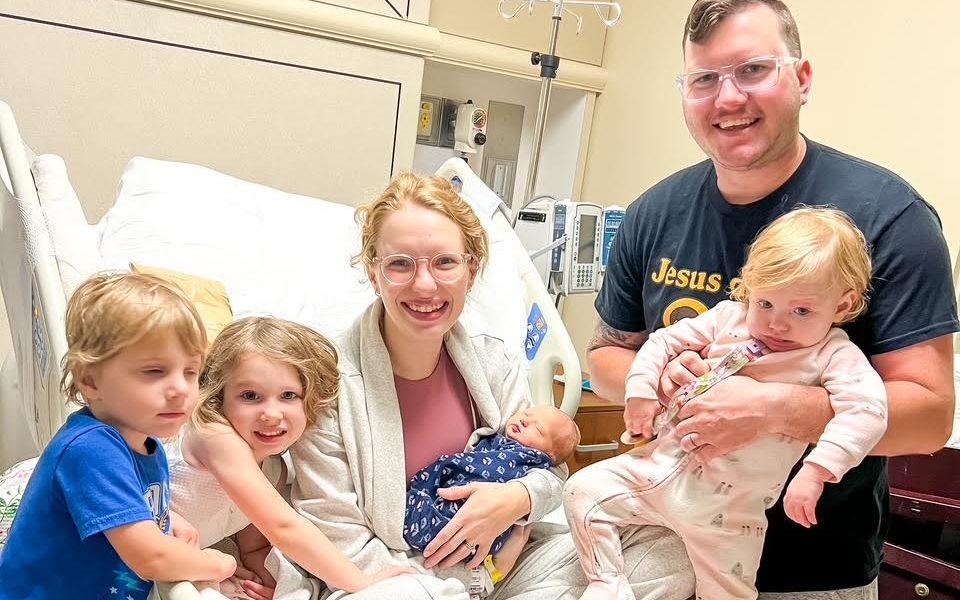
Incredibly, Hunter was able to help deliver Eloise himself. He turned the baby and pulled her out, bringing into the world the daughter they had been warned might be born gravely ill, might need to be rushed away or might not survive at all.

After months of appointments, recommendations to terminate the pregnancy and medical warnings, baby Eloise was born breathing, stable and ready to be held.
“They did this normal initial assessment after they were born to check for breathing and crying and eyes opening, hearing response, response to different kinds of touch around her body,” Hunter said.
Then came words they had emotionally prepared not to expect.
“They said, ‘She’s perfect. Everything is fine,’” Hunter said. “And they handed Kristi the baby.”
The moment was overwhelmingly simple. Eloise did not require immediate surgery, and there would be no long NICU stay.
“This is wild because we spent months hearing doom and gloom,” Hunter said. “The baby’s not going to live, or if she lives, she’s going to need immediate surgery. And then, hey, if she’s born, she’s going to need to be in the NICU for a long time. And now, in the moment, we get to hold on to our baby. And she doesn’t have to go anywhere.”
Kristi said feeding was difficult at first, but they worked through it. Specialists came to look at Eloise. The hospital stay became the ordinary postpartum stay they had not expected.
“It was a normal two-day hospital visit after birth,” Kristi said. “You make sure that you hit all the benchmarks on my side and on her side. And we did, and we were out.”

They were home in 48 hours.
Today, Eloise is 1 year old.
“It’s been a year of just being so thankful,” Kristi said. “Eloise is the chillest.”
Eloise is also starting to find her voice. Kristi said her first physical therapy appointment brought out some of the loudest crying she had heard from her daughter, because the therapist was asking her to do hard things.
“She was like, ‘I don’t like this. This is hard,’” Kristi described.
In physical therapy, Eloise is working on crawling correctly. Kristi said the therapist explained that babies with Down syndrome are often very flexible, and because of that, they may find quick ways to move that do not always support the best developmental patterns.
“Quick doesn’t always mean correct,” Kristi explained. “For development, there’s a correct way to do things.”
Right now, Eloise is working on keeping her hips square, building arm strength, pushing up on her arms, standing, developing core and leg strength, improving balance and building muscle tone. The therapist has mentioned that Eloise may need ankle braces when she begins walking to help with stability, though that is not certain.
For Kristi, the therapy feels manageable. Many of the exercises can be done at home.
Hunter sees her care through the lens of parenting four children.
“This is not any different than any of our other kids,” Hunter said. “All of our kids have needed special attention to make sure these little things they need to hit a benchmark on for their development, like we had to work with them. So this is not anything new or different than any of our other kids.”

Eloise also has other medical care. She sees an endocrinologist for a hyperactive thyroid and takes medication daily to keep her levels where they should be. She recently saw an ENT and is scheduled to have tubes placed in her ears to support her language development. Her eye doctor was pleased with her vision. Her cardiology checkups have gone well.
“We’re just loving life,” Kristi said.
The Burcaws are careful about how they talk about Eloise’s Down syndrome. While they do not ignore the diagnosis, they also refuse to make it the center of her identity.
“I don’t want her to be labeled by this Down syndrome diagnosis,” Kristi said. “It’s a special part of who she is, but it’s not her identity.”
Their goal is to raise Eloise the way they are raising their other children, with the support she needs along the way.
“Our goal is to treat her and to teach her just like we’re going to treat and teach our other kids,” Kristi said. “Yes, are there some times when we’re going to have to do special appointments or special things for Eloise that we won’t have to do for our other kids? But there’s no greater than or less than value in any of our kids. It’s just how we are going to allocate our time with each of them.”
Hunter said he had his own questions early on. He had known people with disabilities growing up, including a friend with Down syndrome, but he did not know all of the intricate details of what it would require to help a child with Down syndrome thrive.
“I did not know a lot about what it takes to raise, to nurture, to cherish and really care for people with Down syndrome well,” he said. “And so I was definitely inside like, ‘Oh, this is challenging,’ not really knowing what all was going to be involved.”
Hunter describes himself as a Type A person who likes to think through details and plan. This was a situation he could not plan his way through.
“I’ve never experienced this before,” he said. “I don’t have many people around me who’ve experienced this. But I know that this baby is created in the image of God, given to me to love, to nourish, to raise up in the way of the Lord. And so I can be confident in that.”

For parents who receive a difficult prenatal diagnosis and are told abortion is the best or only path, Hunter said his first advice is simple: get another opinion.
“Always get a second opinion,” Hunter said. “Always get a second opinion.”
He said he and Kristi intentionally went to multiple doctors at different facilities.
“Doctors have bias, and they practice that bias in their practice,” he said. “So definitely getting second opinions. Don’t just take the first doctor and their recommendations, especially if it’s something as serious as life and death or to keep a baby or not.”
He also encouraged families to find people who have walked through the same kind of diagnosis.
“Find a community of people who have dealt with what you’re going through,” Hunter said. “People who have lived it and can share their experience with you.”
For Hunter and Kristi, that community was found in the church.
“The best place to find a community of people who are going to move heaven and earth to support you and care for you, you’re going to find that in a church, in a Christian community,” Hunter said.
He said parents facing fear in the quiet moments, especially at night when thoughts start racing, can look to God for help.
“God is with us all the time,” Hunter said. “If we look to Him, He is already there with us. The Bible says, knock and the door will open, seek and you will find. And that’s the truth. God is near to us, and He is near to the brokenhearted.”
Kristi said she is grateful Eloise will grow up with a testimony already attached to her life.
“She started off with a story of healing and just God’s provision in her life so early,” Kristi said. “That will continue to be a part of her story as she continues to grow.”
Hunter said the abortion conversation often centers on the phrase “choosing life.” For him, Eloise’s story has deepened that phrase.
“People try to make this issue — not only with kids who have birth defects or issues in utero, but in the abortion conversation as a whole — all about choosing life,” Hunter said. “But the reality of the situation is that we value life, and so we choose love, even when it’s hard.”
That is what he believes he and Kristi were called to do for Eloise from the beginning.
“We chose to love the baby, not knowing what we were walking into, knowing it was going to present challenges, knowing it was going to be hard, but knowing that God who loved us is equally willing and able and already loving this baby,” Hunter said.
The baby they were told might be stillborn is now a 1-year-old girl learning to crawl, finding her voice and growing up surrounded by parents, siblings and a church family who prayed for her before they ever held her.
“It’s more than just choosing life,” Hunter said. “It’s choosing to love even when it’s hard.”