
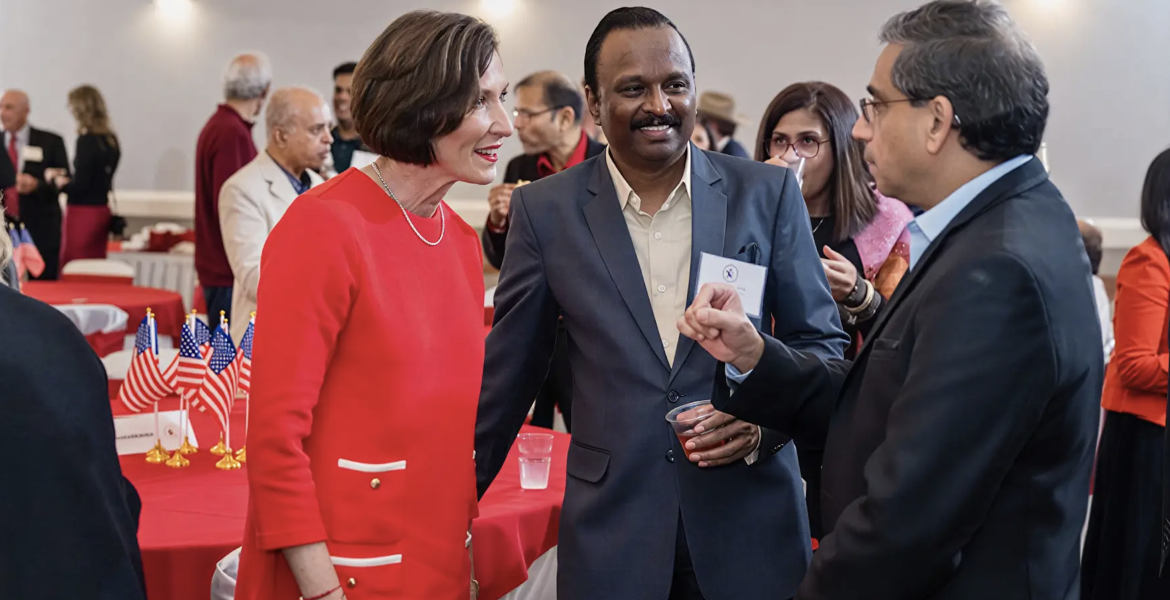
Ramesh Kumar Cherivirala has lived in Fort Bend County for more than 23 years, raising his family in the same home while becoming deeply involved in the civic and political life of the community. Now a candidate for county commissioner in Precinct 4, he enters the race with decades of experience spanning finance, education advocacy, charitable leadership, and local party organizing.
“I’ve been in the Fort Bend community for the last 23 years, living in the same home, raising my two children here,” Ramesh said. “I feel I need to give something back to the community that gave me so much.”
A longtime Texas resident and first generation immigrant, Ramesh said his early years in the United States shaped his belief in local institutions and community responsibility. He describes Fort Bend County as the place where his family built stability, which in turn motivated his sustained involvement in organizations focused on education, public service, and civic engagement.


Professionally, Ramesh holds a Ph.D. in organic chemistry and has spent more than 25 years working in the financial sector. He said that background influences how he evaluates public spending, long-term planning, and fiscal oversight. His campaign centers heavily on budgeting discipline and accountability to taxpayers.
“I believe Fort Bend County has a spending problem, not a revenue problem,” he said.
Ramesh has closely reviewed county budget growth over recent years and said rising expenditures deserve careful scrutiny, particularly as residents feel the effects of increasing property valuations. He argues that financial management at the county level requires the same rigor applied to private-sector balance sheets, including evaluating priorities, identifying inefficiencies, and distinguishing between essential services and discretionary spending.
“As a financial professional, I know that every dollar the county spends belongs to the taxpayers. I am committed to working every day to keep our tax rate low by eliminating wasteful spending and ensuring the county lives within its means,” Ramesh said.
“My goal is a transparent budget that prioritizes essential services like public safety and roads without placing an extra burden on Fort Bend families.”
Beyond his professional career, Ramesh has spent years in leadership roles across civic, cultural, and charitable organizations. He previously served as president of the Indo-American Charity Foundation and the India Culture Center and is a founding member of the Indo-American Conservatives of Texas. Through those roles, he said, he focused on building systems that could endure beyond individual leadership terms.
One example he frequently cites is the scholarship program developed through the Indo-American Charity Foundation. During his tenure, the organization partnered with Fort Bend ISD to formalize its application process, expand outreach to high schools, and grow annual scholarship distributions. What began as a smaller initiative now awards significantly more funding each year, supported by a structure he said continues to function independently.
Those experiences informed how Ramesh approaches leadership. He describes his style as collaborative and responsibility-driven, with an emphasis on shared ownership and follow-through.

“I work with people. I take the blame and give the credit,” he said.
Ramesh has previously sought elected office, including a run for the Fort Bend ISD Board of Trustees in 2014 and a campaign for the Texas House in 2022. He has also served in advisory roles related to public education, including work connected to former State Rep. Rick Miller. He said those experiences gave him insight into how policy decisions are made and how local governance affects families directly.
As a candidate for county commissioner, Ramesh emphasizes the practical responsibilities of the office. Commissioners serve on the Commissioners Court, where they oversee county infrastructure, approve budgets, and help direct funding for roads, drainage systems, flood mitigation projects, and public safety services. They also work collaboratively with other commissioners to allocate resources across the county.
“People want safe roads, good drainage, and public safety,” Ramesh said. “When it rains, they shouldn’t worry about their homes flooding. We cannot afford to wait for the next major storm to act. My priority is to resume and fully implement the flood mitigation projects recommended by the Project Brazos Study.
Ramesh continued, “By investing in these proven infrastructure improvements now, we can protect our homes and businesses from a repeat of the Harvey disaster and ensure our drainage systems are prepared for the future.”
While county government often operates with less public attention than higher levels of politics, Ramesh said its impact is immediate. Decisions made at the county level shape daily conditions for residents, from how easily they commute to how communities respond to severe weather events.
Precinct 4, he noted, is one of the most diverse areas of Fort Bend County. Ramesh said representing the district requires active communication across communities and attention to shared concerns. Despite differences in background and perspective, he said residents consistently raise similar priorities around infrastructure, safety, and taxes.
As the campaign continues, Ramesh frames his candidacy around stewardship and accountability. He describes the position as a responsibility that demands consistency and discipline, particularly when managing public funds.
“I go to work every day to protect taxpayer dollars,” he said. “I’m not running for this position for a paycheck. I’ll do what I was elected to do.”
Early voting in Fort Bend County for the Republican and Democratic primary elections is scheduled to begin on Feb. 17 and run through Feb. 27, allowing voters to cast ballots at any county vote center during that period. March 3, is the official primary Election Day. Voters must be registered and have updated their registration by Feb. 20 to participate in the primary, and a primary runoff, if needed, would take place later in the spring.