
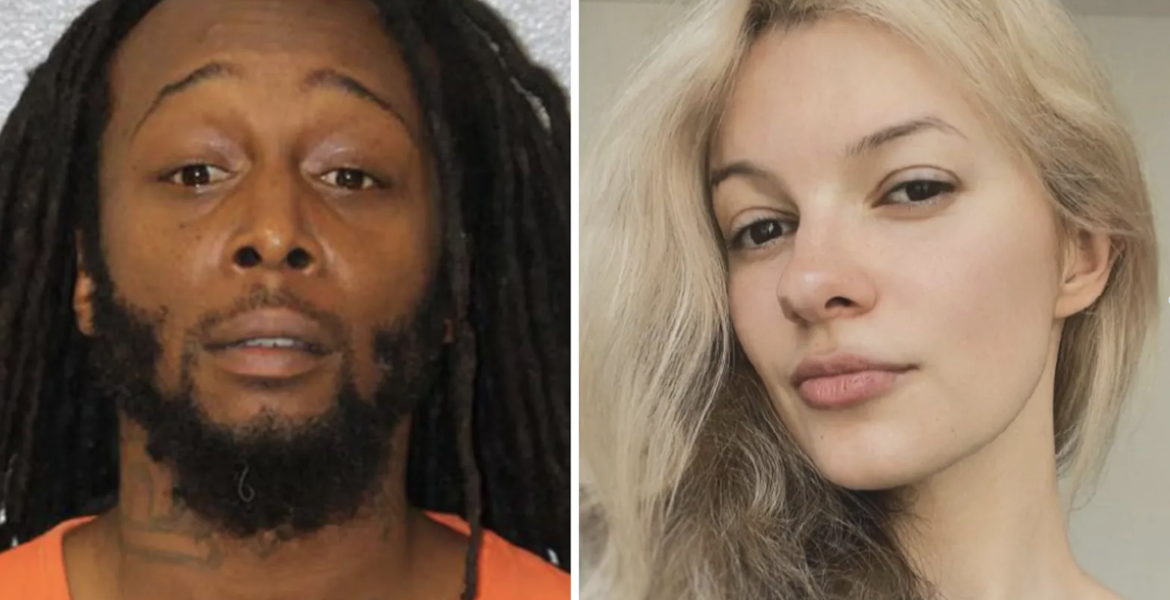
Iryna Zarutska was 23 years old. A Ukrainian refugee. She had fled a country at war and was trying to build a life in the United States.
On August 22, 2025, at around 9:50 p.m., she boarded the Lynx Blue Line in Charlotte, North Carolina. She took a seat on the train. Surveillance footage shows her sitting quietly, facing forward.
Four minutes later, a man seated behind her stood up, pulled a folding knife from his hoodie, and stabbed her three times from behind. At least one of the wounds was to her neck, severing a major vein.
There had been no interaction between them. No argument. No warning.

At least four other passengers were sitting nearby when it happened. There were no security personnel in the train car. Officers were on the train, but in a different car.
She didn’t die instantly. For nearly a minute, she remained conscious or semi-conscious as she bled out. Then she collapsed onto the floor. Passengers rushed to help her as 911 calls came in. People were screaming, describing a woman bleeding heavily, unresponsive.
She was pronounced dead at the scene.
The man who killed her did not disappear.
After the attack, he moved into another train car. Passengers who had just witnessed what happened were calling 911, describing the suspect and what they had just seen. The train was stopped, and police responded. He was still on board when officers arrived and was taken into custody.
The murderer was identified as Decarlos Brown Jr.
And he was not someone unknown to the system.
Brown had been arrested at least 14 times prior to the killing. His record included violent charges such as breaking and entering, larceny, and armed robbery. He had previously served time for felony offenses.
Seven months before Iryna Zarutska was killed, Brown had been arrested again, this time in January 2025.
Unfortunately, that case did not end in detention.
Democratic Magistrate Judge Teresa Stokes released the previous violent offender on a written promise to appear in court. He posted no bail; the only requirement was just a signature before his release. For those wondering how this came to be, the charge at the time of his Jan. 2025 arrest was considered nonviolent—a misuse-of-911 offense. Under standard pretrial practices, that qualified Brown for release.
So he was allowed to walk out.
Seven months later, Brown boarded a train in Charlotte and killed a 23-year-old woman who had done nothing to him.
The decision to release him followed a dangerously flawed, progressive logic.
Pretrial release centers on the charge in front of the court, not the full pattern of a person’s behavior. In Brown’s case, the January charge was classified as nonviolent. That classification carried more weight than his prior arrests for violent charges or felony history.
That is how someone with a long record is treated as low-risk.

In recent years, many jurisdictions with progressive judges have reformed the bail system to reduce or eliminate cash bail for nonviolent offenses, shifting toward release-based systems intended to avoid holding people pretrial.
That approach depends on one thing: accurately identifying who actually poses a risk. Yet that assessment focuses on the most recent crime, turning a blind eye to someone’s overarching criminal history. The consequences are dangerous, and they often show up quickly.
In this case, they showed up on a train car in Charlotte.

A young woman was killed by someone who should not have been free. The public should have been outraged and engrieved.
And to a degree, some of the public was; murals honoring Iryna Zarutska began appearing in cities across the country.
However, things took a dark turn when in New York City, one of those murals was vandalized. Someone spray-painted the words “please vandalize this” across her face.
The New York Post reported that the mural had drawn criticism from local activists who objected to what they described as its “tough-on-crime” message.
In Providence, Rhode Island, another mural became the subject of political pressure. The piece, located on the exterior of The Dark Lady, a well-known LGBTQ+ club, was still in progress when city officials began calling for its removal.
Mayor Brett Smiley confirmed that he wanted the mural taken down.
The artist, Ian Gaudreau, said he had not intended the work to be political. It was meant as a tribute. However, the city paid no mind to the distinction, treating the tribute to the murdered 23-year-old as a political statement anyway.
The story is sickening. A violent, dangerous man with a long criminal record is arrested, released, and goes on to kill an innocent young woman who had done nothing to him. Why would grieving Zarutska cause controversy?
The cruel truth is that the politicization of Zarutska’s death is at the hands of the progressives whose policies allowed Brown to walk free. They don’t want the public to remember her, and then to reflect on why she lost her life. So they shift the focus away from the specific decisions that allowed Brown to roam the streets and toward the public reaction to her death.
The mural is called “divisive.” Not the vandalists, not the magistrate’s failure to identify risk despite a record, not the magistrate’s release decision. The memorial is divisive.
The man who killed her had been through the system repeatedly. That history did not prevent his release.
Yet the human being who died became the source of controversy, and the act of remembering her became controversial.
The imbalance is disgusting, but not surprising. We’ve grown accustomed to watching one side of the story be handled with process, restraint and second chances, while the other gets erased.
Feature photo: Provided by police via Instagram