
FOIA data from Israel’s COVID-19 vaccination campaign has sparked renewed debate about vaccine safety monitoring after researchers identified a cluster of cardiac reports among 12 to 16-year-old children on the day they received their vaccine. Later, the health organization that supplied the data later said the records could not be found.
Concerns about vaccine safety monitoring in Israel are resurfacing after researchers analyzed government-released adverse-event reports and identified a cluster of cardiac incidents in adolescents occurring on the same day as their COVID-19 vaccination.

The findings, drawn from data obtained through Israel’s Freedom of Information laws, were highlighted in a February analysis by entrepreneur and vaccine-safety advocate Steve Kirsch, who argues the reports warrant further investigation by Israeli authorities.
The dataset originated from Clalit Health Services, Israel’s largest health maintenance organization, which provides medical coverage for roughly half of the country’s population.
According to the analysis, the FOIA dataset contains 294,878 adverse-event reports submitted during Israel’s COVID-19 vaccination campaign. Within those records are entries coded 704, the reporting designation for acute myocardial infarction (AMI)—commonly referred to as a heart attack.
The following document is from the Clalit Health Services paper, as obtained by Kirsch:
Kirsch and other researchers reviewing the records identified 646 entries coded as AMI, most involving younger patients. After accounting for duplicate reports, they estimate approximately 219 unique cases, many occurring on the same day adolescents received their vaccine.
The findings were later examined in a 2026 paper by Israeli researchers including Yaakov Ophir and Yaffa Shir-Raz, who analyzed the unprocessed FOIA dataset and reported a concentration of cardiac reports among adolescents during the vaccination rollout.
In the paper, researchers noted that when they contacted Clalit Health Services to verify the unusual clustering, the organization responded that “the data do not exist.”

That statement has raised questions among critics about how records previously provided through an official transparency request could later be unavailable for verification.
The issue emerges alongside a separate government audit documenting significant problems with Israel’s vaccine adverse-event reporting system.
In May 2024, Israel’s State Comptroller released a report examining the country’s monitoring of vaccine side effects during the pandemic. The audit found that the Ministry of Health received 345,200 reports of adverse events in 2021, but only about 18% were properly recorded in the national database.

According to the report, the remaining reports were lost due to technical problems and system integration failures between healthcare providers and the ministry’s reporting platform.
Many of those missing reports were linked to Clalit Health Services, which experienced synchronization failures with the ministry’s data system, according to the audit.
The Comptroller attributed the breakdown largely to technical errors and administrative shortcomings, rather than deliberate suppression of data, and recommended improvements to Israel’s reporting infrastructure.
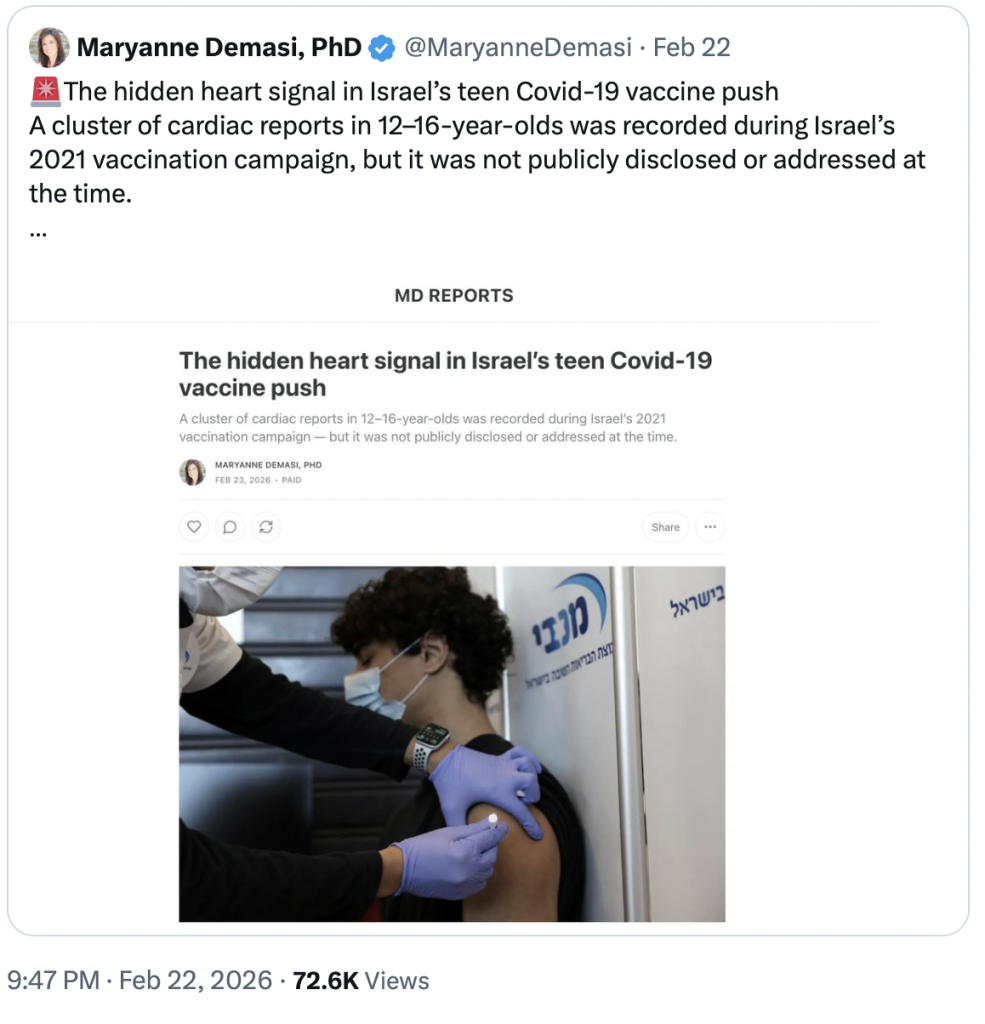
Still, the sequence of events has drawn criticism from some researchers and commentators who say the missing data complicates efforts to analyze potential safety signals in the vaccination program.
Israel’s COVID-19 vaccination campaign was among the earliest and most aggressive in the world. Beginning in late 2020, the country rapidly administered Pfizer-BioNTech vaccines across much of its population and became a major source of early research on vaccine effectiveness and safety.
Because of Israel’s centralized healthcare system and comprehensive electronic medical records, its data played a key role in shaping global public-health policy during the pandemic.
But critics argue that the reporting gaps identified by the State Comptroller highlight weaknesses in the country’s safety monitoring system.
Kirsch, writing on his Substack newsletter, said the clustering of cardiac reports in the FOIA data should prompt further investigation.
The controversy has received little attention from major international news outlets, despite Israel’s prominent role in early COVID-19 vaccine research.
Supporters of further investigation say the issue underscores the importance of transparency in vaccine safety monitoring.
Whether the clustering identified in the Israeli dataset represents a meaningful safety signal or a statistical anomaly remains a matter for researchers and health authorities to determine. For critics, however, the lack of clear answers about the missing records has become the central concern.
In large-scale vaccination campaigns, they argue, public confidence depends not only on the safety of the vaccines themselves but also on the transparency of the systems used to monitor them.
Feature photo: Suyash Dwivedi, CC BY-SA 4.0 <https://creativecommons.org/licenses/by-sa/4.0>, via Wikimedia Commons