

Editor’s Note:
This article examines allegations made against Fort Bend County Clerk candidate J.J. Clemence by reviewing public records, campaign communications, on-the-record statements, and materials circulated as purported evidence.
Katy Christian Magazine reviewed public-records requests, correspondence, photographs, and campaign statements cited in support of the allegation. Those materials are described specifically to clarify what they do — and do not — show. No allegation of criminal wrongdoing is made without documented proof, and all parties referenced were given the opportunity to respond.
In the final weeks before the Republican primary, Fort Bend County Clerk candidate J.J. Clemence has been accused online and in campaign settings of being a “Chinese asset” or a “Chinese Communist Party spy.”
Clemence is Chinese-American, an immigrant, and a naturalized U.S. citizen. She is a long-time Fort Bend County community member and a Republican candidate who has publicly defended her patriotism and transparency as the accusations spread.

The allegation is not subtle. It accuses Clemence of foreign allegiance and national-security betrayal — conduct that, if true, would constitute a serious federal crime. Such claims belong in the hands of law enforcement. Instead, they have circulated through anonymous blogs, activist messaging, campaign communications, public speeches, and private written statements in a local county race.
Clemence said she first became aware of the rumors just hours after the candidate filing deadline on Dec. 8. While variations of the claim have circulated for months, their intensity increased sharply in recent weeks as the primary approached.
The timing matters. So do the stakes. Accusations of espionage are not ordinary political attacks. Even when false, they can permanently damage a person’s career, reputation, and public standing. For Clemence, the allegation threatens both her likelihood of winning this race and — most critically — the professional and personal life she has spent decades building.
Where the accusation originated and what it claims
The accusation traces back to a February 2025 post on Vermilion China, an advocacy website focused on criticism of the Chinese Communist Party’s global influence. The post lists no author and offers no law-enforcement report, intelligence assessment, sworn testimony, or formal finding. Its argument relies on association and insinuation, treating civic interaction involving Chinese nationals as evidence of foreign control.
Specifically, the blog alleges that Clemence’s participation in a brief cultural exchange involving visiting Chinese officials — including assisting with scheduling and interpretation — constitutes evidence that she facilitated access for representatives of the Chinese Communist Party (CCP) to local government offices. It further asserts, without documentation, that such visits are inherently CCP-directed and that Clemence’s role in helping coordinate a meeting and courthouse tour amounts to acting on behalf of a foreign adversary.
The article presents no evidence that Clemence entered into any agreement, exercised governmental authority, violated state law, or acted under the direction of a foreign government.
From there, the allegation spread through social media and activist messaging, repackaged as “public concern” despite the absence of documented proof.
How the allegation entered the campaign
In Fort Bend County’s Clerk race, the accusation quickly trickled out of anonymous online spaces.
Clemence’s opponent, Tamara McFarlane, issued a press release stating her campaign was not behind the Vermilion China article. That same release, however, included a direct hyperlink to the blog post itself.
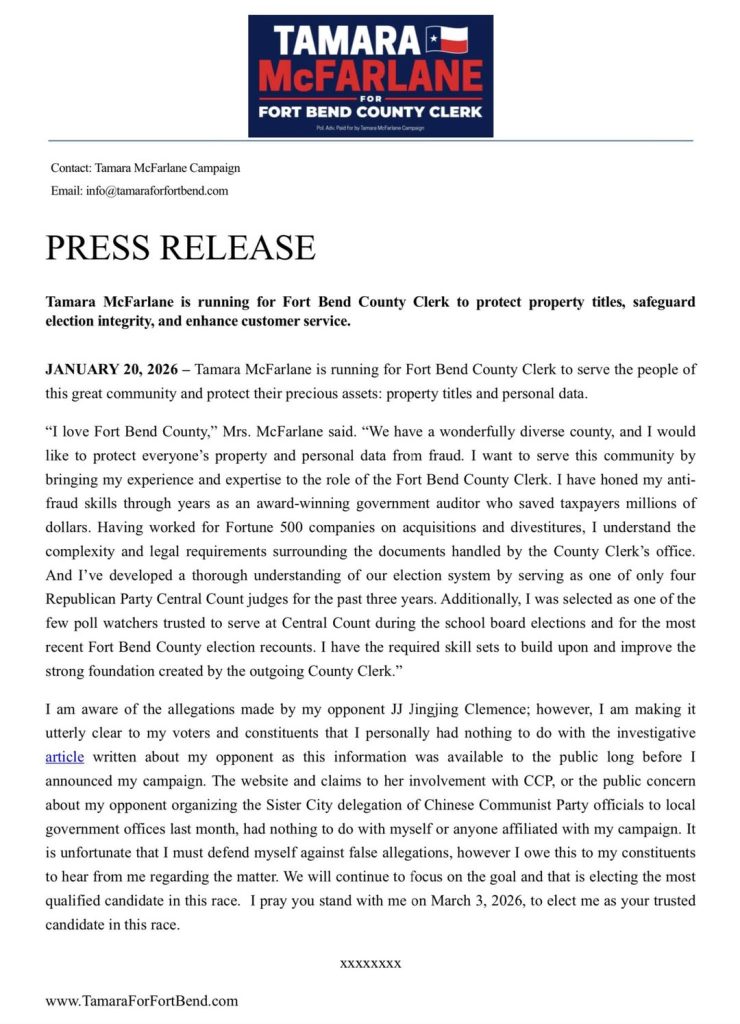
Disclaiming authorship while directing voters to an allegation of espionage is not neutral conduct. It circulates the claim while avoiding accountability for its consequences.
McFarlane then repeated the accusation publicly. On Jan. 22, at a Republican Women’s Club of Katy Primary Candidate forum, she stated that her opponent was “busy bringing in Chinese Communist Party officials in a sister city delegation December 4th,” and asserted that Clemence had coordinated CCP delegations in Houston and Fort Bend County for the past decade.
The forum included over 56 Republican candidates including Texas Congressional candidates, statewide candidates, and Harris County and Fort Bend County candidates.
These remarks were made as part of campaign messaging, presented as fact, and offered without reference to any criminal finding, agency determination, or evidence of unlawful conduct.

The “sister city” claim and what Clemence actually did
Supporters of the accusation have repeatedly pointed to Texas House Bill 128 and invoked “sister city” relationships as proof that Clemence’s conduct was unlawful or suspect. That framing depends on a misunderstanding of both what a sister city relationship is and what the statute actually restricts.
A sister city relationship is a formal partnership between local governments, typically established through official action such as resolutions or agreements.
HB 128 restricts governmental entities from entering into, maintaining, or renewing formal sister city agreements with foreign adversaries. It does not apply to informal visits, meetings, or cultural exchanges.
Those advancing the allegation argue that Clemence violated the spirit, if not the letter, of HB 128 by assisting with a visit from Chinese officials to Fort Bend County. According to that claim, the delegation’s connection to a Chinese sister city means the visitors should be treated as representatives of the CCP, and that any involvement in facilitating their visit constitutes improper foreign access to local government.
The records reviewed by Katy Christian Magazine show what actually occurred.
Clemence assisted with coordinating a brief, publicly documented cultural visit by a Chinese delegation that was already traveling through the United States. Her role was limited to logistical assistance: communicating with county staff to ask whether it would be possible for the visitors to briefly meet the county judge, take a short courthouse tour, and participate in a ceremonial exchange consistent with similar international visits.
She did not vote on, approve, create, or renew any sister city agreement. She did not negotiate or sign any contract. She did not act on behalf of Fort Bend County or exercise governmental authority.
The allegation therefore rests on the premise that relaying scheduling requests and occasionally assisting with interpretation is equivalent to entering into a prohibited governmental agreement with a foreign adversary — a premise not supported by the statute.
HB 128 governs formal governmental actions. It does not prohibit visits, meetings, tours, or cultural exchanges, nor does it criminalize private citizens who help facilitate them. This distinction matters because the claim being made is not that Clemence acted secretly or concealed her involvement.
The communications were open, routine, and conducted through normal county channels. The allegation instead depends on redefining ordinary civic facilitation as evidence of foreign control — a conclusion the documents themselves do not support.
What McFarlane provided when asked for comment
When Katy Christian Magazine reached out to McFarlane for comment, she reiterated the allegation in writing while maintaining that she was not responsible for spreading the rumor.
In her response, McFarlane stated that “the CCP concerns about my opponent … have been circulating in the Asian community for years,” and asserted that Clemence had “demonstrated close ties to CCP organizations and officials.” She claimed those concerns were “valid” and “have nothing to do with my campaign.”
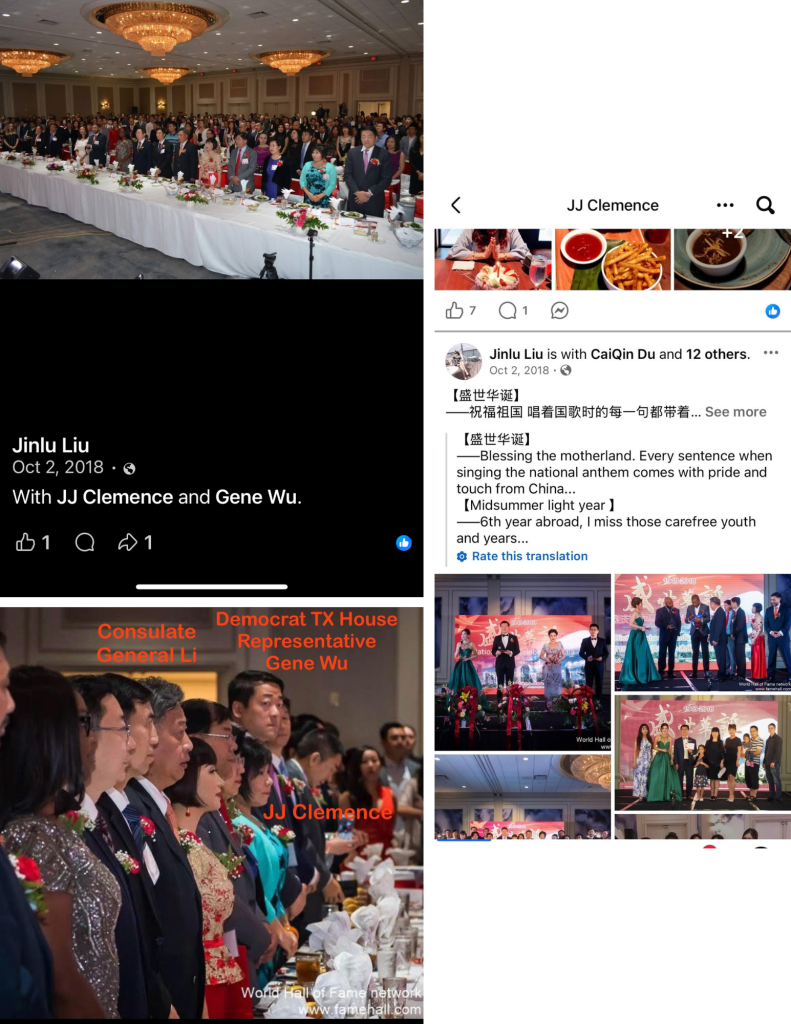
McFarlane then supplied photographs of Clemence attending public events alongside Chinese officials and Chinese-American community members, presenting the images as corroboration of her claims.
The photographs depict Clemence at large, public cultural or community gatherings — events attended by numerous people, including civic leaders and members of the public. They do not show private meetings, policy deliberations, agreements, or any exercise of governmental authority. They do not show Clemence acting on behalf of Fort Bend County or any government entity.

The implication advanced through these images is that Clemence’s presence at public events, and her proximity to Chinese nationals, constitutes evidence of allegiance to the Chinese Communist Party. That implication rests entirely on association rather than conduct. Visibility is treated as evidence. Ethnicity is treated as suspicion. No action, directive, or authority is identified.
This form of argument is central to the smear campaign: ordinary, transparent civic participation is retroactively reframed as proof of foreign control. The photographs do not establish wrongdoing. They are being used to suggest it.
Private accusation, same claim
The allegation has also been asserted privately.
Katy Christian Magazine reviewed a screenshot of a private message sent by McFarlane to a third party in which she stated, “your candidate is a CCP affiliate,” while threatening the recipient with legal action. The recipient authorized publication of the message with identifying information removed.
The language mirrors McFarlane’s public remarks and written response to Katy Christian Magazine. The allegation is stated as fact, not speculation, and is presented without documented proof.

The record the accusation ignores
Only after laying out every version of the allegation does the absence of evidence become unavoidable.
If there were credible national-security concerns about Clemence, they would not first surface through anonymous blogs, campaign speeches, or forwarded screenshots. They would emerge through federal authorities.
Clemence previously worked for two Republican Members of Congress, Troy Nehls and Pete Olson. Both have endorsed her candidacy.
Nehls provided Katy Christian Magazine with on-the-record testimony regarding congressional vetting procedures.
“We send all the information to the U.S. Capitol Police, and they conduct a background check,” Nehls said. “If there are any concerns, they notify the chief of staff or me. A background check would have been conducted on J.J. Clemence.”
Nehls described the allegation as “a horrible attack on an honorable lady” and said, “I support her 110 percent.”
There is no public record of any investigation, charge, or action by the FBI, the Department of Justice, the Department of Homeland Security, or any counterintelligence agency involving Clemence.
What the public-records request actually shows
Much of the smear campaign against Clemence hinges on a public-records request that has been repeatedly cited as evidence of wrongdoing. The materials obtained through that request have been circulated among activists and referenced in campaign messaging as supposed proof of foreign influence.
For that reason, the contents of the request — and what it actually produced — warrant close examination.
A political activist aligned with the McFarlane campaign submitted a public-records request and later forwarded the resulting materials to Katy Christian Magazine, citing them as support for the allegation.



The records consist of routine civic correspondence: nonprofit event invitations, scheduling coordination with county staff, and a recommendation letter written by K. P. George on behalf of a seven-year-old U.S. citizen applying to an international school. The letter references the child’s involvement in the Clemence Youth Foundation. It alleges no wrongdoing and identifies no foreign influence.
The production contains no sister city agreement, no vote, no resolution, no contract, and no law-enforcement determination that Clemence posed a security risk.
When asked how the materials demonstrated wrongdoing, the activist argued that delegations connected to sister city activity should be presumed CCP-affiliated, without providing an official designation or evidentiary basis.
The conclusion preceded the documents. The documents did not support the conclusion.
Why this matters now
As Fort Bend County voters approach the Republican primary, the escalation of an unsubstantiated espionage allegation days before ballots are cast is not incidental.
Campaigns cannot control anonymous blogs. They can control whether they circulate those claims, repeat them publicly, supply materials to reinforce them, or continue asserting them after the record fails to support them.
After reviewing public records, campaign statements, activist communications, photographs, and on-the-record testimony, the conclusion is straightforward:
There is no documented proof that J.J. Clemence violated state law. There is no evidence of foreign influence or espionage. There is no law-enforcement finding supporting the accusation in the Fort Bend County Clerk’s race.
What the record shows is how an anonymous blog post — actively reinforced through campaign messaging and repetition — introduced a claim that does not hold up under scrutiny.
Elections should be decided on qualifications, records, and the ability to serve the public. Accusations of espionage demand proof. In this case, that proof has not been produced.