
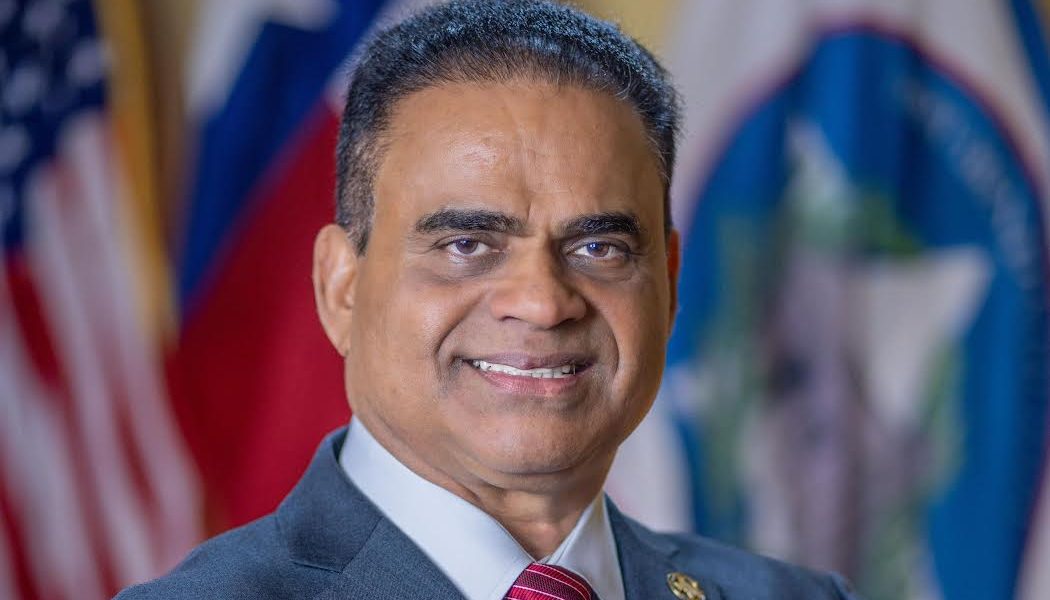
For most Fort Bend County residents, the story has been simple and unsettling. A sitting county judge, once a rising star in local Democratic politics, now faces criminal charges tied to campaign finance violations and an online smear campaign that drew national attention.
KP George says the story is far more complicated.
In an exclusive, hours-long interview with Katy and Fort Bend Christian Magazines, George said his prosecution is the end result of years of internal conflict, political retaliation and what he alleges is selective enforcement inside Fort Bend County’s Democratic leadership.
George, who was first elected county judge in 2018 and re-elected in 2022, said he is speaking publicly now because he believes the same system that turned on him continues to operate unchecked.

“This is all on the record,” George said early in the interview. “These motions have been filed, so this is public information.”
George is currently facing felony money laundering charges and misdemeanor counts connected to alleged campaign finance violations and the online persona known publicly as “Antonio Scalywag,” a fake Facebook account that targeted political figures during local elections.
Prosecutors have said the account was part of a coordinated political smear campaign. George denies creating or directing it.
What he does not deny is that his former chief of staff, Taral Patel, played a central role in Democratic campaign operations during that period. Patel later pleaded guilty to two misdemeanor charges, with other counts dropped as part of a plea deal.
George says the case against him cannot be understood without knowing what he claims happened behind the scenes. George also alleges that Brian Middleton, the Fort Bend County district attorney, is attempting to cover up unlawful activities in his office by silencing George and others like him.
Disappearing Messages and Screenshots
The central piece of George’s allegations are communications exchanged on Signal and WhatsApp, encrypted messaging platforms that allow messages to disappear or be unsent.
George alleges that Middleton used those platforms to communicate with Patel and others about political matters and, at times, about cases.
According to George and the filings submitted by his attorneys, the original messages no longer exist in full. When a message is unsent or expires on those platforms, it can be removed from the recipient’s archive.
George said he does not have original message files. What remains, he said, are screenshots Patel took while the messages still existed. Those screenshots were included in a Oct. 31 motion filed by George’s legal team seeking dismissal of the case for prosecutorial misconduct.
The motion reproduces several messages attributed to Middleton. One reads: “I told KP he was a rat. This shit is bad.” Another states: “I am furious that he called me with that immature bullshit. I am not the one to pick a fight with.”
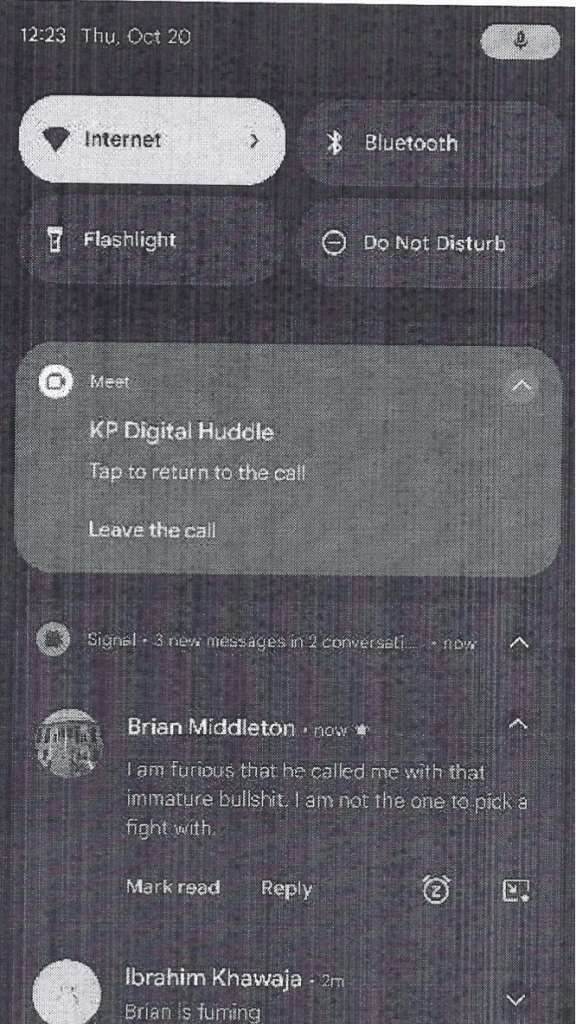
The motion also reproduces a message referencing national political donor Alex Soros, an American investor who is the son of George Soros. Alex Soros manages the Soros Family Foundation and the Open Society Foundation, which distributes some $1.5 billion a year to progressive causes.
“Middleton also sends a secret message to Patel stating his intent to ‘destroy’ Trevor Nehls,” the motion reads. Nehls, a Republican, was formerly Fort Bend County Constable Precinct 4, and is now a candidate for the U.S. House Texas District 22 race.
According to the motion, Middleton texted Patel, stating “Alex Soros needs to understand the only way for me to continue reform is to destroy Trevor… This shit is super urgent.”
George’s attorneys argue that the issue is not merely inflammatory language, but the method and medium through which it was communicated. In their filing, they contend it is categorically inappropriate for a district attorney to discuss official matters on Signal or similar consumer-grade encrypted messaging platforms because features such as automatic deletion and the absence of archival preservation directly conflict with prosecutors’ legal obligations.
The motion cites the Texas Public Information Act, which governs the Fort Bend County District Attorney’s Office and mandates the preservation of official communications. State law, the filing notes, is rooted in the principle that government “is the servant and not the master of the people,” and that public officials do not have discretion to decide what the public is allowed to know.
By using Signal’s disappearing-message function, the defense argues, Middleton made it impossible to retain records required for audits, public information requests, or litigation. The filing characterizes this practice as incompatible with open-government requirements and asserts that it effectively circumvents transparency laws by design.
The defense further argues that this method of communication is especially problematic when applied to discussions involving political actors, criminal investigations, or charging decisions, because it eliminates the very records defendants are entitled to seek through discovery. In that context, the filing does not frame the messages as isolated lapses in judgment, but as conduct that undermines the integrity of the prosecutorial process itself.
Middleton has denied wrongdoing and has not conceded the defense’s characterization of either the messages or the legal implications of their transmission.
Further, George’s legal team argues that the turning point in his prosecution came during a recorded proffer interview conducted with his former chief of staff, Taral Patel, after Patel’s indictment.
According to the motion, Patel participated in a roughly three-hour, tape-recorded interview with prosecutors. Throughout the interview, the filing states, prosecutors repeatedly attempted to implicate George as a co-conspirator in Patel’s fake account activity but were unsuccessful. Patel did not identify George as being aware of or involved in the scheme.
Instead, the motion asserts, Patel implicated other elected officials.
The filing states that during the proffer Patel told prosecutors that “numerous elected officials and community leaders would have been aware” of the fake account activity and that he “specifically coordinated social media strategies with these officials and leaders.”
According to the defense, Patel further indicated that at least one of the fake posts was used to benefit District Attorney Brian Middleton and that Middleton was aware of the “Antonio Scalywag” account as early as 2021.
It is at this point in the interview, the motion alleges, that the record abruptly breaks.
Approximately three minutes of the three-hour proffer recording are missing, corrupted, or otherwise unviewable, according to the filing. The defense asserts that this missing portion corresponds precisely to the moment when Patel was identifying which Fort Bend County public officials knew about or participated in the fake account activity.
“What is extremely troubling,” the motion states, is that the rest of the recording remains intact and audible, with no apparent technical issues, yet “these potentially explosive exculpatory disclosures for the accused and/or incriminating disclosures for the prosecution somehow do not exist.”
The defense argues that the disappearance of this segment is especially significant because Patel’s plea agreement was signed personally by Middleton, whom the filing describes as “the man who had the most to gain” from preventing a public airing of Patel’s statements, given Patel’s indication that Middleton himself may have been involved in or aware of the conduct now labeled criminal.
The motion alleges that after Patel failed to incriminate George and instead implicated other officials, Middleton found himself in what the defense calls an ethical and legal dilemma. According to the filing, the solution was to indict George and shift blame onto him for conduct in which the prosecutor himself allegedly participated.
The defense characterizes this as a pattern rather than an isolated incident, alleging that Middleton “routinely abuses the prosecutorial power of his office in order to protect his friends and punish his enemies.” The filing asserts that Middleton initially shielded George from public scrutiny while the two were political allies, but reversed course once their relationship deteriorated.
Prosecutors have not publicly explained why the final portion of Patel’s proffer recording is unavailable. No court has yet ruled on whether the missing segment constitutes intentional destruction of evidence.
Judges, Campaigns and Redactions
The defense motion also places judicial campaigns directly inside the alleged fake-account operation.
Under a section titled “Democrat Judge’s Request to Create a Fake Account,” the filing states that Taral Patel was creating fake online profiles and websites on behalf of Democratic officials in order to influence elections and counter political attacks. As one example, the motion reproduces a WhatsApp message in which a Fort Bend County at Law judge tells Patel, “I think we need to create some fake profiles ourselves just like Sakki Joseph created for Kevin John.”
The judge’s name is redacted in the filing. The motion emphasizes that, unlike George, the judge was not indicted.
The filing further documents Patel’s communications with political operatives regarding the coordinated use of fake social media identities.
In one exchange, Nishu Siddique, the campaign manager for Becerra, instructs Patel to “COMMENT FROM YOUR FAKE FB.” Patel responds, “My fake fb is a pretend conservative,” and later adds, “I’ll have my fake Trump accounts retweet it.”
The defense presents these messages as evidence of deliberate, organized deception intended to manipulate voters by disguising partisan messaging behind false online personas.
The motion then expands the scope of coordination beyond campaigns and into the district attorney’s office itself. According to the filing, Middleton and Patel exchanged messages reflecting shared political strategy.
In a July 31, 2022 exchange, Middleton texts Patel, “This is war.” Patel agrees. Middleton responds that he is “up on all ten toes ready to knock him the fuck out,” adding that he is “tired of his cowardly attacks.” Patel replies, “We need this to blow up.” Middleton later repeats the same phrase, writing, “we need to blow this up,” while referencing a news article targeting Republican lawmakers.
The defense argues that these exchanges show the same fake accounts referenced elsewhere in the motion were likely deployed to amplify political narratives favorable to Democrats and damaging to opponents.
In this context, the filing indicates a sharp contrast between those alleged to have requested, coordinated, or benefited from fake account activity, and George, the sole elected official criminally charged in connection with it.
George said the redactions in the filings are particularly troubling because judges implicated by office, if not by name, continue to appear on the ballot.
In the interview, George said the distinction between a judge and a judicial campaign does not absolve ethical responsibility, arguing that campaign activity is an extension of the candidate seeking office. He said the redactions in the filings are troubling because judges implicated by office, though not by name, continue to appear on the ballot.
George also alleges that Judge J. Christian Becerra signed a warrant against him and later announced a run for Fort Bend County Judge, and he will potentially be George’s opponent in the race.
George says this sequence raises serious concerns about impartiality. He acknowledges that the allegation has not yet been fully litigated and that additional documentation is being sought.
The Case Against George
Prosecutors allege George improperly handled campaign funds and engaged in money laundering. George said the transactions in question were reimbursements for personal funds he loaned to his own campaigns over many years.
“When a brown guy like me runs for office, nobody writes you a check,” George said. He described self-funding campaigns for years before receiving donations after being elected.
George said the money laundering statute was used because it allowed prosecutors to reach further back in time. He compared his case to other Texas prosecutions that later collapsed.
“If I did something wrong, I absolutely believe there should be consequences,” George said. “Let somebody else come and prosecute me.”
George was indicted in the fall of 2024 and later was re-indicted. His attorneys have argued the prosecution is retaliatory and selective. George repeatedly alleged that others were protected while he was prosecuted.
The defense filing states that Patel sent screenshots of fake account activity to Democratic County Commissioner Dexter McCoy. McCoy was not charged. George alleged McCoy later announced a run against him for county judge.
“That’s the only way they can win,” George said of the charges against him.
George also referenced the case of Tax Assessor-Collector Carmen Turner, alleging Middleton recused himself due to a prior professional relationship and that the matter was sent elsewhere. George said he believes nothing will come of it. He acknowledged he is seeking additional documentation.
George formally left the Democratic Party in 2024 and registered as a Republican. He said the shift followed years of conflict over spending, redistricting and what he described as unchecked growth in county government.
“When you come to my office, you will see a Bible,” George said, describing his faith as central to his decision to speak out.
George said he regrets hiring Patel and McCoy and described the experience as a hard lesson.
“Don’t hire suckers like Patel and McCoy,” he said. “That’s the biggest lesson I learned.”
He said he was offered a deal to resign in exchange for dropped charges but refused.
“I will stand up and fight,” George said. “As long as I can.”
George’s motions remain pending. Prosecutors maintain the case is evidence-based and deny political motivation.
What is clear is that Fort Bend County remains divided.
George insists the allegations he raises go beyond his own fate.
“Fort Bend County is going in the wrong way,” he said. “It’s a web of corruption.”
Whether a court ultimately agrees remains to be seen.