
Submission by Aimee Tooker, American Policy Center
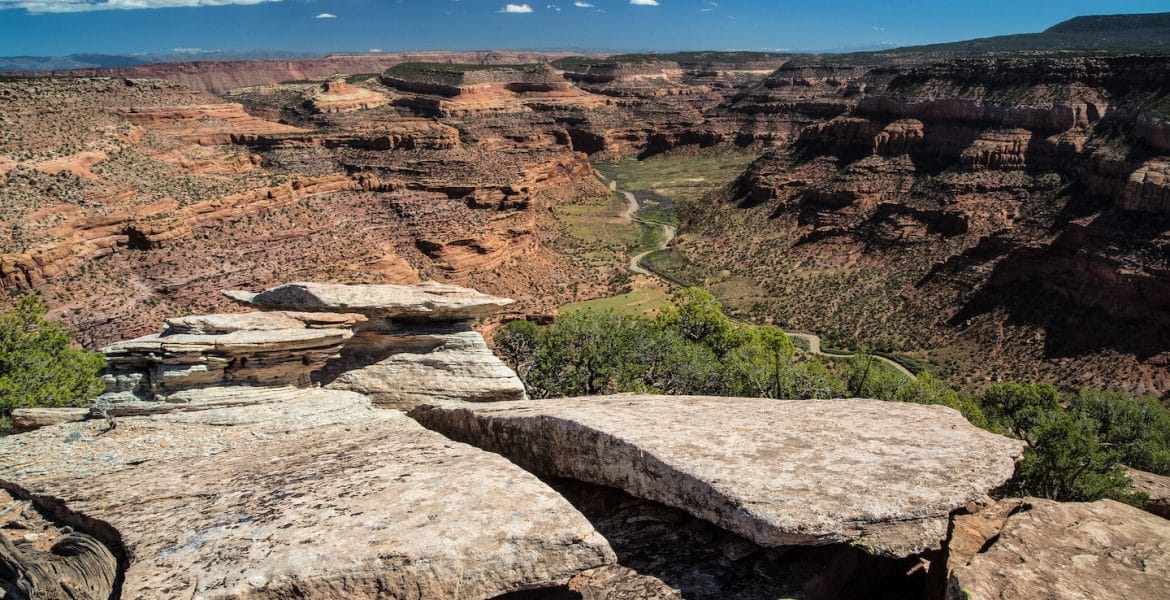
From the San Juan Mountains in southwest Colorado, the Dolores River flows through Montezuma, Dolores, San Miguel, Montrose and Mesa counties before crossing into Utah. For nearly 50 years, national and local environmental and rewilding advocates have pushed for a Wild and Scenic designation on the Dolores River.
It never happened—because over time, generational locals, municipalities and tax districts determined that such a restrictive designation was not the right way to manage the river. The proposal, which represents the most restrictive classification for a river, sparked widespread public outcry in southwest Colorado. At stake were future water-development projects, private-property rights and the operational capabilities of agriculture and ranching communities in the watershed.
Colorado’s senators urged stakeholders to come together to find a compromise. That compromise took decades of conversations and negotiations. Acting in good faith, the Mesa County commissioners in 2011 and the Montrose County commissioners in 2018 voted to remove their counties from the proposed area.

However, rather than working toward consensus, some proponents drafted a proposal for a national monument encompassing nearly 400,000 acres along the Dolores River—without the knowledge of the affected communities. Their plan was to bypass local input and seek a presidential proclamation under the Antiquities Act of 1906. That backroom proposal is at the heart of the issue.
The Dolores River National Conservation Area proposal—covering 68,000 acres in Montezuma, Dolores and San Miguel counties—has been reintroduced in Congress this year. Meanwhile, the much larger Dolores River National Monument proposal continues to circulate quietly among supporters. Public opposition to this and other large-scale monument proposals, such as the 250,000-acre Mimbres Peak proposal in New Mexico, underscores the need to amend the Antiquities Act of 1906.
It’s time for the nation, states, municipalities and stakeholders to return to the original intent of land-management policies. Municipalities are entitled to a seat at the table—not just a chair in the room—when it comes to decisions affecting their lands and livelihoods. That’s what the coordination process ensures.
As directed by Congress, coordination is the process by which local governments and federal agencies meet in a government-to-government dialogue to achieve consistency between federal plans and local policies. Every federal agency is required to engage in this process with local governments.
There’s an important distinction between coordination, cooperation and collaboration. Coordination is ongoing and can occur alongside participation as a cooperating agency on a specific NEPA project. The two are not mutually exclusive. Coordination gives local governments access to pre-decisional information—collaboration does not. Coordination is a federal obligation, not a geographic one.
Unfortunately, the shift toward collaboration without accountability has opened the door for lawsuits from extreme environmental groups, rewilding advocates, NGOs and nonprofits. Hundreds of lawsuits now burden federal land-management agencies, drawing attention away from meaningful coordination and toward litigation. This cycle has created a system where decisions are made through legal pressure rather than balanced dialogue.
Real coordination ensures that every stakeholder—from local ranchers to state officials—has a defined place and voice in the process. It’s the only way to protect local communities, private-property rights, grazing allotments, mining claims, water projects and outfitter operations that depend on access to these lands. Imagine the progress we could make by being proactive instead of reactive—by ensuring meaningful local input before decisions are finalized.
Federal law already requires this approach:
“The Secretary of the Interior shall … coordinate the land-use inventory, planning and management activities … with the land-use planning and management programs of other Federal departments and agencies and of the States and local governments within which the lands are located.” (43 U.S.C. § 1712(c)(9))
“The Secretary of Agriculture shall develop, maintain, and, as appropriate, revise land and resource management plans … coordinated with the land- and resource-management planning processes of State and local governments and other Federal agencies.” (16 U.S.C. § 1604(a))
Any project requiring a NEPA or Environmental Impact Statement must coordinate studies and plans with local municipalities (§ 4331).
On Aug. 3, 2017, 22 members of Congress sent a draft executive order and letter to President Trump urging stronger coordination with state and local governments.
Letter to President Trump (2017)
Draft Executive Order
As Rep. Tom Tiffany stated:
“The concept of coordination is firmly rooted in the constitutional principles of our nation. States and their local governments were never intended to be displaced by federal agencies determining and restricting the uses of their land within their jurisdiction.”
Watch Tom Tiffany discuss the coordination process:
Video 1 | Video 2 | Video 3 | Video 4
Garfield County, Colorado, has successfully implemented coordination since 2012, engaging in major policy decisions in the Bureau of Land Management’s 2015 and 2019 Resource Management Plans and the 2012 Greater Sage-Grouse EIS. The county formally adopted its Federal Lands Natural Resources Coordination Plan and Policies in September 2020.
Other counties and tax districts in Texas, Oregon, Idaho and California have followed suit, forming committees to educate public officials and align local strategies with federal land-management plans.
In summer 2024, the towns of Naturita and Nucla in southwest Colorado—at the heart of the Dolores River National Monument proposal—passed resolutions invoking coordination with land-management agencies. By December 2024, the local BLM office signed a Letter of Agreement to coordinate with both towns. They are now expanding that effort to include the U.S. Forest Service and other federal agencies.
Congressional support is crucial to strengthen and validate coordination efforts. It would also reaffirm the commitment made by Rep. Tiffany and the 22 members of Congress who supported the 2017 draft executive order.
True coordination—grounded in law and mutual respect—ensures balance between conservation, economic growth and local input. Western communities depend on this process to sustain their economies, protect their culture and preserve their way of life.
Had the proposed Dolores River National Monument been approved, it would have transformed the local economy and culture beyond recognition, stripping communities of control over their future. It is time to amend the Antiquities Act of 1906 and reaffirm the right of local communities to participate meaningfully in federal land decisions—because managing our lands should always mean having a seat at the table, not just a chair in the room.