

Submission by Joseph Menslage
Charlie Kirk, one of the country’s most prominent conservative voices, was fatally shot during his “American Comeback Tour” stop at Utah Valley University on Sept. 10. What should have been an evening of debate and discussion instead ended in an assassination carried out in front of thousands. Witnesses say the gunman fired from behind the stage, cutting short the event in an instant.
Almost immediately, liberal commentators and social media accounts began shifting blame away from the killer. On MSNBC, Matthew Dowd suggested that Kirk’s rhetoric may have played a role in the violence, framing it as a consequence of “the toxic political climate.”
Others on X (formerly Twitter) went further, openly mocking his death or arguing that he brought it upon himself.

Posts included disturbingly detached or even amused statements like:
“Charlie Kirk had no empathy when it came to his career. His rhetoric hurt a lot of people, and it almost certainly led to the violence against him. You don’t need to feel sorry for him.”
“Pro-gun racist misogynist Charlie Kirk dead by gun shot.”
“According to Charlie Kirk’s logic, his death is his own fault, not the shooter’s.”
These are not isolated trolls. They reflect a wider willingness on the left to point fingers at speech rather than confront violence directly.


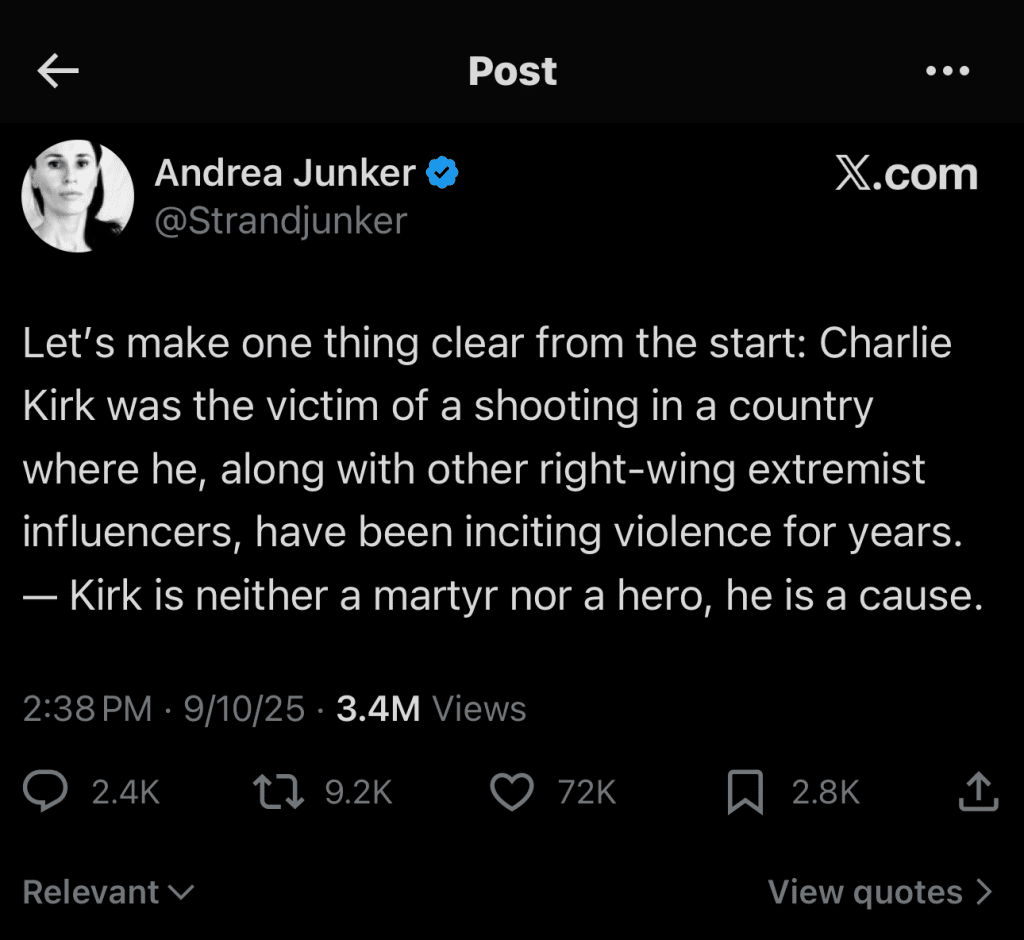

This double standard has become familiar. When conservatives are threatened or attacked, outrage is muted. And when a victim of violence is a conservative leader, the same voices quickly argue that words—not killers—are to blame.
The truth is harder to face: violence driven by ideology is not limited to one side.

In August, a 23-year-old named Robin Westman opened fire during Mass at Annunciation Catholic School in Minneapolis, killing two children and wounding 18. Authorities said it was both a hate crime and domestic terrorism.
In 2023, a transgender shooter killed three children and three adults at Covenant School in Nashville, targeting the Christian community there.
These tragedies remind us that when people decide to act on hate, it is not simply mental illness or rhetoric—it is ideology turned deadly.
Charlie Kirk wasn’t murdered because he was “hateful.” He was murdered because he inspired a movement. His unapologetic message of faith, patriotism, and conservatism made him a target. That is what his critics fear, and that is why their response has been to deflect blame.
Violence is not the result of strong words. It is the result of individuals who choose to act on hatred. Pretending otherwise not only insults the victims but also gives cover to those who would turn ideology into bloodshed.
Charlie Kirk’s murder was not caused by a speech. It was caused by a bullet. And the truth, no matter how inconvenient, cannot be denied.