

YEREVAN, Armenia — Chelsea Sobolik has spent years walking the halls of Congress, speaking out for the persecuted church. But she admits she was “a little embarrassed” by how little she knew about Armenia’s deep Christian roots before stepping foot in the small Caucasus nation earlier this month.
“I told some friends where I was going, and half of them didn’t even know where Armenia was,” said Sobolik in a recent interview with Christian Post. Sobolik is the director of government relations for World Relief.
“And these are people who should be a little more informed. There’s a huge education gap with American Christians.”
Sobolik joined a delegation of U.S. pastors, advocates and scholars to meet with families driven from Artsakh, the historic Armenian region known internationally as Nagorno-Karabakh, after a September 2023 assault by Muslim-majority Azerbaijan. The attack followed a 10-month blockade that choked off food and medicine to more than 120,000 Armenians, forcing nearly all of them to flee.

International observers condemned the offensive as ethnic cleansing, some calling it genocide. Azerbaijan has since been accused of demolishing Armenian neighborhoods, bulldozing centuries-old churches and erasing cultural landmarks, all in defiance of a U.N. court order guaranteeing refugees the right to return.
Armenia became the first nation to declare Christianity its state religion in A.D. 301, a fact many in the West have forgotten. For centuries, the faith has been etched into the stone of monasteries, cross-studded cemeteries and holy sites that still dot the landscape of Artsakh. Now, advocates say, these treasures, and the people who have preserved them, face extinction.
“Throughout the centuries, Armenia used to be a lot bigger than it is today,” said Save Armenia Director Matias Perttula, who organized the trip alongside the Tufenkian Foundation. “The proof that Nagorno-Karabakh is Armenian is literally in the churches and the monasteries. These are ancient, from the early centuries of Christianity, and they’re under threat.”
Pastor Bill Devlin, who ministers globally to persecuted believers, put it bluntly.
“It’s heartbreaking to see the disintegration of a nation, but also the desecration of the Christian faith. It’s all about ethnic cleansing. It’s all about genocide,” he said.
The suffering is tragically familiar. In 1915, the Ottoman Empire killed as many as 1.5 million Armenians, prompting American Christians to lead one of history’s first large-scale international relief efforts.
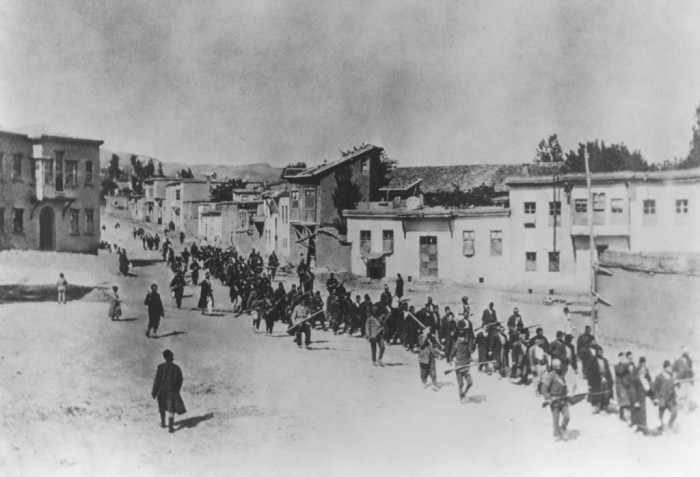
“You know, 110 years ago, when the genocide was happening, it was American Christians who stood up,” Sobolik said. “It really was the birth of the international human rights movement by Christians.”
That earlier generation, Perttula noted, raised what would be the equivalent of $2 billion today to aid Armenian survivors.
“We feel a calling to return to that,” he said, “to awaken the Church to become a force multiplier again.”
But that awakening faces headwinds. Sobolik believes compassion fatigue, worsened by constant exposure to tragedies online, has dulled the urgency many Christians once felt. Armenia’s plight is also overshadowed by persecution in larger, more familiar countries like Iran and Turkey.
Meanwhile, Azerbaijan’s government spends heavily to shape Western narratives, Devlin said, “crafting a false narrative about Armenia” and downplaying its Christian heritage. “They just want to wipe out any vestige of Christianity in Armenia,” he said.