

HOUSTON — Texas Congressional candidate Martin Etwop remembers the moment he realized something was off.
Texas was in the middle of defending its law requiring pornography websites to verify users’ ages, a law aimed at protecting children, and not a single conservative group had filed an amicus brief in support of the state. Meanwhile, more than 30 organizations connected to the adult entertainment industry had lined up to challenge it in court.
“I wondered how this was possible,” said Etwop, a Ugandan immigrant and attorney based in Texas. “How could conservatives be so passive?”
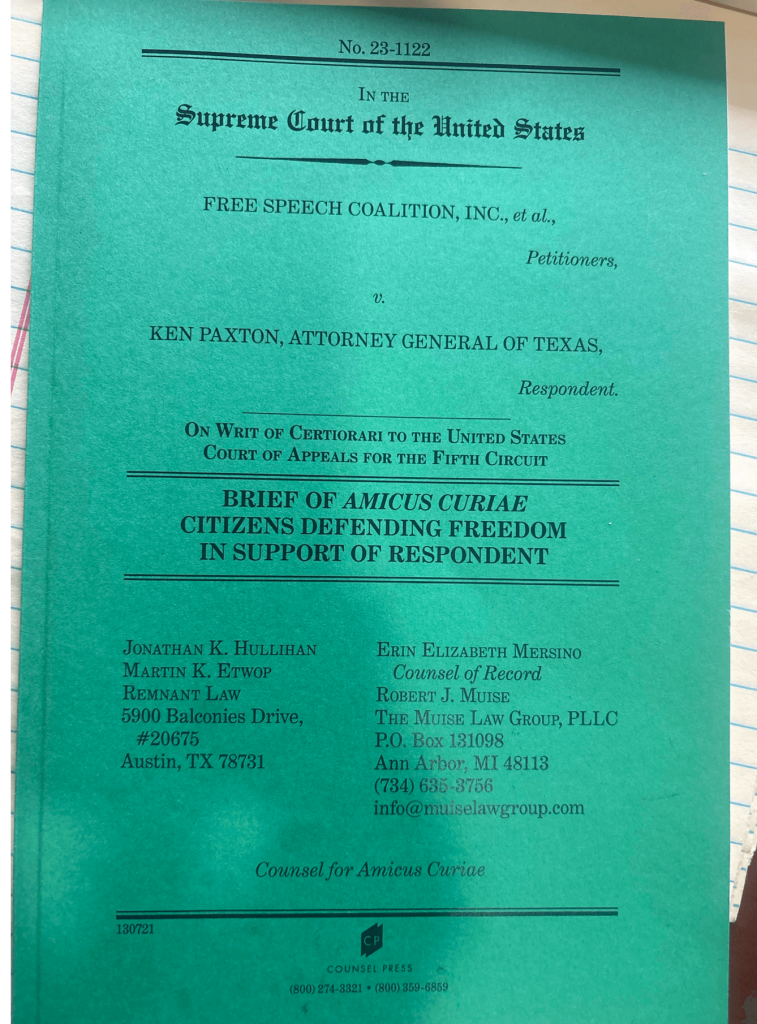
He took action. Etwop and his team filed a brief to the U.S. Supreme Court, which ultimately ruled in favor of Texas in Free Speech Coalition v. Paxton this June. The decision gave Texas the green light to enforce safeguards against minors accessing pornography. For Etwop, the father of four children, the case was personal.

 “Pornography affects children’s development. Addiction starts early and becomes a lifelong struggle, and the industry counts on that,” he said. “It was rewarding to see the Court use some of our research in the ruling. We were proud to lead that effort.”
The brief was one of several recent legal victories that Etwop has played a key role in. Over the past few years, he’s carved out a reputation as a bold legal advocate for conservative causes, often stepping in when no one else will.
Earlier this year, Etwop also filed an amicus brief in United States v. Skrmetti, where the U.S. Supreme Court upheld Tennessee’s law banning puberty blockers and gender-related medical treatments for minors.
His argument: Children’s bodies and minds are still developing — well into their twenties — and it is reasonable for states to regulate irreversible decisions made in adolescence.
“You can’t allow a kid to start transitioning now, when two years from now, or ten years from now, their mindset could be completely different,” he said. “That’s not discrimination. That’s protection.”
The court agreed. The ruling was a landmark win for states’ rights and set precedent for similar laws around the country.
Etwop’s advocacy often centers around religious liberty. In Fort Worth, he defended a 19-year-old who was arrested after preaching at a public event using a small microphone. The arrest followed complaints that he was too loud and disruptive, but in court, Etwop proved otherwise.
“I played audio of the event and asked the courtroom if he sounded loud or obnoxious. No one thought he did,” Etwop said. “The police officer even admitted the kid shouldn’t have been arrested.”
The jury unanimously agreed. The case was dismissed within fifteen minutes of deliberation.
In another case, Etwop defended a pastor who was sued for defamation after criticizing a political candidate from the pulpit. The pastor never endorsed a specific opponent but warned his congregation to research a candidate’s record.
“We argued that the First Amendment protects a pastor’s right to share his beliefs,” Etwop said. “You can’t sue someone just because you don’t like what they say in church.”
A Texas judge sided with Etwop’s team, citing the state’s anti-SLAPP law. Attempts to force the church to hand over donor and attendee lists were also denied.
Not all of Etwop’s work makes national headlines, but he’s just as passionate about smaller cases that impact local governance.
In the May 2025 Humble ISD school board election, Etwop challenged the eligibility of a Democratic candidate who won the race despite failing to meet the residency requirement. Texas law requires candidates to live in the district for at least six months before running. Etwop filed suit, and the district quietly removed the ineligible member and reappointed the previous trustee.
“School boards in Texas are powerful, and too often, no one holds them accountable,” Etwop said. “If the law isn’t enforced, the system breaks down.”
 One of Etwop’s most high-profile cases involved the so-called “Trump Train” incident during the final days of the 2020 presidential campaign. Supporters of then-President Donald Trump followed a Biden-Harris campaign bus across Texas in caravans of flag-bearing vehicles.
The campaign and several high-profile Democrats, including Wendy Davis, sued the participants under an 1871 anti-Ku Klux Klan law, accusing them of voter intimidation. Etwop called the comparison “absurd.”
“These were six everyday Texans — a retired teacher, a veteran, a pastor and his wife,” he said. “They were getting steamrolled by 35 lawyers on the other side. No one was helping them.”
Etwop joined the case in 2024, helping to raise funds and mount a defense. In September 2024, the federal court in Austin ruled in favor of five of the six defendants. One case is still pending appeal.
“For four years, their lives were torn apart,” Etwop said. “But they never gave up. And they won.”
Martin Etwop isn’t one for flashy rhetoric or media circuits. His focus is on legal work that defends faith, free speech, and what he sees as the foundational principles of American life. Whether it’s in a Supreme Court brief or a small-town courtroom, he’s become a quiet but forceful presence in conservative legal circles.
“I came here as a missionary. I love this country,” he said. “If we want to preserve our rights and protect our children, then we have to show up, and we have to fight.”