
Submission by Daniel Wong, Republican Candidate for Fort Bend County Judge
In 2021, Fort Bend County residents witnessed a troubling chapter in local governance. During open sessions of the Commissioners Court, officials openly admitted to drawing district boundaries based on racial considerations, explicitly aimed at influencing electoral outcomes. This deliberate gerrymandering represented a clear violation of constitutional principles, undermining fair and equal representation. That same year, Commissioner Andy Meyers was districted out of his own residence—a stark example of how political manipulation of maps can personally and strategically target elected officials and their constituents.
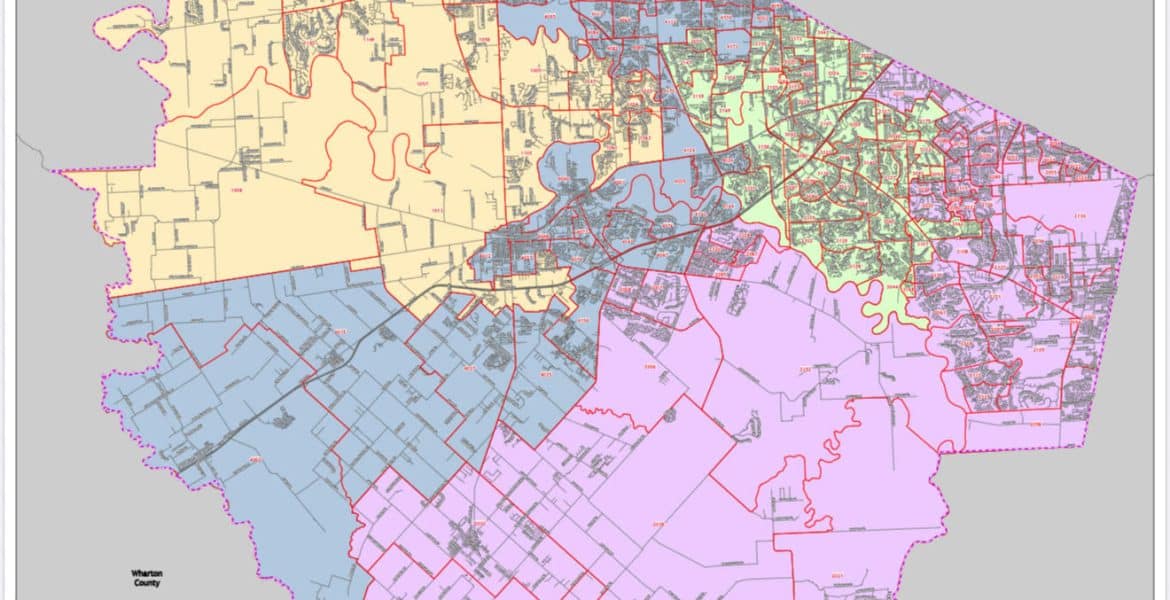
Among the most glaring examples was Precinct 2. Rural residents, particularly those in Needville, saw their constitutional rights compromised as their communities were unjustly merged with vastly different urban and suburban areas separated by the Brazos River. This artificial division ignored community cohesion, diluted the political influence of rural voters, and effectively silenced their voices in local governance.
The newly proposed 2025 redistricting map by Commissioner McCoy fails to address any of these significant issues. Instead, it repeats and exacerbates past mistakes, unlawfully and impractically combining urban and rural communities. Notably, the proposed map mixes parts of Katy and Fulshear with unincorporated areas, causing governance confusion and weakening effective representation for residents.

Additionally, major cities in Fort Bend County continue to face severe fragmentation under both the current and proposed maps. Sugar Land is presently divided among three commissioners, while Stafford and Rosenberg are each split between two. Such fragmentation complicates governance and coordination efforts, particularly affecting Municipal Utility Districts (MUDs), Levee Improvement Districts (LIDs), and Emergency Services Districts (ESDs). These entities, responsible for critical infrastructure and emergency services, face significant hurdles when forced to coordinate across multiple commissioner precincts, resulting in delays, inefficiencies, and increased risks to public safety.
This persistent disregard for logical and legal district boundaries violates Texas Election Code Sections 42.006(a), 42.007, and 43.007(f), echoing constitutional violations condemned in landmark cases such as Larios v. Cox. District boundaries must never be drawn to manipulate electoral outcomes, fracture communities, or dilute representation for specific groups.
Furthermore, the proposed maps include voter precincts with fewer than 100 voters—in some cases, precincts with just one voter. This glaring oversight risks compromising ballot secrecy, allowing individual voter identities and preferences to be easily identified, thus violating fundamental democratic principles.
The solution is clear: Fort Bend County must reject this flawed proposal immediately. The Commissioners Court must swiftly engage specialized outside legal counsel to ensure district boundaries comply fully with state and federal laws. Additionally, re-establishing a citizens committee to oversee the redistricting process will guarantee transparency, accountability, and public trust.
Fort Bend County residents deserve district maps that genuinely reflect their communities’ shared interests, geographic realities, and infrastructure needs. The Commissioners Court must act decisively to rectify these injustices and safeguard both the democratic integrity and practical governance of Fort Bend County.