
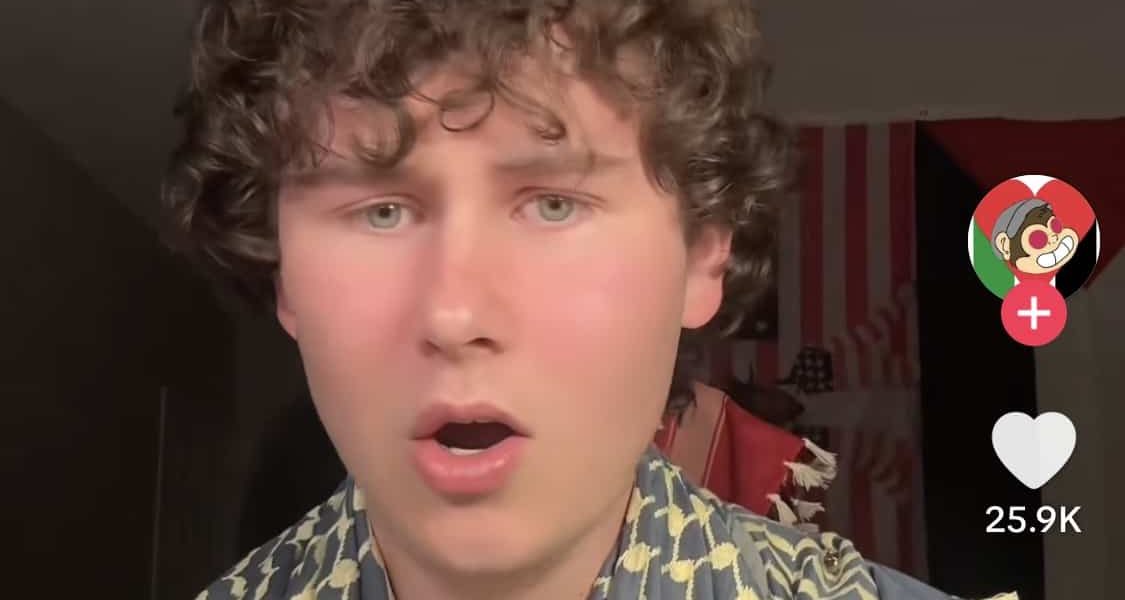
A 19-year-old TikTok influencer from Pennsylvania is under fire for endorsing the killing of two Israeli embassy employees in Washington, D.C., a move that highlights the disturbing rise of social media personalities who use their platforms to glorify violence and radicalize young audiences.
Guy Christensen, who goes by @YourFavoriteGuy on TikTok and boasts 3.4 million followers, posted a video Thursday defending the deadly shooting allegedly carried out by a man named Elias Rodriguez. In the video, Christensen explicitly praised the murders of Yaron Lischinsky and Sarah Milgrim, a young couple attending an American Jewish Committee event.
“I do not condemn the elimination of the Zionist officials who worked at the Israeli embassy last night,” Christensen said. “I want to urge you first to support Elias’ actions. He is not a terrorist. He’s a resistance fighter, and the fact is that the fight against Israel’s war machine, against their genocide machine, against their criminality, includes their foreign diplomats in this country.”
The video, which has since been deleted, marked a sharp departure from a post he made earlier in the day, in which he condemned the killings.

“I don’t support the slaughter of civilians,” he said in that first post. “That’s not the way to go about it and bring justice.” Still, even that video suggested the victims were not innocent, with Christensen stating, “These people deserve to be tried and punished and sentenced to jail for their facilitation of this genocide.”
The apparent contradiction quickly disappeared as Christensen made his position clear. Violence against diplomats was, in his view, justified.
The reversal, combined with his massive audience and calculated messaging, places Christensen at the center of a growing online movement where social media influencers act as de facto propagandists.
While activists have long used the internet to voice political dissent, Christensen’s transformation from critic to apologist for deadly violence is a case study in the escalating radicalization of political discourse online.
Christensen’s earlier condemnation video was laced with conspiratorial thinking. He predicted the U.S. government would use the attack as a pretext to target pro-Palestinian activists, comparing the potential crackdown to one of the darkest chapters of the Holocaust: “Kristallnacht.”
He suggested that anyone working for the Israeli government was inherently complicit in war crimes. The framing appears designed to make his audience more receptive to violence under the banner of “resistance.”
Christensen’s rhetoric echoes language long used by extremist movements, yet he delivers it through the polished aesthetic of Gen Z content creation. In the video praising the murders, he wore a keffiyeh, a shirt that appeared to read “Jesus was a Palestinian,” and sat in front of a Palestinian flag.
Such visuals aren’t new to his content. Since Hamas’ Oct. 7, 2023, terror attack on Israel and the war that followed in Gaza, Christensen has built a significant online following by posting anti-Israel content, often framed as exposing the “truth” behind mainstream narratives. His support for the Palestinian cause, he has said, began after discovering “more than what the media was telling me.”
But his evolution from activist to agitator has moved far beyond advocacy. In the video defending the embassy murders, Christensen read aloud a manifesto that appears to have been posted by the alleged shooter. Titled “Escalate For Gaza, Bring The War Home,” the document calls for violent retaliation within the U.S.—a message Christensen amplified without hesitation.
He later expressed concern that his public endorsement of the attack might make him a target for investigation.
“I hope my retracted condemnation does not allow our government to condemn me to a cell,” he said. “But I don’t know. Follow my page for more. Thank you and free Palestine.”
In another video, Christensen tried to frame the backlash as the product of a smear campaign.
“Since Zionists on Twitter are going rabid over what I just posted, I just want to disclaim that I’m not suicidal, I would never make a threat that would jeopardize my position to influence and educate people about the atrocity and evils that Zionism is currently bringing down upon the Palestinian people, especially in Gaza,” he said.
“I hate Nazis and I hate Zionists, so I don’t have a problem with you much if you’re not one of those things.”
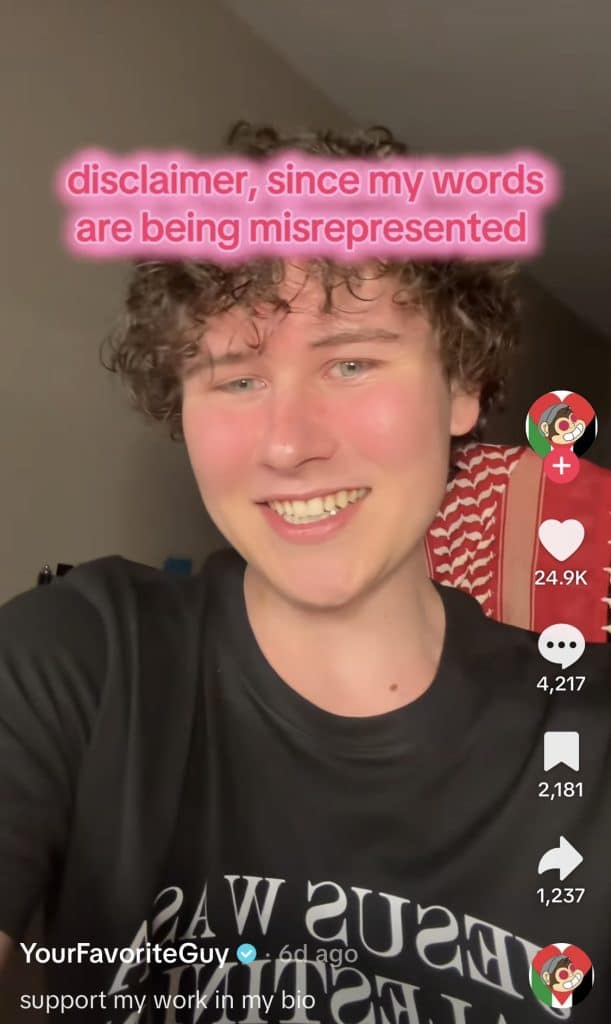
The statement doubled down on his most inflammatory rhetoric. Later, he argued that calling the attack antisemitic was dishonest, given that Lischinsky had self-identified as a Christian and affiliated with the Messianic Jewish movement.
“Do not let yourself be fooled by the media, by the Zionists in this country who are telling you that this was an antisemitic terrorist attack,” Christensen said. “It was not. First of all, the man who was assassinated was a Christian Zionist, proclaiming it so on his social media. He spent his days working at the Israeli Embassy fighting to maintain Israel’s genocide and support for that genocide in this country.”
Christensen continued, “He is a war criminal, and the same is true for the woman. This was not because they were Jewish, it was because they were Zionists.”
Christensen’s defenders have praised his supposed courage, while others in his audience believe the murders were orchestrated by Israel to discredit the pro-Palestinian movement—a baseless “false flag” theory that spread quickly online. Even progressive organizations like Jewish Voice for Peace, which condemned the shooting, were attacked by users who responded, “Condemn yourselves.”
News outlets covering the shooting have also seen their comment sections flood with radical sentiment. A story from Block Club Chicago about the police search of the alleged gunman’s apartment drew requests for a legal defense fund.
“Democracy Now,” a left-wing radio program, posted about the attack and was met with comparisons to the murder of UnitedHealthcare’s CEO, suggesting a disturbing normalization of violence in online spaces.
Christensen, unfazed, framed his stance with a pop culture analogy that trivialized the violence. Refusing to condemn the shooter, he said, would be like “condemning Luke Skywalker for attacking the Death Star because the Empire might crack down on the resistance.”
That kind of framing—equating real-world killings with fantasy rebellion—distorts the truth and encourages young audiences to view violence not as a tragedy, but as heroism.
What’s clear is that Guy Christensen is no longer just a teenager with a smartphone. He is now a self-anointed voice of radical defiance, legitimizing murder under the flag of political resistance, and reaching millions of youth in the process.